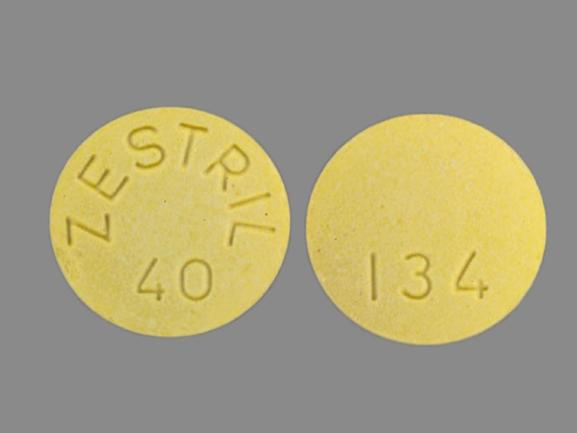
Zestril
Generic name: lisinopril [ lyse-IN-oh-pril ]
Dosage form: oral tablet (2.5 mg; 5 mg; 10 mg; 20 mg; 30 mg; 40 mg)
Drug class: Angiotensin Converting Enzyme Inhibitors
What is Zestril?
Zestril (lisinopril) is used alone or in combination with other medications to treat high blood pressure in adults and children 6 years of age and older.
Zestril is also used in adults to treat congestive heart failure and to improve survival after a heart attack.
Zestril belongs to a class of medications called angiotensin-converting enzyme (ACE) inhibitors. It works by decreasing certain chemicals that tighten the blood vessels, so blood flows more smoothly and the heart can pump blood more efficiently.
Warnings
Do not use Zestril if you are pregnant. It could harm the unborn baby. Stop using this medicine and tell your doctor right away if you become pregnant.
You should not use this medicine if you have ever had angioedema. Do not take Zestril within 36 hours before or after taking medicine that contains sacubitril (such as Entresto).
If you have diabetes, do not use Zestril together with any medication that contains aliskiren (such as Amturnide, Tekturna, Tekamlo).
You may also need to avoid taking Zestril with aliskiren if you have kidney disease.
Before taking this medicine
You should not use Zestril if you are allergic to lisinopril or to any other ACE (angiotensin converting enzyme) inhibitor such as captopril, fosinopril, enalapril, benazepril, moexipril, perindopril, quinapril, ramipril, or trandolapril.
Do not take Zestril within 36 hours before or after taking medicine that contains sacubitril (such as Entresto).
If you have diabetes, do not take Zestril with any medication that contains aliskiren (a blood pressure medicine).
Do not take Zestril if you have a history of angioedema (severe allergic reaction).
To make sure Zestril is safe for you, tell your doctor if you have ever had:
-
heart disease, heart problems such as a recent heart attack;
-
low white blood cell count;
-
stomach pain;
-
if you are on a low-salt diet;
-
diabetes;
-
liver disease; or
-
kidney disease (or if you are on dialysis).
You may also need to avoid taking Zestril with aliskiren if you have kidney disease.
Stop using this medicine and tell your doctor right away if you become pregnant. Zestril can cause injury or death to the unborn baby if you use the medicine during your second or third trimester.
Do not breastfeed.
How should I take Zestril?
Take Zestril exactly as prescribed by your doctor. Follow all directions on your prescription label and read all medication guides or instruction sheets. Your doctor may occasionally change your dose..
You may take Zestril with or without food.
Your blood pressure will need to be checked often and you may need frequent blood tests.
Tell your doctor if you have a planned surgery.
Call your doctor if you have ongoing vomiting or diarrhea, or if you are sweating more than usual. You can easily become dehydrated while taking Zestril. This can lead to very low blood pressure, an electrolyte imbalance, or kidney failure.
If you have high blood pressure, keep using Zestril even if you feel well. High blood pressure often has no symptoms.
Store tightly closed at room temperature, away from moisture and heat. Do not freeze.
Dosing information
Usual Adult Dose for Hypertension:
Initial dose: 10 mg orally once a day; 5 mg orally once a day
Maintenance dose: 20 to 40 mg orally once a day
Maximum dose: 80 mg orally once a day
Comments:
-The initial dose is 5 mg orally once a day in patients receiving a diuretic.
-The 80 mg dose is used but does not appear to give greater effect.
-If blood pressure is not controlled with Zestril alone, a low dose of a diuretic may be added (e.g., hydrochlorothiazide, 12.5 mg). After the addition of a diuretic, it may be possible to reduce the dose of Zestril.
Usual Adult Dose for Congestive Heart Failure:
Initial dose: 2.5 to 5 mg orally once a day
Maintenance dose: Dosage should be increased as tolerated
Maximum dose: 40 mg orally once a day
Comments:
-The diuretic dose may need to be adjusted to help minimize hypovolemia, which may contribute to hypotension. The appearance of hypotension after the initial dose of Zestril does not preclude subsequent careful dose titration with the drug.
Usual Adult Dose for Myocardial Infarction:
Initial dose: 5 mg orally (within 24 hours of the onset of acute myocardial infarction)
Subsequent doses: 5 mg orally after 24 hours, then 10 mg orally after 48 hours.
Maintenance dose: 10 mg orally once a day. Dosing should continue for at least 6 weeks.
Comments:
-Therapy should be initiated at 2.5 mg in patients with a low systolic blood pressure (less than or equal to 120 mm Hg and greater than 100 mmHg) during the first 3 days after the infarct. If prolonged hypotension occurs (systolic blood pressure less than 90 mmHg for more than 1 hour) therapy should be withdrawn.
Uses: Reduction of mortality in acute myocardial infarction
Usual Adult Dose for Diabetic Nephropathy:
Initial dose: 10 to 20 mg orally once a day
Maintenance dose: 20 to 40 mg orally once a day
Dosage may be titrated upward every 3 days
Comments:
-Not an approved indication.
Usual Geriatric Dose for Hypertension:
Initial dose: 2.5 to 5 mg orally once a day
Maintenance dose: Dosages should be increased at 2.5 mg to 5 mg per day at 1 to 2 week intervals.
Maximum dose: 40 mg orally once a day
Usual Pediatric Dose for Hypertension:
Pediatric patients greater than or equal to 6 years of age:
Initial dose: 0.07 mg/kg orally once a day (Maximum initial dose is 5 mg once a day)
Maintenance dose: Dosage should be adjusted according to blood pressure response at 1 to 2 week intervals.
Maximum dose: Doses above 0.61 mg/kg or greater than 40 mg have not been studied in pediatric patients
Comments:
-This drug is not recommended in pediatric patients less than 6 years old or in pediatric patients with glomerular filtration rate less than 30 mL/min.
What happens if I miss a dose?
Take the medicine as soon as you can, but skip the missed dose if it is almost time for your next dose. Do not take two doses at one time.
What happens if I overdose?
Seek emergency medical attention or call the Poison Help line at 1-800-222-1222.
What should I avoid while taking Zestril?
Avoid getting up too fast from a sitting or lying position, or you may feel dizzy.
Do not use potassium supplements or salt substitutes, unless your doctor has told you to.
Avoid becoming overheated or dehydrated during exercise, in hot weather, or by not drinking enough fluids. Follow your doctor's instructions about the type and amount of liquids you should drink. In some cases, drinking too much liquid can be as unsafe as not drinking enough.
Zestril side effects
Get emergency medical help if you have signs of an allergic reaction to Zestril: severe stomach pain, hives, difficult breathing, swelling of your face, lips, tongue, or throat.
Zestril may cause serious side effects. Call your doctor at once if you have:
-
a light-headed feeling, like you might pass out;
-
high blood potassium - nausea, weakness, tingly feeling, chest pain, irregular heartbeats, loss of movement;
-
low white blood cell counts - fever, mouth sores, skin sores, sore throat, cough;
-
kidney problems - swelling, urinating less, feeling tired or short of breath; or
-
liver problems - loss of appetite, stomach pain (upper right side), tiredness, itching, dark urine, clay-colored stools, jaundice (yellowing of the skin or eyes).
Common Zestril side effects may include:
-
headache, dizziness;
-
low blood pressure, cough; or
-
chest pain.
This is not a complete list of side effects and others may occur. Call your doctor for medical advice about side effects. You may report side effects to FDA at 1-800-FDA-1088.
Related/similar drugs
What other drugs will affect Zestril?
Lisinopril can harm your kidneys, especially if you also use certain medicines for infections, cancer, or osteoporosis.
Tell your doctor about all your other medicines, especially:
-
a diuretic or "water pill" that may increase blood potassium such as spironolactone, triamterene, or amiloride;
-
NSAIDs (nonsteroidal anti-inflammatory drugs) - aspirin, ibuprofen (Advil, Motrin), naproxen (Aleve), celecoxib, diclofenac, indomethacin, meloxicam, and others;
-
insulin or diabetes medications;
-
medicine to prevent organ transplant rejection such as temsirolimus, sirolimus, or everolimus; or
-
heart or blood pressure medication.
This list is not complete. Other drugs may affect Zestril, including prescription and over-the-counter medicines, vitamins, and herbal products. Not all possible drug interactions are listed here.
Ingredients
Active ingredient: lisinopril.
Inactive ingredients:
2.5 mg tablets - calcium phosphate, magnesium stearate, mannitol, starch.
5, 10, 20 and 30 mg tablets - calcium phosphate, magnesium stearate, mannitol, red ferric oxide, starch.
40 mg tablets - calcium phosphate, magnesium stearate, mannitol, starch, yellow ferric oxide.
Manufacturer
AstraZeneca UK Limited, Macclesfield, UK
Popular FAQ
What is the best time of day to take blood pressure medication?
Research has suggested that taking your blood pressure medication at night instead of in the morning can provide better blood pressure control at night without compromising daytime blood pressure control and reduce your overall risk of dying because of cardiovascular disease by 45%. Continue reading
Does Green Tea interact with any drugs?
Drug interactions with green tea can include certain blood pressure medicines, statin cholesterol-lowering treatments, and warfarin, an anticoagulant (blood thinner) used to help prevent blood clots and medicines used to treat hot flashes and night sweats in women due to menopause. Continue reading
Which blood pressure medications cause coughing?
Angiotensin-converting enzyme (ACE) inhibitors are a class of prescription blood pressure medications that commonly cause coughing as a side effect. Available medications in this class include...
Continue readingCan I just stop taking lisinopril?
Lisinopril is a commonly prescribed medication for high blood pressure and heart conditions, but stopping it suddenly without medical advice can be dangerous and is not recommended in most situations.
Continue readingDoes lisinopril cause weight gain?
Lisinopril, a commonly prescribed angiotensin converting enzyme (ACE) inhibitor, does not lead to any measurable weight gain or weight loss based on clinical studies conducted by the manufacturer. Continue reading
What is the strength of Qbrelis (lisinopril) oral solution?
Qbrelis (generic name: lisinopril) is an oral solution available in 1 mg/mL strength. The oral solution allows for easier weight-based dosing for children. Adult patients who have trouble swallowing lisinopril tablets may also benefit from Qbrelis. Continue reading
More FAQ
- How long after taking 5 mg lisinopril will my blood pressure drop down?
- Do ACE inhibitors make COVID-19 worse?
References
More about Zestril (lisinopril)
- Check interactions
- Compare alternatives
- Pricing & coupons
- Reviews (12)
- Drug images
- Side effects
- Dosage information
- During pregnancy
- Generic availability
- Drug class: Angiotensin Converting Enzyme Inhibitors
- Breastfeeding
- En español
Patient resources
Other brands
Professional resources
Other brands
Related treatment guides
Further information
Remember, keep this and all other medicines out of the reach of children, never share your medicines with others, and use Zestril only for the indication prescribed.
Always consult your healthcare provider to ensure the information displayed on this page applies to your personal circumstances.
Copyright 1996-2025 Cerner Multum, Inc. Version: 18.01.