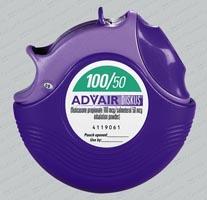
Advair Diskus Side Effects
Generic name: fluticasone / salmeterol
Medically reviewed by Drugs.com. Last updated on Nov 9, 2023.
Note: This document provides detailed information about Advair Diskus Side Effects associated with fluticasone / salmeterol. Some dosage forms listed on this page may not apply specifically to the brand name Advair Diskus.
Applies to fluticasone / salmeterol: inhalation aerosol liquid, inhalation disk, inhalation powder.
Precautions
If you will be using this medicine for a long time, it is very important that your doctor check the progress of you or your child at regular visits. This will allow your doctor to see if the medicine is working properly and to check for any unwanted effects.
Tell your doctor if you or your child are also using other medicines for your COPD. Your doctor may want you to stop using the medicine and use it only during a severe COPD attack. Follow your doctor's instructions on how you should take your medicine.
This medicine should not be used if you are having a severe COPD attack, or if symptoms of a COPD attack has already started. Your doctor may prescribe another medicine for you to use in case of an acute COPD attack. If the other medicine does not work as well, tell your doctor right away.
This medicine should only be used as an additional treatment for patients who cannot be treated with other asthma medicines (such as inhaled corticosteroids) or for asthma patients that require two medicines, including salmeterol. Ask your doctor if you have any questions.
Although this medicine decreases the number of asthma episodes, it may increase the chance of a severe asthma attack when they do occur. Be sure to read about these risks in the patient information leaflet and talk to your doctor or pharmacist about any questions or concerns that you have.
You should not use this medicine if your asthma attack has already started. Your doctor will prescribe another medicine (eg, a short-acting inhaler) for you to use in case of an acute asthma attack. Make sure you understand how to use the short-acting inhaler. Talk to your doctor if you need instructions.
Talk with your doctor or get medical care right away if:
- Your or your child's symptoms do not improve after using this medicine for 1 week or if they become worse.
- Your short-acting inhaler does not seem to work as well as it used to and you or your child need it more often than normal (eg, you use 1 whole canister of the short-acting inhaler in 8 weeks time, or you need to use 4 or more inhalations of the short-acting inhaler for 2 or more days in a row).
- You or your child have a big decrease in your peak flow when measured as directed by your doctor.
Do not use this medicine to treat wheezing that is getting worse. Call your doctor right away if wheezing worsens while using this medicine.
Do not use any other asthma medicine or medicine for breathing problems without talking to your doctor. This medicine should not be used with other inhalers that contain budesonide and formoterol combination (Symbicort®), formoterol (Foradil® Aerolizer®, Perforomist™), or arformoterol (Brovona™).
This medicine may cause a fungus infection of the mouth or throat (thrush). Tell your doctor right away if you have white patches in the mouth or throat, or pain when eating or swallowing.
Patients with COPD may be more likely to have pneumonia. Call your doctor if you or your child start having increased sputum (spit) production, change in sputum color, fever, chills, increased cough, or an increase in breathing problems.
Do not change your dose or stop using your medicine without first asking your doctor.
Your doctor may want you to carry a medical identification (ID) card stating that you or your child are using this medicine. The card will say that you may need additional medicine during an emergency, a severe asthma attack or other illness, or unusual stress.
Using too much of this medicine or using it for a long time may increase your risk of having adrenal gland problems. Talk to your doctor if you or your child have more than one of these symptoms while you are using this medicine: darkening of the skin, diarrhea, dizziness, fainting, loss of appetite, mental depression, nausea, skin rash, unusual tiredness or weakness, or vomiting.
This medicine may cause paradoxical bronchospasm, which may be life-threatening. Check with your doctor right away if you or your child are having a cough, difficulty with breathing, shortness of breath, or wheezing after using this medicine.
If you or your child develop a skin rash, hives, or any allergic reaction (including anaphylaxis) to this medicine, check with your doctor right away.
Check with your doctor right away if you or your child have chest pain, a fast heartbeat, nervousness, shaking of the hands or feet, noisy breathing, a feeling of choking, or tightness or irritation of the throat while using this medicine.
This medicine may affect blood sugar and potassium levels. If you have heart disease or are diabetic and notice a change in the results of your blood or urine sugar or potassium tests, check with your doctor.
Check with your doctor right away if blurred vision, difficulty in reading, or any other change in vision occurs during or after treatment with this medicine. Your doctor may want you or your child to have your eyes checked by an ophthalmologist (eye doctor).
This medicine may decrease bone mineral density when used for a long time. A low bone mineral density can cause weak bones or osteoporosis. If you have any questions about this, ask your doctor.
This medicine may cause children to grow more slowly than usual. Talk to your child's doctor if you have any concerns.
Do not take other medicines unless they have been discussed with your doctor. This includes prescription or nonprescription (over-the-counter [OTC]) medicines and herbal or vitamin supplements.
Serious side effects of Advair Diskus
Along with its needed effects, fluticasone/salmeterol may cause some unwanted effects. Although not all of these side effects may occur, if they do occur they may need medical attention.
Check with your doctor immediately if any of the following side effects occur while taking fluticasone / salmeterol:
More common side effects
- black, tarry stools
- blindness
- blurred vision
- burning, tingling, numbness, or pain in the hands, arms, feet, or legs
- chills
- cough
- decreased vision
- difficulty with breathing or swallowing
- eye pain
- fast heartbeat
- fever
- headache
- hives or welts, skin itching, rash, or redness
- large, hive-like swelling on the face, eyelids, lips, tongue, throat, hands, legs, feet, or sex organs
- nausea
- noisy breathing
- painful or difficult urination
- sensation of pins and needles
- sore throat
- sores, ulcers, or white spots on the lips or in the mouth
- stabbing pain in the arms or legs
- swollen glands
- tearing
- unusual bleeding or bruising
- vomiting
Incidence not known
- backache
- bruising
- darkening of the skin
- decrease in height
- diarrhea
- difficulty with moving
- dizziness
- facial hair growth in females
- fainting
- fast, slow, pounding, or irregular heartbeat or pulse
- flushed, dry skin
- fractures
- fruit-like breath odor
- full or round face, neck, or trunk
- heavy bleeding
- increased hunger
- increased thirst or urination
- irritability
- large, flat, blue, or purplish patches in the skin
- loss of sexual desire or ability
- menstrual irregularities
- mental depression
- muscle pain or stiffness
- muscle wasting
- pain in the back, ribs, arms, or legs
- pain in the joints
- stomach pain
- sweating
- unexplained weight loss
- unusual tiredness or weakness
- weight gain
Get emergency help immediately if any of the following symptoms of overdose occur while taking fluticasone / salmeterol:
Symptoms of overdose
- chest pain or tightness
- confusion
- decreased urine output
- dry mouth
- faintness, or lightheadedness when getting up suddenly from a lying or sitting position
- general feeling of discomfort or illness
- high blood pressure
- loss of appetite
- mood changes
- nervousness
- numbness or tingling in the hands, feet, or lips
- seizures
- sudden sweating
- tremors
- trouble with sleeping
Other side effects of Advair Diskus
Some side effects of fluticasone / salmeterol may occur that usually do not need medical attention. These side effects may go away during treatment as your body adjusts to the medicine. Also, your health care professional may be able to tell you about ways to prevent or reduce some of these side effects.
Check with your health care professional if any of the following side effects continue or are bothersome or if you have any questions about them:
More common side effects
- body aches or pain
- choking
- congestion
- dryness of the throat
- high-pitched noise when breathing
- hoarseness
- runny nose
- sneezing
- trouble with swallowing
- voice changes
Less common side effects
- cough-producing mucus
- irritation or inflammation of the eye
- muscle pain
- pain or tenderness around the eyes and cheekbones
- sleep disorders
- stuffy nose
- white patches in the mouth or throat or on the tongue
See also:
Breztri Aerosphere
Breztri (budesonide/glycopyrrolate/formoterol fumarate) is a combination inhaler used for the ...
Xolair
Xolair injection (omalizumab) is used to help improve allergic asthma, nasal polyps, and chronic ...
Dupixent
Dupixent is used to treat eczema, eosinophilic or oral-corticosteroid-dependent asthma, chronic ...
Symbicort
Symbicort (budesonide and formoterol) is used to prevent bronchospasm in people with asthma or ...
Ventolin
Ventolin is used for asthma, acute, asthma, maintenance, bronchiectasis, bronchospasm prophylaxis ...
Ventolin HFA
Ventolin HFA (albuterol) is used to treat or prevent breathing problems in patients who have asthma ...
Breo Ellipta
Breo Ellipta (fluticasone and vilanterol) is used to prevent airflow obstruction or bronchospasm in ...
Spiriva
Spiriva (tiotropium) is used to prevent bronchospasm in people with bronchitis, emphysema, or COPD ...
Xopenex
Xopenex is a short-acting bronchodilator used to treat or prevent bronchospasm in asthma and other ...
For healthcare professionals
Applies to fluticasone / salmeterol: inhalation aerosol, inhalation powder.
General adverse events
The most common events that occurred more frequently were nasopharyngitis, upper respiratory tract infection, nasal congestion, back pain, sinusitis, dizziness, nausea, pneumonia, candidiasis, and dysphonia.[Ref]
Nervous system
- Very common (10% or more): Headache (up to 21%)
- Common (1% to 10%): Migraine
- Uncommon (0.1% to 1%): Tremor
- Postmarketing reports: Paraesthesia, restlessness, compressed nerve syndrome, aphonia[Ref]
Respiratory
- Very common (10% or more): Upper respiratory tract infections (up to 27%), pharyngitis (up to 13%), nasopharyngitis
- Common (1% to 10%): Pneumonia, bronchitis, throat irritation, hoarseness, dysphonia, sinusitis, upper respiratory inflammation, viral respiratory infections, cough, rhinorrhea/postnasal drip, epistaxis, nasal congestion/blockage, laryngitis, unspecified oropharyngeal plaques, dryness of nose, lower respiratory signs and symptoms, lower respiratory infections, lower respiratory hemorrhage, congestion
- Uncommon (0.1% to 1%): Dyspnea
- Rare (less than 0.1%): Oropharyngeal angioedema, bronchospasm, paradoxical bronchospasm
- Frequency not reported: Nose, and throat infections, laryngitis, nasal sinus disorders, nasal sinus disorders
- Postmarketing reports: Paranasal sinus pain, rhinitis, throat soreness, tonsillitis, asthma, asthma exacerbation, chest congestion, chest tightness, tracheitis, wheezing, report of upper respiratory symptoms of laryngeal spasm, irritation, or swelling such as stridor or chocking[Ref]
The incidence of pneumonia was higher in adult subjects with COPD older than 65 years compared with younger subjects with COPD (18% versus 14%).[Ref]
Cardiovascular
- Common (1% to 10%): Palpitations, tachycardia, arrhythmias, myocardial infarction, postoperative complications
- Uncommon (0.1% to 1%): Atrial fibrillation, angina pectoris
- Rare (less than 0.1%): Cardiac arrhythmias (including supraventricular tachycardia and extrasystoles)
- Frequency not reported: Hematomas
- Postmarketing reports: Ventricular tachycardia, pallor[Ref]
Dermatologic
- Common (1% to 10%): Contusions, wounds, eczema, dermatitis, dermatosis
- Frequency not reported: Skin flakiness and acquired ichthyosis, disorders of sweat and sebum
- Postmarketing reports: Ecchymoses, photodermatitis[Ref]
Gastrointestinal
- Common (1% to 10%): Oral and throat candidiasis, nausea and vomiting, gastrointestinal discomfort and pain, dental discomfort and pain, hyposalivation, gastrointestinal infections, disorders of hard tissue of teeth, abdominal discomfort and pain, oral abnormalities, gastrointestinal discomfort and pain, viral gastrointestinal infections, diarrhea
- Rare (less than 0.1%): Esophageal candidiasis
- Frequency not reported: Oral lesions
- Postmarketing reports: Oral ulcerations, dyspepsia, xerostomia[Ref]
Immunologic
- Common (1% to 10%): Allergies and allergic reactions[Ref]
Metabolic
- Common (1% to 10%): Hypokalemia, weight gain
- Uncommon (0.1% to 1%): Hyperglycemia
- Frequency not reported: Fluid retention[Ref]
Musculoskeletal
- Common (1% to 10%): Muscle cramps, traumatic fractures, arthralgia, myalgia, arthralgia, articular rheumatism, muscle spasms, musculoskeletal inflammation, bone and skeletal pain, muscle injuries, soft tissue injuries
- Postmarketing reports: Muscle stiffness, tightness and rigidity, bone and cartilage disorders, myositis, osteoporosis, fractures[Ref]
Ocular
- Common (1% to 10%): Allergic eye disorders, eye edema and swelling
- Uncommon (0.1% to 1%): Cataract
- Rare (less than 0.1%): Glaucoma
- Frequency not reported: Dry eyes, eye infections, keratitis, conjunctivitis[Ref]
Other
- Common (1% to 10%): Candidiasis unspecified site, ear signs and symptoms, viral infections, bacterial infections, inflammation, bacterial reproductive infections
- Rare (less than 0.1%): Angioedema, facial angioedema
- Frequency not reported: Syncope, edema and swelling, dysmenorrhea, pain, unusual taste, lacerations
- Postmarketing reports: Ear ache, fever[Ref]
Hypersensitivity
- Uncommon (0.1% to 1%): Cutaneous hypersensitivity reactions
- Rare (less than 0.1%): Anaphylactic reactions including anaphylactic shock[Ref]
Psychiatric
- Uncommon (0.1% to 1%): Anxiety, sleep disorders
- Rare (less than 0.1%): Behavioral changes, including psychomotor hyperactivity and irritability (predominately in children)
- Frequency not reported: Depression, aggression (predominantly in children)
- Postmarketing reports: Agitation[Ref]
Endocrine
- Rare (less than 0.1%): Cushing's syndrome, Cushingoid features, adrenal suppression, growth retardation in children and adolescents, decrease bone mineral density
- Frequency not reported: Hypothyroidism
- Postmarketing reports: Hypercorticism[Ref]
Hepatic
- Frequency not reported: Abnormal liver function tests[Ref]
References
1. Brogden RN, Faulds D (1991) "Salmeterol xinafoate. A review of its pharmacological properties and therapeutic potential in reversible obstructive airways disease." Drugs, 42, p. 895-912
2. (1994) "Salmeterol." Med Lett Drugs Ther, 36, p. 37-9
3. "Product Information. Serevent (salmeterol)." Glaxo Wellcome
4. Nathan RA, Seltzer JM, Kemp JP, Chervinsky P, Alexander WJ, Liddle R, Mills R (1995) "Safety of salmeterol in the maintenance treatment of asthma." Ann Allergy Asthma Immunol, 75, p. 243-8
5. Lorentzen KA, Vanhelmond JLM, Bauer K, Langaker KE, Bonifazi F, Harris TAJ (1996) "Fluticasone propionate 1 mg daily and beclomethasone dipropionate 2 mg daily: a comparison over 1 yr." Respir Med, 90, p. 609-17
6. (2001) "Product Information. Advair Diskus (fluticasone-salmeterol)." Glaxo Wellcome
7. Cerner Multum, Inc. "UK Summary of Product Characteristics."
8. Cerner Multum, Inc. "Australian Product Information."
9. D'Alonzo GE, Nathan RA, Henochowicz S, Morris RJ, Ratner P, Rennard SI (1994) "Salmeterol xinafoate as maintenance therapy compared with albuterol in patients with asthma." JAMA, 271, p. 1412-6
10. Kemp JP, Bierman CW, Cocchetto DM (1993) "Dose-response study of inhaled salmeterol in asthmatic patients with 24-hour spirometry and Holter monitoring." Ann Allergy, 70, p. 316-22
11. Pearlman DS, Chervinsky P, LaForce C, Seltzer JM, Southern DL, Kemp JP, Dockhorn RJ, Grossman J, Liddle RF, Yancey SW, et al. (1992) "A comparison of salmeterol with albuterol in the treatment of mild-to- moderate asthma." N Engl J Med, 327, p. 1420-5
12. Meyer JM, Wenzel CL, Kradjan WA (1993) "Salmeterol: a novel, long-acting beta 2-agonist." Ann Pharmacother, 27, p. 1478-87
13. Maconochie JG, Forster JK (1992) "Dose-response study with high-dose inhaled salmeterol in healthy subjects." Br J Clin Pharmacol, 33, p. 342-5
14. Lopezguillen A, Marques L, Lopezllorente MT, Pastor E, Figueras A (1994) "Salmeterol-induced vertigo." Eur Respir J, 7, p. 2089-90
15. Barnes PJ (1995) "Drug therapy: inhaled glucocorticoids for asthma." N Engl J Med, 332, p. 868-75
16. Mann RD, Kubota K, Pearce G, Wilton L (1996) "Salmeterol: a study by prescription-event monitoring in a UK cohort of 15,407 patients." J Clin Epidemiol, 49, p. 247-50
17. (2001) "Product Information. Flovent (fluticasone)." Glaxo Wellcome
18. Wilkinson JR, Roberts JA, Bradding P, Holgate ST, Howarth PH (1992) "Paradoxical bronchoconstriction in asthmatic patients after salmeterol by metered dose inhaler." BMJ, 305, p. 931-2
19. Clark CE, Ferguson AD, Siddorn JA (1993) "Respiratory arrests in young asthmatics on salmeterol." Respir Med, 87, p. 227-8
20. Dottorini ML, Tantucci C, Peccini F, Grassi V, Sorbini CA (1996) "Diurnal change of bronchial caliber and airway responsiveness in asthmatics during long-term treatment with long-acting beta 2-agonist salmeterol." Int J Clin Pharmacol Ther, 34, p. 438-43
21. Maconochie JG, Minton NA, Chilton JE, Keene ON (1994) "Does tachyphylaxis occur to the non-pulmonary effects of salmeterol?" Br J Clin Pharmacol, 37, p. 199-204
22. Britton MG, Earnshaw JS, Palmer JB (1992) "A twelve month comparison of salmeterol with salbutamol in asthmatic patients. European Study Group [published erratum appears in Eur Respir J 1993;6(1):150]." Eur Respir J, 5, p. 1062-7
23. Ullman A, Svedmyr N (1988) "Salmeterol comparison with salbutamol in adult asthmatic patients." Thorax, 43, p. 674-8
24. Tranfa CME, Pelaia G, Grembiale RD, Naty S, Durante S, Borrello G (1998) "Short-term cardiovascular effects of salmeterol." Chest, 113, p. 1272-6
25. Holliday SM, Faulds D, Sorkin EM (1994) "Inhaled fluticasone propionate. A review of its pharmacodynamic and pharmacokinetic properties, and therapeutic use in asthma." Drugs, 47, p. 318-31
26. Paggiaro PL, Dahle R, Bakran I, Frith L, Hollingworth K, Efthimiou J (1998) "Multicenter randomised placebo-controlled trial of inhaled fluticasone propionate in patients with chronic obstructive pulmonary disease." Lancet, 351, p. 773-80
27. Executive Committee American Academy of Allergy and Immunology (1993) "Inhaled corticosteroids and severe viral infections." J Allergy Clin Immunol, 92, p. 223-8
28. Packe GE, Douglas JG, McDonald AF, Robins SP, Reid DM (1992) "Bone density in asthmatic patients taking high dose inhaled beclomethasone diproprionate and intermittent systemic corticosteroids." Thorax, 47, p. 414-7
29. Garbe E, LeLorier J, Boivin JF, Suissa S (1997) "Inhaled and nasal glucocorticoids and the risks of ocular hypertension or open-angle glaucoma." JAMA, 277, p. 722-7
30. Svedmyr N, Lofdahl CG (1996) "The use of beta(2)-adrenoceptor agonists in the treatment of bronchial asthma." Pharmacol Toxicol, 78, p. 3-11
31. Booth H, Bish R, Walters J, Whitehead F, Walters EH (1996) "Salmeterol tachyphylaxis in steroid treated asthmatic subjects." Thorax, 51, p. 1100-4
32. Hatton MQ, Allen MB, Mellor EJ, Cooke NJ (1991) "Salmeterol rash ." Lancet, 337, p. 1169-70
33. Grahnen A, Eckernas SA, Brundin RM, Lingandersson A (1994) "An assessment of the systemic activity of single doses of inhaled fluticasone propionate in healthy volunteers." Br J Clin Pharmacol, 38, p. 521-5
34. Howland WC (1996) "Fluticasone propionate: topical or systemic effects?" Clin Exp Allergy, 26 ( Suppl, p. 18-22
35. Clark DJ, Lipworth BJ (1997) "Adrenal suppression with chronic dosing of fluticasone propionate compared with budesonide in adult asthmatic patients." Thorax, 52, p. 55-8
36. Thorsson L, Dahlstrom K, Edsbacker S, Kallen A, Paulson J, Wiren JE (1997) "Pharmacokinetics and systemic effects of inhaled fluticasone propionate in healthy subjects." Br J Clin Pharmacol, 43, p. 155-61
37. Derom E, Schoor JV, Verhaeghe W, Vincken W, Pauwels R (1999) "Systemic effects of inhaled fluticasone propionate and budesonide in adult patients with asthma." Am J Respir Crit Care Med, 160, p. 157-61
Frequently asked questions
- Can asthma inhalers cause a sore throat?
- Symbicort vs. Advair: How do they compare?
- Is Wixela Inhub the same as Advair Diskus?
More about Advair Diskus (fluticasone / salmeterol)
- Check interactions
- Compare alternatives
- Pricing & coupons
- Reviews (114)
- Drug images
- Dosage information
- During pregnancy
- Generic availability
- Support group
- Drug class: bronchodilator combinations
- En español
Patient resources
Other brands
Wixela Inhub, Advair HFA, AirDuo Respiclick, AirDuo Digihaler
Professional resources
Other brands
Wixela Inhub, AirDuo Respiclick, AirDuo Digihaler
Related treatment guides
Further information
Advair Diskus side effects can vary depending on the individual. Always consult your healthcare provider to ensure the information displayed on this page applies to your personal circumstances.
Note: Medication side effects may be underreported. If you are experiencing side effects that are not listed, submit a report to the FDA by following this guide.