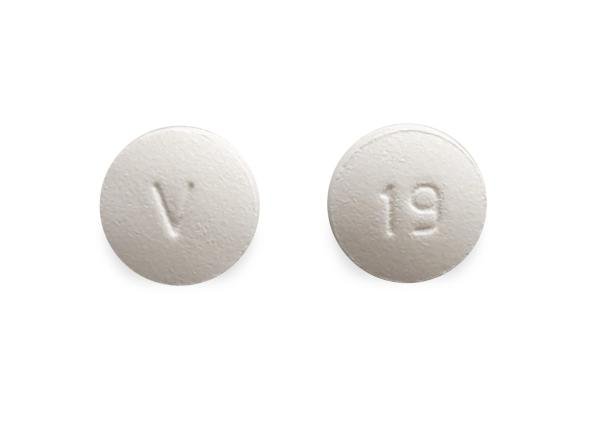
Solifenacin (Monograph)
Brand name: Vesicare
Drug class: Antimuscarinics
Chemical name: (1S)-(3R)-1-azabicyclo[2.2.2]oct-3-yl-3,4-dihydro-1-phenyl-2(1H)-isoquinolinecarboxylate cmpd. with butanedioic acid (1:1)
Molecular formula: C23H26N2O2•C4H6O4
CAS number: 242478-38-2
Introduction
Genitourinary antispasmodic agent; an antimuscarinic agent.
Uses for Solifenacin
Overactive Bladder
Relief of symptoms associated with voiding (e.g., urge urinary incontinence, urgency, frequency).
Solifenacin Dosage and Administration
Administration
Oral Administration
Administer orally once daily with liquids without regard to meals.
Swallow tablets whole.
Dosage
Available as solifenacin succinate; dosage expressed in terms of the salt.
Adults
Overactive Bladder
Oral
Initially, 5 mg once daily. If well tolerated, may increase to 10 mg once daily.
Prescribing Limits
Adults
Overactive Bladder
Oral
Maximum 10 mg daily.
Special Populations
Hepatic Impairment
Maximum 5 mg daily in patients with moderate hepatic impairment (Child-Pugh class B). (See Elimination: Special Populations, under Pharmacokinetics.)
Use not recommended in patients with severe hepatic impairment (Child-Pugh class C).
Renal Impairment
Maximum 5 mg daily in patients with severe renal impairment (Clcr <30 mL/minute). (See Elimination: Special Populations, under Pharmacokinetics.)
Cautions for Solifenacin
Contraindications
-
Urinary retention, gastric retention, or uncontrolled angle-closure glaucoma.
-
Known hypersensitivity to solifenacin succinate or any ingredient in the formulation.
Warnings/Precautions
Sensitivity Reactions
Angioedema
Angioedema reported in at least 1 patient.
General Precautions
Urinary Retention
Risk of urinary retention; use with caution in patients with clinically important bladder outflow obstruction.
Decreased GI Motility
Use with caution in patients with decreased GI motility (e.g., patients with severe constipation, ulcerative colitis, or myasthenia gravis) or obstructive GI disorders.
Fecal impaction, colonic obstruction, and intestinal obstruction reported rarely with 10-mg daily dosage.
Prolongation of QT Interval
30-mg daily dosage associated with more pronounced prolongation of QT interval than 10-mg daily dosage. (See Prescribing Limits under Dosage and Administration.) Consider this observation when deciding to use solifenacin in patients with history of QT interval prolongation or receiving drugs that prolong QT interval.
Controlled Angle-closure Glaucoma
Use with caution in patients being treated for angle-closure glaucoma. (See Contraindications under Cautions.)
Specific Populations
Pregnancy
Category C.
Lactation
Distributed into milk in mice; not known whether distributed into human milk. Discontinue nursing or the drug.
Pediatric Use
Safety and efficacy not established in children <18 years of age.
Geriatric Use
No substantial differences in safety and efficacy relative to younger adults. (See Elimination: Special Populations, under Pharmacokinetics.)
Hepatic Impairment
Use with caution. (See Hepatic Impairment under Dosage and Administration and see Elimination: Special Populations, under Pharmacokinetics.)
Use not recommended in patients with severe hepatic impairment (Child-Pugh class C).
Renal Impairment
Use with caution. (See Renal Impairment under Dosage and Administration and see Elimination: Special Populations, under Pharmacokinetics.)
Common Adverse Effects
Dry mouth, constipation.
Drug Interactions
Metabolized principally by CYP3A4. Does not inhibit CYP1A1/2, 2C9, 2C19, 2D6, or 3A4.
Drugs Affecting Hepatic Microsomal Enzymes
Inhibitors of CYP3A4: Potential pharmacokinetic interaction (increased plasma solifenacin concentrations). Do not exceed 5 mg daily when used concomitantly with potent inhibitors of CYP3A4. (See Specific Drugs under Interactions.)
Inducers of CYP3A4: Potential pharmacokinetic interaction (altered solifenacin pharmacokinetics).
Drugs Metabolized by Hepatic Microsomal Enzymes
Substrates of CYP1A1/2, CYP2C9, CYP2C19, CYP2D6, or CYP3A4: Pharmacokinetic interaction unlikely
Drugs Affected by GI Motility
Potential pharmacokinetic interaction (altered absorption because of decreased GI motility). (See Decreased GI Motility under Cautions.)
Specific Drugs
|
Drug |
Interaction |
Comments |
|---|---|---|
|
Anticholinergic agents |
Possible additive anticholinergic effects |
|
|
Digoxin |
No substantial effect on digoxin pharmacokinetics |
|
|
Hormonal contraceptives |
No substantial changes in plasma concentrations of ethinyl estradiol or levonorgestrel |
|
|
Ketoconazole |
Increased plasma solifenacin concentrations |
Do not exceed a solifenacin succinate dosage of 5 mg daily |
|
Warfarin |
No substantial effect on warfarin pharmacokinetics |
Solifenacin Pharmacokinetics
Absorption
Bioavailability
Absolute bioavailability is approximately 90%.
Peak plasma concentrations achieved within 3–8 hours after administration.
Food
Food does not affect pharmacokinetics of solifenacin.
Special Populations
Increased plasma concentrations reported in geriatric patients, patients with moderate hepatic impairment (Child-Pugh class B), and patients with severe renal impairment (Clcr <30 mL/minute). (See Special Populations under Dosage and Administration and see Elimination: Special Populations, under Pharmacokinetics.)
Distribution
Extent
Highly distributed to tissues outside the CNS.
Distributed into milk in mice; not known whether distributed into human milk.
Plasma Protein Binding
Approximately 98% (mainly to α1-acid glycoprotein).
Elimination
Metabolism
Extensively metabolized in the liver, mainly via CYP3A4.
Elimination Route
Excreted in urine (approximately 69%) and in feces (approximately 23%); unchanged drug accounts for <15% of recovered radioactivity.
Half-life
45–68 hours following long-term administration.
Special Populations
Prolonged half-life in geriatric patients, patients with moderate hepatic impairment (Child-Pugh class B), and patients with severe renal impairment (Clcr <30 mL/minute). (See Special Populations under Dosage and Administration.)
Stability
Storage
Oral
Tablets
25°C (may be exposed to 15–30°C).
Actions
-
Potent and selective antimuscarinic agent.
-
Inhibits contraction of the detrusor muscle of the bladder, resulting in decreased bladder activity.
-
Demonstrates binding specificity for muscarinic M3 receptors in vitro and functional selectivity for urinary bladder over secretory (e.g., salivary) glands.
-
Risk of blurred vision, constipation, dry mouth, and heat prostration (when used in a hot environment). Use caution when driving or performing dangerous activities until effects on vision are known. Consult a clinician if severe abdominal pain occurs or if constipation persists for ≥3 days.
-
Importance of taking solifenacin succinate with liquids and swallowing the tablet whole. If a dose is skipped, resume therapy the next day; do not take 2 doses in the same day.
-
Importance of reading manufacturer’s patient information leaflet before initiating therapy.
-
Importance of informing clinicians of existing or contemplated concomitant therapy, including prescription and OTC drugs and dietary or herbal supplements, as well as any concomitant illnesses.
-
Importance of women informing their clinician if they are or plan to become pregnant or plan to breast-feed.
-
Importance of informing patients of other important precautionary information. (See Cautions.)
Preparations
Excipients in commercially available drug preparations may have clinically important effects in some individuals; consult specific product labeling for details.
Please refer to the ASHP Drug Shortages Resource Center for information on shortages of one or more of these preparations.
|
Routes |
Dosage Forms |
Strengths |
Brand Names |
Manufacturer |
|---|---|---|---|---|
|
Oral |
Tablets, film-coated |
5 mg |
Vesicare |
Yamanouchi (also promoted by GlaxoSmithKline) |
|
10 mg |
Vesicare |
Yamanouchi (also promoted by GlaxoSmithKline) |
AHFS DI Essentials™. © Copyright 2025, Selected Revisions August 26, 2015. American Society of Health-System Pharmacists, Inc., 4500 East-West Highway, Suite 900, Bethesda, Maryland 20814.
Reload page with references included
Related/similar drugs
More about solifenacin
- Check interactions
- Compare alternatives
- Pricing & coupons
- Reviews (224)
- Drug images
- Side effects
- Dosage information
- During pregnancy
- Drug class: urinary antispasmodics
- Breastfeeding
- En español