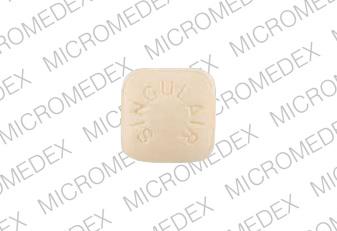
Singulair Side Effects
Generic name: montelukast
Medically reviewed by Drugs.com. Last updated on Dec 11, 2024.
Note: This document provides detailed information about Singulair Side Effects associated with montelukast. Some dosage forms listed on this page may not apply specifically to the brand name Singulair.
Applies to montelukast: oral packet, oral tablet, oral tablet chewable.
Important warnings
This medicine can cause some serious health issues
Oral route (tablet; tablet, chewable; granule)
Warning: Serious Neuropsychiatric Events. Serious neuropsychiatric (NP) events have been reported in patients taking montelukast.
The types of events reported were highly variable, and included, but were not limited to, agitation, aggression, depression, sleep disturbances, suicidal thoughts and behavior (including suicide).
The mechanisms underlying NP events associated with montelukast use are currently not well understood.Because of the risk of NP events, the benefits of montelukast may not outweigh the risks in some patients, particularly when the symptoms of disease may be mild and adequately treated with alternative therapies.
Reserve use of montelukast for patients with allergic rhinitis who have an inadequate response or intolerance to alternative therapies.
In patients with asthma or exercise-induced bronchoconstriction, consider the benefits and risks before prescribing montelukast.Discuss the benefits and risks of montelukast with patients and caregivers when prescribing montelukast.
Advise patients and/or caregivers to be alert for changes in behavior or new NP symptoms when taking montelukast.
If changes in behavior are observed, or if new NP symptoms or suicidal thoughts and/or behavior occur, advise patients to discontinue montelukast and contact a healthcare provider immediately.
Precautions
If you will be taking this medicine for a long time, it is very important that your doctor check you or your child at regular visits. This will allow your doctor to see if the medicine is working properly and to check for any unwanted effects.
You may be taking other medicines for asthma together with montelukast (the active ingredient contained in Singulair). Do not stop taking these medicines and do not reduce the dose, even if your asthma seems better, unless you or your child are told to do so by your doctor.
Talk to your doctor or get medical care right away if:
- Your or your child's symptoms do not improve after using this medicine or if they become worse.
- Your short-acting inhaler does not seem to be working as well as usual and you need to use it more often.
Montelukast may cause some people to be agitated, disoriented, irritable, or display other abnormal behaviors. It may also cause some people to have suicidal thoughts and tendencies or to become more depressed. Report any unusual thoughts or behaviors that trouble you or your child, especially if they are new or get worse quickly. Make sure the doctor knows if you or your child have trouble sleeping, get upset easily, or start to act reckless. Also tell the doctor if you or your child have sudden or strong feelings, such as feeling nervous, angry, restless, violent, or scared.
This medicine may increase certain white blood cells (eosinophils) and may cause Churg-Strauss syndrome (blood vessel disease). This usually occurs in patients who have asthma or are taking oral steroid medicines that is being stopped or the dose is being reduced or lowered. Check with your doctor right away if you have a feeling of pins and needles, numbness in your arms or legs, flu-like symptoms, rash, or pain or swelling of the sinuses.
Do not take other medicines unless they have been discussed with your doctor. This includes prescription or nonprescription (over-the-counter [OTC]) medicines and herbal or vitamin supplements.
Serious side effects of Singulair
Along with its needed effects, montelukast may cause some unwanted effects. Although not all of these side effects may occur, if they do occur they may need medical attention.
Check with your doctor immediately if any of the following side effects occur while taking montelukast:
More common side effects
- body aches or pain
- cough
- difficulty in breathing
- dryness or soreness of the throat
- fever
- headache
- loss of voice
- pain or tenderness around the eyes and cheekbones
- pain, redness, or swelling in the ear
- stomach pain
- stuffy or runny nose
- tender, swollen glands in neck
- trouble in swallowing
- unusual tiredness or weakness
- voice changes
Less common side effects
- bloody nose
- general feeling of discomfort or illness
- joint pain
- sweating
Rare side effects
- pus in the urine
Incidence not known
- agitation
- anxiety
- attempts at killing oneself
- breathing problems
- confusion about identity, place, and time
- constipation
- fast, irregular, pounding, or racing heartbeat or pulse
- feeling sad or empty
- hives or welts
- indigestion
- itching, puffiness, or swelling of the eyelids or around the eyes, face, lips, or tongue
- lack of appetite
- pains in the stomach, side, or abdomen, possibly moving to the back
- redness of the skin
- shaking or trembling of the hands or feet
- trouble with concentrating
- unable to sleep
- unpleasant breath odor
- vomiting of blood
- yellow eyes or skin
Other side effects of Singulair
Some side effects of montelukast may occur that usually do not need medical attention. These side effects may go away during treatment as your body adjusts to the medicine. Also, your health care professional may be able to tell you about ways to prevent or reduce some of these side effects.
Check with your health care professional if any of the following side effects continue or are bothersome or if you have any questions about them:
More common side effects
- diarrhea
Less common side effects
- acid or sour stomach
- belching
- blurred vision
- change in near or distance vision
- dental pain
- heartburn
- lack or loss of strength
- pain
- skin rash, encrusted, scaly and oozing
- stomach discomfort, upset, or pain
Incidence not known
- burning, crawling, itching, numbness, prickling, “pins and needles”, or tingling feelings
- dreams that are unusual
- increased tendency to bleed
- large, flat, blue or purplish patches on the skin
- muscle aching or cramping
- sleepiness
- swollen joints
See also:
Xolair
Xolair injection (omalizumab) is used to help improve allergic asthma, nasal polyps, and chronic ...
Zyrtec
Zyrtec (cetirizine) is used to treat allergy symptoms such as sneezing, itching, watery eyes, or ...
Dupixent
Dupixent is used to treat eczema, eosinophilic or oral-corticosteroid-dependent asthma, chronic ...
Promethazine
Promethazine is a phenothiazine and antihistamine used to treat allergies, motion sickness, nausea ...
Diphenhydramine
Diphenhydramine is an antihistamine used to treat sneezing, runny nose, itching, hives and other ...
Triamcinolone nasal
Triamcinolone nasal is used for allergic rhinitis, allergies
Dexamethasone
Dexamethasone is used to treat inflammatory conditions such as allergies, skin conditions ...
Methylprednisolone
Methylprednisolone is used to treat conditions such as allergies, arthritis, lupus and ulcerative ...
Loratadine
Loratadine is a non-drowsy antihistamine used to relieve allergy symptoms like sneezing, runny ...
Fluticasone nasal
Fluticasone nasal is used for allergic rhinitis, allergies, chronic rhinosinusitis with nasal ...
For healthcare professionals
Applies to montelukast: oral granule, oral tablet, oral tablet chewable.
General adverse events
The most common adverse reactions (incidence more than 5% and greater than placebo) were: Upper respiratory infection, fever, headache, pharyngitis, cough, abdominal pain, diarrhea, otitis media, influenza, rhinorrhea, sinusitis, otitis.[Ref]
Immunologic
- Very rare (less than 0.01%): Churg-Strauss Syndrome[Ref]
Churg-Strauss syndrome is a rare granulomatous eosinophilic condition that involves the upper and lower airways and manifests as rhinitis, sinusitis and asthma. If untreated the syndrome may progress to systemic vasculitis, peripheral neuropathy and potentially fatal cardiac complications. In most cases, the condition emerged during withdrawal of oral corticosteroid therapy. A causative role for leukotriene receptor antagonists has not been ruled out.[Ref]
Nervous system
- Very common (10% or more): Headache (18.4%)
- Common (1% to 10%): Dizziness (1.9%)
- Postmarketing reports: Disturbance in attention, irritability, memory impairment, tremor, drowsiness, paraesthesia/hypoesthesia, seizures[Ref]
Dermatologic
- Common (1% to 10%): Rash (1.6%), atopic dermatitis, skin infection, eczema, urticaria
- Postmarketing reports: Angioedema, bruising, erythema multiforme, erythema nodosum, pruritus, Stevens-Johnson syndrome/toxic epidermal necrolysis[Ref]
Gastrointestinal
- Common (1% to 10%): Abdominal pain (2.9%), dyspepsia (2.1%), dental pain (1.7%), gastroenteritis (1.5%), nausea, diarrhea, dyspepsia, gastroenteritis, tooth infection[Ref]
Hepatic
- Common (1% to 10%): ALT increase (2.1%), AST increased (1.6%)
- Postmarketing reports: Hepatic eosinophilic infiltration; cases of cholestatic hepatitis, hepatocellular liver-injury, and mixed-pattern liver injury. Most of these occurred in combination with other confounding factors, such as use of other medications, or when administered to patients who had underlying potential for liver disease such as alcohol use or other forms of hepatitis.[Ref]
Ocular
- Common (1% to 10%): Myopia, conjunctivitis[Ref]
Other
- Common (1% to 10%): Asthenia, fatigue (1.8%), fever (1.5%), trauma (1%), influenza, fever, otitis, viral infection, varicella, ear pain, otitis media
- Uncommon (0.1% to 1%): Malaise
- Postmarketing reports: Edema[Ref]
Respiratory
- Common (1% to 10%): Influenza (4.2%), cough (2.7%), nasal congestion (1.6%), pharyngitis, sinusitis, laryngitis, infective rhinitis, acute bronchitis, rhinorrhea, pneumonia, upper respiratory infection, wheezing, tonsillitis
- Postmarketing reports: Epistaxis, pulmonary eosinophilia[Ref]
Cardiovascular
- Postmarketing reports: Palpitations[Ref]
Genitourinary
- Postmarketing reports: Enuresis in children[Ref]
Hematologic
- Postmarketing reports: Increased bleeding tendency, thrombocytopenia[Ref]
Hypersensitivity
- Postmarketing reports: Anaphylaxis[Ref]
Musculoskeletal
- Postmarketing reports: Arthralgia, myalgia including muscle cramps[Ref]
Psychiatric
- Postmarketing reports: Agitation including aggressive behavior or hostility, anxiousness, depression, disorientation, dream abnormalities, hallucinations, insomnia, restlessness, somnambulism, suicidal thinking and behavior (including suicide), tic, obsessive-compulsive symptoms, dysphemia/stuttering[Ref]
References
1. (2001) "Product Information. Singulair (montelukast)." Merck & Co., Inc
2. McMorran M (1999) "Leukotriene receptor antagonists: suspected adverse reactions." Can Med Assn J, 161, p. 868-70
3. Cerner Multum, Inc. "UK Summary of Product Characteristics."
4. Cerner Multum, Inc. "Australian Product Information."
5. (2016) "Product Information. Montelukast Sodium (montelukast)." Ajanta Pharma USA
6. Bronsky EA, Kemp JP, Zhang J, Guerreiro D, Reiss TF (1997) "Dose-related protection of exercise bronchoconstriction by montelukast, a cysteinyl leukotriene-receptor antagonist, at the en of a once-daily dosing interval." Clin Pharmacol Ther, 62, p. 556-61
7. De Lepeleire I, Reiss TF, Rochette F, Botto A, Zhang J, Kundu S, Decramer M (1997) "Montelukast causes prolonged, potent leukotriene D4-receptor antagonism in the airways of patients with asthma." Clin Pharmacol Ther, 61, p. 83-92
8. Reiss TF, Chervinsky P, Dockhorn RJ, Shingo S, Seidenberg B, Edwards TB (1998) "Montelukast, a once-daily leukotriene receptor antagonist, in the treatment of chronic asthma: A multicenter, randomized, double-blind trial." Arch Intern Med, 158, p. 1213-20
9. Noonan MJ, Chervinsky P, Brandon M, Zhang J, Kundu S, McBurney J, Reiss TF (1998) "Montelukast, a potent leukotriene receptor antagonist, causes dose-related improvements in chronic asthma." Eur Respir J, 11, p. 1232-9
10. Leff JA, Busse WW, Pearlman D, et al. (1998) "Montelukast, a leukotriene-receptor antagonist, for the treatment of mild asthma and exercise-induced bronchoconstriction." N Engl J Med, 339, p. 147-52
11. Reiss TF, Altman LC, Chervinsky P, Bewtra A, Stricker WE, Noonan GP, Kundu S, Zhang J (1996) "Effects of montelukast (MK-0476), a new potent cysteinyl leukotriene (LTD4) receptor antagonist, in patients with chronic asthma." J Allergy Clin Immunol, 98, p. 528-34
12. Sabio JM, Jimenez-Alonso J, Gonzalez-Crespo F (2001) "More About Churg-Strauss Syndrome and Montelukast Treatment." Chest, 120, p. 2116
13. Minciullo PL, Saija A, Bonanno D, Ferlazzo E, Gangemi S (2004) "Montelukast-induced generalized urticaria." Ann Pharmacother, 38, p. 999-1001
14. Sass DA, Chopra KB, Wu T (2003) "A case of montelukast-induced hepatotoxicity." Am J Gastroenterol, 98, p. 704-5
15. Goldstein MF, Anoia J, Black M (2004) "Montelukast-induced hepatitis." Ann Intern Med, 140, p. 586-7
16. Wechsler ME, Finn D, Gunawardena D, Westlake R, Barker A, Haranath SP, Pauwels RA, Kips JC, Drazen JM (2000) "Churg-Strauss syndrome in patients receiving montelukast as treatment for asthma." Chest, 117, p. 708-13
17. Price D (2000) "Tolerability of montelukast." Drugs, 59, p. 35-42
18. Jarvis B, Markham A (2000) "Montelukast - A review of its therapeutic potential in persistent asthma." Drugs, 59, p. 891-928
19. Dempsey OJ (2000) "Leukotriene receptor antagonist therapy." Postgrad Med J, 76, p. 767-73
20. Tang MB, Yosipovitch G (2003) "Acute churg-strauss syndrome in an asthmatic patient receiving montelukast therapy." Arch Dermatol, 139, p. 715-8
21. Sabbagh R, Sheikh-Taha M (2009) "Possible montelukast-induced angioedema." Am J Health Syst Pharm, 66, p. 1705-6
22. Kelsay K (2009) "Assessing risk: Data from montelukast clinical trials." J Allergy Clin Immunol, 124, p. 697-8
23. Philip G, Hustad C, Noonan G, et al. (2009) "Reports of suicidality in clinical trials of montelukast." J Allergy Clin Immunol, 124, 691-696.e6
Frequently asked questions
More about Singulair (montelukast)
- Check interactions
- Compare alternatives
- Pricing & coupons
- Reviews (221)
- Drug images
- Dosage information
- Patient tips
- During pregnancy
- Generic availability
- Support group
- Drug class: leukotriene modifiers
- Breastfeeding
- En español
Patient resources
Professional resources
Related treatment guides
Further information
Singulair side effects can vary depending on the individual. Always consult your healthcare provider to ensure the information displayed on this page applies to your personal circumstances.
Note: Medication side effects may be underreported. If you are experiencing side effects that are not listed, submit a report to the FDA by following this guide.