Influenza
What is influenza?
Influenza Care Guide
Influenza is also called the flu. It is an illness that causes signs and symptoms in your nose, throat, and lungs. Most people get better within a week after getting the flu. In some people, the flu can cause health problems that are serious or life-threatening.
What causes influenza, and how is it spread?
The flu is caused by a virus (germ) called influenza. The flu is spread easily from person to person. If you have the flu, you can spread germs by coughing, sneezing, or being near other people. When you cough or sneeze, the virus goes in the air, and can land on surfaces or objects. People can get the flu by touching something that has the virus on it, and then touching their mouth or nose. The flu can also be spread from one person to another by breathing in the virus.
What may increase my risk of getting the flu, or if I already have the flu, making the illness worse?
- Being around someone who has the flu: Living with or caring for someone with the flu increases your risk of getting it.
- Living with many people: People who live in nursing homes or long-term-care facilities have a higher risk of getting the flu.
- Medical problems: These problems include heart, liver, brain, kidney, or lung disease. Medical problems that increase your risk also include cancer and diabetes. You are at a higher risk if you have seizures, or if you have injured your spinal cord.
- Older age: Adults who are 50 years of age or older are at a higher risk of serious illness if they get the flu.
- Travel: Traveling to places where many people have the flu increases your risk of getting it.
- Weak immune system: The immune system in your body helps fight infection. People who have HIV, AIDS, or other immune system disorders have a weak immune system. A person who has had surgery to transplant an organ such as their kidney also has a weak immune system. A weak immune system increases your risk of getting the flu.
- Women who are pregnant: Your signs and symptoms may be worse if you are pregnant.
What are the signs and symptoms of influenza?
You may have any of the following signs and symptoms:
- Cough, runny nose, and sore throat
- Feeling tired easily
- Fever and chills
- Headaches, body aches, and muscle or joint pain
- Not wanting to eat
- Trouble breathing
- Vomiting (throwing up) and diarrhea
How is influenza diagnosed?
Caregivers will ask you questions about your signs and symptoms. Tell your caregiver if you have been around sick people or animals. Tell him if you have traveled recently. Tell your caregiver if you have diabetes, heart disease, asthma, or emphysema. If you are a women, tell your caregiver if you are pregnant. You may need one or more of the following tests:
- Culture: This is a test that is done to learn about the germ that is causing your illness. For this test, fluid samples from your nose or throat are collected and tested.
- Sputum sample: Sputum (mucus from your lungs) is collected in a cup when you cough. The sample is sent to a lab to be tested for the germ that is causing your illness. It can also help your caregiver choose the best medicine to treat the infection.
- Nasal wash: A nasal wash is a test that is done to learn about the germ that is causing your illness. For this test, a sample of mucus from your nose is collected using a suction tube, and then the sample is tested.
- Bronchoscopy: This is a procedure to look inside your airway and learn the cause of your airway or lung condition. A bronchoscope (thin tube with a light) is inserted into your mouth and moved down your throat to your airway. You may be given medicine to numb your throat and help you relax during the procedure. Tissue and fluid may be collected from your airway or lungs to be tested.
What may be done to treat influenza?
Treatment depends on how bad your symptoms are. If your flu signs and symptoms are severe (very bad), you may be treated in the hospital. Treatment may include any of the following:
- Liquids: Having a fever, vomiting, and diarrhea can cause you to lose too much body fluid. This is called dehydration. If you are dehydrated, you will be offered liquids to drink. If you cannot drink enough liquid, caregivers may put an intravenous (IV) tube into your vein. You will be given the liquid that you need through the IV.
- Isolation: You will need to wear a mask to help prevent spreading the flu to other people. Anyone who comes near you should also wear a mask, and may wear gloves, goggles, and a gown. People who enter the room that you are in should wash their hands before leaving the room.
- Suctioning: Caregivers may need to use suction to help you breathe more easily. To use suction, a small tube is placed in your mouth or nose. The suction in the tube removes mucus.
- Nebulizer treatments: During this treatment you are given medicine in the form of a mist, which is easy to breathe in. Nebulizer treatments are given through a mouthpiece or mask that is attached to the nebulizer machine.
- Oxygen: You may need extra oxygen if your blood oxygen level is lower than it should be. You may get oxygen through a mask placed over your nose and mouth or through small tubes placed in your nostrils. Ask your caregiver before you take off the mask or oxygen tubing.
- Ventilator: This is a machine that gives you oxygen and breathes for you when you cannot breathe well on your own. An endotracheal (ET) tube is put into your airway through your mouth or nose. You may need a trach if an ET tube cannot be placed. A trach is an airway tube put into an incision (cut) in the front of your neck. The ET tube or trach is attached to the ventilator.
What type of medicine may be used to treat influenza?
You may need one or more of the following medicines:
- Antivirals: Antiviral medicine is given to fight infection that is caused by a virus. This medicine can decrease your signs and symptoms, and help you get better faster. This medicine can also help prevent serious medical problems that can come with the flu.
- Antibiotics: The flu may lead to an infection in your lungs that is caused by germs called bacteria. If you get this lung infection, you may need to take antibiotic medicine to treat it.
- Bronchodilators: Bronchodilators may be given to help open your airways. This medicine can help you breathe more easily.
What can I do to manage influenza at home?
- Wash your hands often with soap and water:
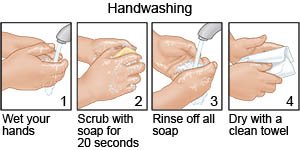
- Take off your hand and arm jewelry before washing your hands. Scrub your hands for at least 15 seconds, using warm water and soap. This is about as long as it takes to sing the happy birthday song twice. Wash between your fingers, and under your nails. Wash both the front and the back of each hand. After washing your hands, gently rub them dry using a clean towel or paper towel. Hold a paper towel in your hand while turning off the water tap.
- When leaving the bathroom, grab the door handle while holding a paper towel in your hand. Everyone should wash their hands before eating, after using the bathroom, and after petting animals.
- Take off your hand and arm jewelry before washing your hands. Scrub your hands for at least 15 seconds, using warm water and soap. This is about as long as it takes to sing the happy birthday song twice. Wash between your fingers, and under your nails. Wash both the front and the back of each hand. After washing your hands, gently rub them dry using a clean towel or paper towel. Hold a paper towel in your hand while turning off the water tap.
- Alcohol-based hand rubs can be used for hand cleaning if there is no water: Carry germ-killing hand gel (hand rub) with you when you leave the house. Before using a hand rub, wipe dirt off of your hands as much as you can. Your hands should be dry before hand rub is used. Take enough of the hand rub to cover your hands and fingers. Rub your hands together until all of the hand rub liquid has dried up.
- Drinking liquids: Adults should drink about 9 to 13 cups of liquid each day. One cup is 8 ounces. Good choices of liquids for most people include water, juice, and milk. Coffee, soup, and fruit may be counted in your daily liquid amount. Ask your caregiver how much liquid you should drink each day.
- Ask your caregiver if you should use over-the-counter medicine: Over-the-counter (OTC) medicine can be bought without a doctor's order. OTC medicine may be used to decrease fever, body aches, coughing, and other signs and symptoms of the flu. These medicines are safe for most people to use, and can help you feel better when used correctly. When this medicine is not used correctly it can cause serious problems, such as liver damage. People who use other medicines, or people with certain medical conditions have a higher risk for problems. Follow the directions on the label carefully. Using too much, or using these medicines for longer than the label says can be harmful. If you need to take antiviral or antibiotic medicine, follow your caregivers directions for taking it.
- Rest: Try to get enough rest and sleep. Rest and sleep may help you get better faster when you have the flu.
What are the risks of having influenza?
Influenza can lead to dehydration. If you lose too much water, your heart may not pump enough blood. Being dehydrated can hurt your kidneys, heart, and brain. With the flu, diseases such as asthma, lung disease, and heart disease may get worse. Having the flu can lead to ear, throat, and sinus infections. If you have a high fever, you may begin to have seizures (convulsions). You may get lung infections such as pneumonia or bronchitis. You may get an infection in your blood, heart, or brain, and you may die.
What are the risks of treating influenza?
- Antiviral medicine may cause dizziness, confusion, trouble sleeping, nausea (an upset stomach) and vomiting. If you already have seizures, using this medicine may increase your risk of having more seizures. If you are allergic to the medicine, your face may swell, and you may have trouble breathing. Antiviral medicine may cause headaches, dizziness, and ear, nose, and throat infections. You may still have signs and symptoms of the flu during and after using antiviral medicine.
- The influenza vaccine can cause an upset stomach, and you may throw up. The area where the vaccine is given may feel sore and look red. The vaccine may cause a sore throat, coughing, or a runny nose. You may get a headache, body aches, and a fever. You may have trouble breathing or chest tightness, or your throat or tongue may swell up. You may still get influenza, even after you get the vaccine to prevent it. Women who are pregnant should talk to their caregiver before taking medicine to prevent or treat the flu. Talk to your caregiver about the risks of being treated for the flu.
What can I do to help prevent getting influenza?
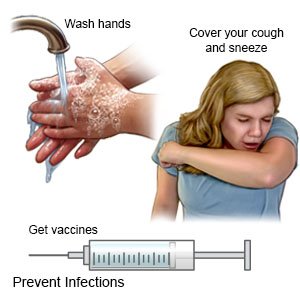
- Wash your hands often with soap and water. Carry germ-killing hand gel with you when you leave the house. You can use the gel to clean your hands if there is no water. Do not touch your eyes, nose, or mouth until after you have washed your hands.
- Ask people around you to cover their mouths when they cough. Avoid people who have signs or symptoms of a cold or the flu.
- Clean tables, door knobs, and light switches with a germ-killing cleaner.
- Wash bed sheets, towels, silverware, and dishes with soap and water.
- Throw items used by a person who has the flu, such as tissues, into the trash. Wash your hands after touching these items.
- Wear a face mask. If you must be near anyone who has the flu, wear a mask over your mouth and nose. Wearing a mask can decrease the risk of getting the flu. Ask caregivers where to buy single-use masks.
- Ask your caregiver if you need to take medicine. Ask your caregiver for more information about the following medicines:
- Antiviral medicine: This medicine may decrease your risk of getting the flu. Antiviral medicine stops the flu virus from growing.
- Influenza vaccine: This vaccine helps prevent influenza (flu). Everyone older than age 6 months should get a yearly influenza vaccine. Get the vaccine as soon as it is available, usually in October or November each year.
What can I do to help prevent spreading influenza?
If you have the flu:
- Wash your hands often with soap and water.
- Do not share any items such as towels, silverware, and dishes with other people.
- Cover your mouth when you cough or sneeze. Cough or sneeze into a tissue or your shirt sleeve, not into your hand. Throw used tissues into the trash.
- Stay away from other people until you have recovered from the flu. Stay in one room. Wear a mask to help prevent spreading the flu to other people.
Where can I find more information?
Contact the following:
- Centers for Disease Control and Prevention
1600 Clifton Road
Atlanta , GA 30333
Phone: 1- 800 - 232-4636
Web Address: http://www.cdc.gov
- National Institute of Allergy and Infectious Diseases
NIAID Office of Communications & Government Relations
6610 Rockledge Drive, MSC 6612
Bethesda , MD 20892-6612
Phone: 1- 301 - 496-5717
Phone: 1- 866 - 284-4107
Web Address: www3.niaid.nih.gov
When should I call my caregiver?
Call your caregiver if:
- You have symptoms such as a fever, chills, cough, or sore throat.
- You have nausea, vomiting, or diarrhea.
- You live in or have visited an area where people have the flu, and you have one or more signs or symptoms of the flu.
- Your symptoms, such as fever and coughing, seem to get better, but then get worse again.
- You have new muscle pain or weakness.
When should I seek immediate care?
Seek care immediately or call 911 if:
- You are dizzy, or are urinating less, or not at all.
- You have a seizure.
- You have a headache with a stiff neck, and feel very tired or confused.
- You are having more trouble breathing, and your lips look purple or blue in color.
- You have new pain or pressure in your chest.
- Your symptoms, such as shortness of breath, get worse.
Care Agreement
You have the right to help plan your care. Learn about your health condition and how it may be treated. Discuss treatment options with your caregivers to decide what care you want to receive. You always have the right to refuse treatment.
Copyright © 2012. Thomson Reuters. All rights reserved. Information is for End User's use only and may not be sold, redistributed or otherwise used for commercial purposes.
The above information is an educational aid only. It is not intended as medical advice for individual conditions or treatments. Talk to your doctor, nurse or pharmacist before following any medical regimen to see if it is safe and effective for you.
Learn more about Influenza
Drugs associated with:
Micromedex Care Notes:
Related encyclopedia articles: