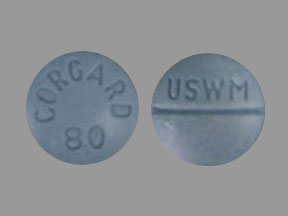
Corgard Side Effects
Generic name: nadolol
Medically reviewed by Drugs.com. Last updated on Jan 20, 2025.
Note: This document provides detailed information about Corgard Side Effects associated with nadolol. Some dosage forms listed on this page may not apply specifically to the brand name Corgard.
Applies to nadolol: oral tablet.
Important warnings
This medicine can cause some serious health issues
Oral route (tablet)
Following abrupt cessation of therapy with certain beta-blocking agents, exacerbations of angina pectoris and, in some cases, myocardial infarction have occurred.
The dosage should be gradually reduced over a period of 1 to 2 weeks and the patient should be carefully monitored when discontinuing chronic therapy, particularly in patients with ischemic heart disease.
If angina markedly worsens or acute coronary insufficiency develops, nadolol administration should be reinstated promptly, at least temporarily, and other measures appropriate for the management of unstable angina should be taken.
Patients should be warned against interruption or discontinuation of therapy without the physician's advice.
Precautions
It is very important that your doctor check your progress at regular visits to make sure this medicine is working properly and to check for unwanted effects .
Nadolol may cause heart failure in some patients. Check with your doctor right away if you are having chest pain or discomfort; dilated neck veins; extreme fatigue; irregular breathing; an irregular heartbeat; shortness of breath; swelling of the face, fingers, feet, or lower legs; weight gain; or wheezing .
This medicine may cause changes in your blood sugar levels. Also, this medicine may cover up signs of low blood sugar, such as a rapid pulse rate. Check with your doctor if you have these problems or if you notice a change in the results of your blood or urine sugar tests .
Make sure any doctor or dentist who treats you knows that you are using this medicine. You may need to stop using this medicine several days before having surgery .
Serious side effects of Corgard
Along with its needed effects, nadolol (the active ingredient contained in Corgard) may cause some unwanted effects. Although not all of these side effects may occur, if they do occur they may need medical attention.
Check with your doctor immediately if any of the following side effects occur while taking nadolol:
Less common side effects
- blurred vision
- chest pain or discomfort
- confusion
- dilated neck veins
- dizziness, faintness, or lightheadedness when getting up from a lying or sitting position suddenly
- extreme fatigue
- irregular breathing
- lightheadedness, dizziness, or fainting
- paleness or cold feeling in fingertips and toes
- shortness of breath
- slow or irregular heartbeat
- sweating
- swelling of face, fingers, feet, or lower legs
- tingling or pain in fingers or toes when exposed to cold
- unusual tiredness or weakness
- weight gain
- wheezing
Rare side effects
- burning, crawling, itching, numbness, prickling, "pins and needles", or tingling feelings
- changes in behavior
- cough
- difficulty breathing
- noisy breathing
- slurred speech
- tightness in chest
Other side effects of Corgard
Some side effects of nadolol may occur that usually do not need medical attention. These side effects may go away during treatment as your body adjusts to the medicine. Also, your health care professional may be able to tell you about ways to prevent or reduce some of these side effects.
Check with your health care professional if any of the following side effects continue or are bothersome or if you have any questions about them:
Rare side effects
- bloated
- continuing ringing or buzzing or other unexplained noise in ears
- decreased interest in sexual intercourse
- diarrhea
- difficulty having a bowel movement (stool)
- drowsiness
- dry mouth, eyes, or skin
- excess air or gas in stomach or intestines
- full feeling
- gas in stomach
- hair loss, thinning of hair
- headache
- hearing loss
- heartburn
- inability to have or keep an erection
- itching skin
- loss in sexual ability, desire, drive, or performance
- loss of appetite
- nausea
- passing gas
- rash
- relaxed and calm
- sleepiness
- stomach pain
- stomach soreness or discomfort
- stuffy nose
- vomiting
- weight loss
See also:
Lasix
Lasix is a loop diuretic used to treat fluid retention from heart, liver, or kidney conditions, and ...
Enalapril
Enalapril is used to treat high blood pressure, congestive heart failure and to improve survival ...
Ozempic
Learn about Ozempic (semaglutide) for type 2 diabetes treatment, weight management, cardiovascular ...
Valsartan
Valsartan is an angiotensin II receptor blocker (ARB) that may be used to treat high blood pressure ...
Hydrochlorothiazide
HCTZ (hydrochlorothiazide) used to treat high blood pressure (hypertension) and edema. Includes ...
Atenolol
Atenolol is used to treat angina (chest pain) and hypertension (high blood pressure). Learn about ...
Furosemide
Furosemide is a loop diuretic used to treat fluid retention and high blood pressure by increasing ...
Metoprolol
Metoprolol is used to treat angina (chest pain) and hypertension (high blood pressure). Learn about ...
Losartan
Losartan is used to treat high blood pressure (hypertension). It is also used to lower the risk of ...
Lisinopril
Lisinopril is an ACE inhibitor. It is used to treat high blood pressure, congestive heart failure ...
For healthcare professionals
Applies to nadolol: compounding powder, oral tablet.
General adverse events
The most common adverse reactions were bradycardia, cardiac failure, rhythm/conduction disturbances, symptoms of peripheral vascular insufficiency, hypotension, dizziness, and fatigue.[Ref]
Cardiovascular
- Common (1% to 10%): Heart rate less than 60 beats per minute (bpm), heart rate less than 40 bpm, cardiac failure, rhythm/conduction disturbances, symptoms of peripheral vascular insufficiency usually of the Raynaud type, hypotension
- Frequency not reported: First degree and third degree heart block, cold extremities[Ref]
Nervous system
- Common (1% to 10%): Dizziness
- Uncommon (0.1% to 1%): Paresthesias, sedation, headache, slurred speech, tinnitus
- Frequency not reported: Lightheadedness[Ref]
Other
- Common (1% to 10%): Fatigue[Ref]
Gastrointestinal
- Uncommon (0.1% to 1%): Nausea, diarrhea, abdominal discomfort, constipation, vomiting, indigestion, bloating, flatulence, dry mouth[Ref]
Dermatologic
- Uncommon (0.1% to 1%): Rash, pruritus, dry skin, sweating, facial swelling
- Frequency not reported: Reversible alopecia[Ref]
Respiratory
- Uncommon (0.1% to 1%): Cough, nasal stuffiness, bronchospasm[Ref]
Metabolic
- Uncommon (0.1% to 1%): Anorexia, weight gain
- Frequency not reported: Hypoglycemia[Ref]
Ocular
- Uncommon (0.1% to 1%): Dry eyes, blurred vision[Ref]
Psychiatric
- Uncommon (0.1% to 1%): Change in behavior
- Frequency not reported: Insomnia[Ref]
Genitourinary
References
1. (2002) "Product Information. Corgard (nadolol)." Bristol-Myers Squibb
2. Cerner Multum, Inc. "UK Summary of Product Characteristics."
More about Corgard (nadolol)
- Check interactions
- Compare alternatives
- Reviews (8)
- Drug images
- Dosage information
- During pregnancy
- Drug class: non-cardioselective beta blockers
- Breastfeeding
- En español
Patient resources
Professional resources
Related treatment guides
Further information
Corgard side effects can vary depending on the individual. Always consult your healthcare provider to ensure the information displayed on this page applies to your personal circumstances.
Note: Medication side effects may be underreported. If you are experiencing side effects that are not listed, submit a report to the FDA by following this guide.