Home CareNotes Hearing Loss
Thomson Reuters Micromedex

Hearing Loss

What is it?

Hearing Loss Care Guide

People who have hearing loss cannot hear well or do not hear at all. You may have hearing loss in one or both ears. Hearing loss can happen suddenly or slowly over time. Because hearing is often lost slowly, many people do not notice their hearing loss. They may learn of their hearing loss when family or friends notice or when a caregiver examines them. Hearing loss can occur at any age, but it is most common in people 60 years or older. Most people with hearing loss can be helped.

How does the ear work?

Your ears help you to hear and keep your balance. The ear is made up of three parts:

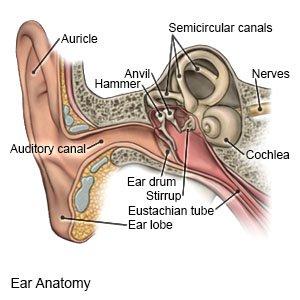
  • The outer ear is made up of the part you see on the side of your head and the outer ear canal. The outer ear canal is also called the external auditory (AW-di-tor-ee) canal. The outer ear catches sound waves and sends them to the tympanic (tim-PAH-nik) membrane, or eardrum. The eardrum is like a window that separates the outer ear from the middle ear.

  • The middle ear sends sound waves from the outer ear to the inner ear. Sound strikes the eardrum and is sent through three bones of the middle ear to the inner ear.

  • The inner ear is a fluid-filled pouch that is covered with bone. The cochlea (KOHK-lee-ah) is inside the inner ear and is the hearing organ. It contains many cells that can feel the fluid in the inner ear move. When the cells feel the fluid move, an impulse (or action) is started in the nervous system. The impulses travel through the hearing part of the nervous system and reach your brain.
Picture of a normal ear

What are the types of hearing losses?

  • Conductive hearing loss: This is a problem with the outer or middle ear. With conductive (kon-DUK-tiv) hearing loss, sound waves cannot reach the inner ear very well. Sometimes this hearing loss can be treated by removing the cause. Examples of this are removing earwax or an object, or treating an ear infection (in-FEK-shun) with medicine. Conductive hearing loss is often helped with medicine or surgery.

  • Sensorineural hearing loss: This is a problem with the inner ear. There may be problems with the nerve paths from the inner ear to the brain. There may be damage to parts of the inner ear. There is usually no cure for sensorineural (sen-sah-ree-NOOR-al) hearing loss. Most people with this type of hearing loss must use hearing aids or other devices to hear better.

  • Mixed hearing loss: With mixed hearing loss, a person has both conductive and sensorineural hearing loss.
  • Central auditory processing disorder: This is a problem in the brain. Sounds go through the ears. Nerves take the sound signals from the ears to the brain. When the brain gets the sound signals, it does not understand or know how to handle them correctly.

What are some common causes of hearing loss?

  • Aging. Hearing loss caused by aging is called presbycusis (pres-bee-KU-sis).

  • Blockage. The ear canal is blocked by an object, is full of earwax, or is swollen.

  • Certain medicines.

  • Congenital (kon-JEN-i-tl) problems. A baby may be born with this kind of hearing loss. This problem may be caused by the baby not getting enough oxygen while in his mother's uterus (womb). Certain medicines or infections (in-FEK-shuns) that the mother has during pregnancy may cause a congenital hearing loss. Infections such as herpes (HER-peez) or rubella may also cause a child to have a hearing loss.

  • Ear and head injury. You may have hearing loss because of a hole in your eardrum.

  • Ear infections (in-FEK-shuns) or fluid in the middle ear.

  • Meniere's (men-YARZ) disease. This is a hearing problem in which fluid in the inner ear increases.

  • Noise. You may have hearing loss because you have been around loud noises for long time periods.

  • Tumors that grow on or near the middle or inner ear.

  • Otosclerosis (oh-toh-skle-ROH-sis). With this problem, the small bones of the middle ear do not send sound normally.

What are the signs and symptoms of hearing loss in a child?

Take your child to a caregiver if you see one or more of the following:

  • A baby may not notice sounds around him, like shaking a rattle or making a loud sound.

  • Your child's speech does not sound normal for his age. Your child is old enough to talk, but he is not saying words yet.

  • Your child may sit close to the TV with the volume up. He may turn up the volume when listening to music.

  • Your child may move the telephone from ear to ear.

  • Your child may closely watch the faces and lips of others when talking to them.

  • Your child may say "what?" or "huh?" often.

  • Your child may not answer someone when the person is not in clear view.

What are the signs and symptoms that you may have hearing loss?

See your caregiver if you have one or more of the following:

  • You may ask others to repeat what they just said. You often think people are mumbling or they are not speaking clearly.

  • Family members may ask you if your hearing is OK.

  • You may cup your hand behind one of your ears when listening.

  • You may need to have the radio or television louder than usual.

  • You may need to lean forward or turn your head to be able to hear. You have a frown on your face as you try to hear.

  • You may not understand what people are saying because you are not hearing clearly.

  • You may have problems hearing people talk if there is loud background noise.

  • You may have dizziness, and ringing or buzzing in your ears.

  • You may not want to be around others because you have a hard time hearing.

How is hearing loss diagnosed?

Your caregiver will do tests to learn how well you can hear and listen. Your caregiver will look for problems in your outer, middle, and inner ear. Your caregiver will use an otoscope (OH-toh-skohp). This is an instrument that has a light and magnifying glass in it. Your caregiver will look at your ear canal and eardrum to see if they are OK. Your caregiver may put a tuning fork next to your ears or onto certain areas of your head. Many tests may be done to learn about hearing loss. Some common tests for hearing loss are:

  • Audiometry:

    • These tests may be called pure-tone audiometry (aw-dee-OM-e-tree) and speech audiometry. They help measure the faintest (most quiet) sounds or speech that you can hear. They help measure how well you can recognize (understand) words when spoken at a normal sound level. You will sit in a small soundproof (soundless) room. The room will have special panels on the ceiling, walls, and floor to make in very quiet. Caregivers will use a machine called an audiometer (aw-dee-OM-e-ter) during the tests.

    • The audiometer sends sounds that are high and low, and loud and soft, to your ears. The sounds will come through earphones that you wear, or through a small speaker in the room. Caregivers will test one of your ears, then the other. You may be asked to lift a hand or finger, or push a button when you hear a sound. You may be asked to repeat words or point to a picture when you hear words. Your caregivers may send sounds through a small vibrating button placed behind your ear or on your forehead. Your test results will be put on a chart called an audiogram (AW-dee-oh-gram).

  • Acoustic immittance measures: Acoustic (ah-KOOS-tik) immittance (ih-MIT-tans) measures are a group of tests. They can help caregivers learn more about your middle ear and eardrum. In a test called tympanometry (tim-pah-NOM-e-tree), caregivers put a small probe (tube) into your ear canal. They push air through the probe into your ear to learn how well your eardrum moves. Results of this test are put on a chart called a tympanogram (tim-PAN-oh-gram). This test can show fluid in the middle ear, a hole in the eardrum, or wax build-up. Other tests may measure the amount of air in your ear canal. They may measure the way a tiny muscle in your ear reacts to loud sounds.

How is hearing loss treated?

Your caregivers will use test results to help them understand about your hearing loss. Treatment will depend on the degree (how much hearing loss), cause, and type of hearing loss you have. You may have one or more of the following treatments:

  • Remove the cause of your hearing loss. For example, if your ear is plugged with earwax or an object, your caregiver will remove it. Caregivers may change or stop certain medicines if they think the medicines are causing your hearing loss.

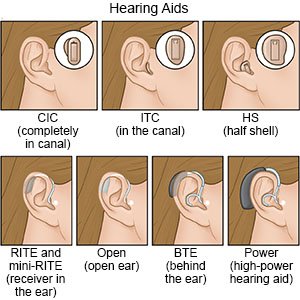
  • Hearing aids. A hearing aid is a small device that fits inside your ear. Hearing aids may help you hear better while you are wearing them. Work with your caregiver to decide which hearing aid is best for you.

  • Assistive listening devices (ALDs). These devices are like small radios that pick up sound and bring it to you. ALDs may help you hear better when watching TV, sitting in a classroom, or listening to a speaker. You may use earphones or a headset to receive (hear) the sound that the device sends to you. ALDs for phones and doorbells may use flashing lights or vibrators to let you know they are ringing. People with or without hearing aids may use ALDs to help them hear better.

  • Cochlear implant. This is a tiny device that is put into your cochlea (KOHK-lee-ah) (a part of your inner ear) during surgery. This device is only given to people with sensorineural hearing loss. These people are very hard of hearing in both ears, and are not helped by hearing aids.

  • Antibiotic medicine. This medicine may be given if you have an ear infection (in-FEK-shun) caused by bacteria (bak-TE-re-ah). Always take your antibiotics (an-ti-bi-OT-iks) exactly as ordered by your caregiver. Stopping antibiotics without your caregiver's OK may make the medicine unable to kill the germs causing your infection.

  • Surgery. If your hearing loss is caused by problems such as otosclerosis or a tumor, you may need surgery. People who need ear tubes to help prevent ear infections may also need surgery.

  • Therapy. You may need to work with a therapist (THER-ah-pist). A therapist is a specially trained caregiver who can help you with your speech and hearing.

Why do I need to try to correct my hearing loss?

Hearing affects your quality of life. Hearing loss not only affects you, but it affects those around you, like your family. Hearing loss can cause loneliness, depression, and unhappiness. Some people feel embarrassed that they cannot hear well, but it is better to tell your family and caregivers. Ask them to speak clearly and to face you when they are talking. Without treatment for hearing loss, you may have problems with learning, speaking, or at your workplace. Without treatment, hearing loss can be dangerous when you cannot hear alarms, sirens, phones or important announcements.

How can I help protect my hearing?

  • Protect your ears from loud noises. If you are doing an activity that will be very loud, use ear plugs or ear protectors. These activities include using a lawnmower and power tools, or going to a concert that has loud music. They include riding motorcycles or snowmobiles, or shooting guns, such as rifles at a shooting range.

  • Do not put cotton balls in your ears. They do not protect your ears from loud noise. Use foam earplugs. Your earplugs should fit so that your ear canal is completely blocked. If you are around very loud noises, be doubly careful. Use well-fitting earplugs, and also wear earmuffs that completely cover your outer ears.

  • Adjust your music or television volume (sound level) so that it is comfortable to hear, but not too loud. Do not listen to very loud music through headphones or earphones.

  • If you must be around short, loud noises, block your ears with clean fingertips during the noise.

Where can I go for support?

You may feel scared, confused, and anxious because of your hearing loss. You may blame yourself and think you have done something wrong. These feelings are normal. Talk about them with your caregiver or with someone close to you. Ask your caregiver about support groups for people with hearing loss. Such a group can give you support and information. Call or write the following organizations for more information.

  • American Hearing Research Foundation
    8 South Michigan Avenue, Suite 814
    Chicago , IL 60603-4539
    Phone: 1- 312 - 726-9670
    Web Address: http://www.american-hearing.org
  • American Speech-Language-Hearing Association
    10801 Rockville Pike
    Rockville , MD 20852
    Phone: 1- 800 - 638-8255
    Web Address: http://www.asha.org
  • Better Hearing Institute
    515 King Street, Suite 420
    Alexandria , VA 22314
    Phone: 1- 703 - 684-3391
    Web Address: www.betterhearing.org
  • Hear-It
    Web Address: http://www.hear-it.org

Care Agreement

You have the right to help plan your care. Learn about your health condition and how it may be treated. Discuss treatment options with your caregivers to decide what care you want to receive. You always have the right to refuse treatment.

Copyright © 2011. Thomson Reuters. All rights reserved. Information is for End User's use only and may not be sold, redistributed or otherwise used for commercial purposes.

The above information is an educational aid only. It is not intended as medical advice for individual conditions or treatments. Talk to your doctor, nurse or pharmacist before following any medical regimen to see if it is safe and effective for you.

Learn more about Hearing Loss

(web5)