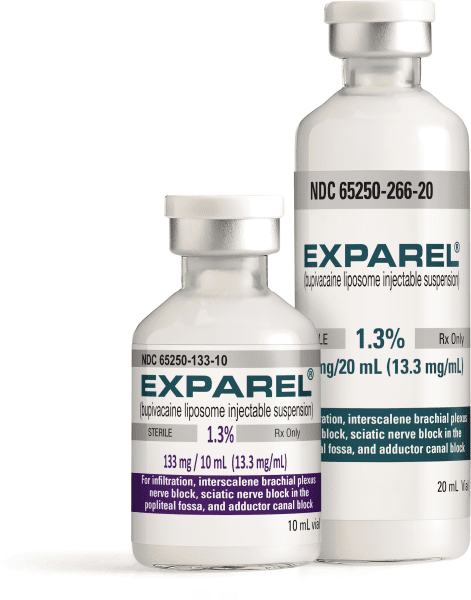
Bupivacaine Liposome Side Effects
Medically reviewed by Drugs.com. Last updated on Aug 9, 2024.
Applies to bupivacaine liposome: injection suspension.
Precautions
It is very important that your doctor check your progress closely after you receive this medicine to see if the medicine is working properly. Blood tests may be needed to check for any unwanted effects.
This medicine should not be given to women during labor (obstetrical paracervical block anesthesia).
This medicine may cause a rare, but serious blood problem called methemoglobinemia. The risk may be increased in elderly patients or patients with certain inborn defects. It is more likely to occur in patients receiving too much of the medicine, but can also occur with small amounts. Check with your doctor right away if you or your child has the following symptoms after receiving this medicine: pale, gray, or blue-colored skin, lips, or nails, confusion, headache, lightheadedness, fast heartbeat, or unusual tiredness or weakness.
Tell your doctor or nurse right away if you have the following symptoms with this medicine: anxiety, blurred vision, depression, drowsiness, lightheadedness, nausea or vomiting, numbness and tingling of the mouth or lips, restlessness, ringing in the ears, speech problems, or tremors.
This medicine may cause serious allergic reactions, including anaphylaxis, which can be life-threatening and require immediate medical attention. Call your doctor right away if you have a rash, itching, hoarseness, trouble breathing, trouble swallowing, or any swelling of your hands, face, mouth, or throat after receiving this medicine.
This medicine may make you dizzy or drowsy. Do not drive or do anything else that could be dangerous until you know how this medicine affects you.
This medicine may also increase your risk of having serious heart and blood vessel problems (eg, heart attack, heart rhythm changes, or low blood pressure). Check with your doctor if you have chest pain or discomfort, pain or discomfort in the arms, jaw, back, or neck, dizziness, fainting, pounding, slow heartbeat, trouble breathing, or unusual tiredness or weakness.
Check with your doctor if you have joint pain, stiffness, or loss of motion of the shoulder. This may be symptoms of a serious bone or joint problem called chondrolysis.
Check with your doctor before receiving this medicine with other medicines that affect the central nervous system (CNS). The use of other medicines that affect the CNS with bupivacaine liposome injection may worsen the side effects of this medicine, including dizziness, poor concentration, drowsiness, unusual dreams, and trouble with sleeping. Some examples of medicines that affect the CNS are antihistamines or medicine for allergies or colds, sedatives, tranquilizers, or sleeping medicines, medicine for depression, medicine for anxiety, prescription pain medicine or narcotics, medicine for attention deficit and hyperactivity disorder, medicine for seizures or barbiturates, or muscle relaxants.
Do not take other medicines unless they have been discussed with your doctor. This includes prescription or nonprescription (over-the-counter [OTC]) medicines and herbal or vitamin supplements.
Serious side effects
Along with its needed effects, bupivacaine liposome may cause some unwanted effects. Although not all of these side effects may occur, if they do occur they may need medical attention.
Check with your doctor or nurse immediately if any of the following side effects occur while taking bupivacaine liposome:
More common side effects
- blurred vision
- chills
- confusion
- dizziness, faintness, or lightheadedness when getting up suddenly from a lying or sitting position
- fast, pounding, or irregular heartbeat or pulse
- fever
- sweating
Less common side effects
- bloating or swelling of the face, arms, hands, lower legs, or feet
- burning, crawling, itching, numbness, prickling, "pins and needles", or tingling feelings
- chest pain or discomfort
- collection of blood under the skin
- decrease in frequency of urination
- decrease in urine volume
- deep, dark purple bruise
- difficulty in passing urine (dribbling)
- dry mouth
- headache
- increased thirst
- irregular heartbeat
- itching, pain, redness, or swelling
- loss of appetite
- mood changes
- muscle pain, cramp, spasm, or twitching
- nausea
- nervousness
- painful urination
- pale skin
- pounding in the ears
- rapid weight gain
- seizures
- slow or fast heartbeat
- tingling of the hands or feet
- trouble breathing
- unusual bleeding or bruising
- unusual weight gain or loss
- vomiting
Incidence not known
- loss of consciousness
- no blood pressure or pulse
- stopping of the heart
- weakness of the muscles in your face
Other side effects
Some side effects of bupivacaine liposome may occur that usually do not need medical attention. These side effects may go away during treatment as your body adjusts to the medicine. Also, your health care professional may be able to tell you about ways to prevent or reduce some of these side effects.
Check with your health care professional if any of the following side effects continue or are bothersome or if you have any questions about them:
More common side effects
- motor dysfunction
- trouble sleeping
Less common side effects
- anxiety
- belching
- change in taste
- constipation
- decreased appetite
- falls
- feeling hot
- heartburn
- hiccups
- indigestion
- itching in the genitals or other skin areas
- loss of taste
- scaling
- seeing double
- sensory loss
- stomach discomfort, upset, or pain
- swelling at the surgical site
Rare side effects
- increased sweating
See also:
For healthcare professionals
Applies to bupivacaine liposome: injectable suspension.
General adverse events
The most common adverse reactions reported when administration was via infiltration were nausea, vomiting, and dizziness; when administration was via nerve block, common adverse reactions have included nausea, pyrexia, and constipation.[Ref]
Nervous system
- Very common (10% or more): Dizziness (up to 11.3%), motor dysfunction (14.9%)
- Common (1% to 10%): Headache, somnolence, hypoesthesia, syncope, dysgeusia, sensory loss
- Frequency not reported: Tremor, dizziness postural, paresthesia, syncope, tinnitus, sedation, somnolence, convulsions[Ref]
Convulsions have been reported following accidental intravascular injection of this drug and other amide-containing products.[Ref]
Gastrointestinal
- Very common (10% or more): Nausea (up to 40.2%), vomiting (up to 27.8%), constipation (up to 22%)
- Common (1% to 10%): Anal hemorrhage, painful defecation, rectal discharge, hypoesthesia oral
- Frequency not reported: Procedural nausea[Ref]
Dermatologic
- Very common (10% or more): Pruritus (up to 15%)
- Common (1% to 10%): Pruritus generalized, hyperhidrosis,
- Frequency not reported: Erythema, rash pruritic, cold sweat, urticaria, cellulitis, wound dehiscence, wound secretion, blister, drug eruption, erythema, rash, hematoma[Ref]
Psychiatric
- Common (1% to 10%): Insomnia, confusional state
- Frequency not reported: Anxiety, depression, agitation, restlessness[Ref]
Cardiovascular
- Common (1% to 10%): Hypotension, tachycardia, sinus tachycardia, bradycardia, peripheral edema, hypertension
- Frequency not reported: Bradycardia, procedural hypertension, procedural hypotension, palpitations, sinus bradycardia, supraventricular extrasystoles, ventricular extrasystoles, ventricular tachycardia, blood pressure increased, blood pressure decreased, pallor, arrhythmia, atrial fibrillation, atrioventricular block first degree, bundle branch block left, bundle branch block right, cardiac arrest, deep vein thrombosis, orthostatic hypotension, electrocardiogram QT prolonged, presyncope, syncope[Ref]
Cardiac arrest has been reported following accidental intravascular injection of this drug and other amide-containing products.[Ref]
Hypersensitivity
- Rare (less than 0.1%): Allergic-type reactions[Ref]
Other
- Very common (10% or more): Pyrexia (up to 23.3%)
- Common (1% to 10%): Procedural pain, lethargy, body temperature increased, feeling hot, post-procedural swelling, fatigue, fall
- Frequency not reported: Chills, pain, edema, hearing impaired, asthenia[Ref]
Hematologic
- Common (1% to 10%): Anemia, anemia postoperative, hemorrhagic anemia, postprocedural hematoma
- Frequency not reported: White blood cell count increased[Ref]
Hepatic
- Common (1% to 10%): Alanine aminotransferase increased, aspartate aminotransferase increased, increased hepatic enzyme
Musculoskeletal
- Common (1% to 10%): Muscle spasms, back pain, muscle twitching
- Frequency not reported: Muscular weakness, neck pain, arthralgia, back pain, joint swelling, mobility decreased, muscle spasms, muscular weakness, musculoskeletal pain[Ref]
Immunologic
- Common (1% to 10%): Fungal infection[Ref]
Metabolic
- Common (1% to 10%): Appetite decreased
- Frequency not reported: Oxygen saturation decreased, hypokalemia[Ref]
Renal
- Common (1% to 10%): Blood creatinine increased[Ref]
Respiratory
- Common (1% to 10%): Hiccups, hypoxia
- Frequency not reported: Laryngospasm, apnea, respiratory depression, respiratory failure, lung infection, pneumonia, cough, dyspnea, lung infiltration, atelectasis[Ref]
Genitourinary
- Frequency not reported: Urinary retention, urinary incontinence, dysuria[Ref]
Local
- Frequency not reported: Incision site edema[Ref]
Ocular
- Frequency not reported: Vision blurred, visual impairment[Ref]
References
1. Cerner Multum, Inc. "UK Summary of Product Characteristics."
2. (2011) "Product Information. Exparel (BUPivacaine liposome)." Pacira Pharmaceuticals Inc
More about bupivacaine liposome
- Check interactions
- Compare alternatives
- Reviews (83)
- Dosage information
- During pregnancy
- Drug class: local injectable anesthetics
- En español
Patient resources
Other brands
Related treatment guides
Further information
Bupivacaine liposome side effects can vary depending on the individual. Always consult your healthcare provider to ensure the information displayed on this page applies to your personal circumstances.
Note: Medication side effects may be underreported. If you are experiencing side effects that are not listed, submit a report to the FDA by following this guide.