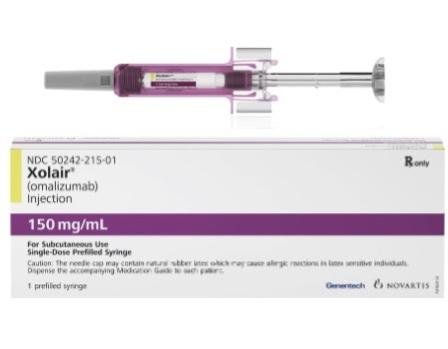
Omalizumab Side Effects
Applies to omalizumab: subcutaneous powder for solution, subcutaneous solution.
Important warnings
This medicine can cause some serious health issues
Subcutaneous route (powder for solution; solution)
Anaphylaxis. Anaphylaxis presenting as bronchospasm, hypotension, syncope, urticaria, and/or angioedema of the throat or tongue, has been reported to occur after administration of omalizumab. Anaphylaxis has occurred as early as after the first dose of omalizumab, but also has occurred beyond 1 year after beginning regularly administered treatment.
Because of the risk of anaphylaxis, initiate omalizumab therapy in a healthcare setting and closely observe patients for an appropriate period of time after omalizumab administration.
Health care providers administering omalizumab should be prepared to manage anaphylaxis which can be life-threatening.
Inform patients of the signs and symptoms of anaphylaxis and instruct them to seek immediate medical care should symptoms occur.
Selection of patients for self-administration of omalizumab should be based on criteria to mitigate risk from anaphylaxis.
Precautions
It is very important that your doctor check your or your child's progress at regular visits. This will allow your doctor to see if the medicine is working properly and to decide if you should continue to receive it. Blood tests and other exams may be needed to check for unwanted effects.
If you stop receiving omalizumab injections, your symptoms can be expected to return.
You may not see immediate improvement in your asthma after omalizumab treatment begins. It takes time for the medicine to work. It is important to continue your omalizumab injections until your doctor tells you otherwise.
This medicine may cause a serious type of allergic reaction called anaphylaxis, which can be life-threatening and requires immediate medical attention. Anaphylaxis may occur right away or up to 4 days after receiving this medicine. Tell your doctor right away if you or your child have a rash, cough, chest tightness, trouble breathing, lightheadedness, dizziness, fainting, rapid or weak heartbeat, anxiety, flushing, itching, hives, feeling warm, swelling of the throat or tongue, throat tightness, hoarseness, or trouble swallowing after receiving this medicine.
A rare but serious condition called eosinophilia (increased white blood cells in the body) may occur while you are receiving this medicine. A condition called vasculitis (inflammation of the blood vessels) may also be present. Eosinophilia can be serious and requires immediate medical attention. Tell your doctor right away if you or your child have worsening lung symptoms, rash or bruising of the skin, fever, chest pain, or burning, tingling, or numbness in the hands and feet after receiving this medicine.
Your doctor will ask you or your child to remain at the healthcare facility or clinic for at least 2 hours after each injection to watch for immediate side effects that can be serious.
Some patients who are receiving this medicine may have fever, rash, or muscle or joint pain. Tell your doctor right away if you or your child have any of these symptoms.
Using this medicine may increase your risk of getting certain cancers or infections. Talk to your doctor if you or your child have concerns about this risk.
The needle cap of the prefilled syringe contains dry natural rubber (a derivative of latex), which may cause allergic reactions in people who are sensitive to latex. Tell your doctor if you have a latex allergy before receiving this medicine.
Before you have any medical tests, tell the medical doctor in charge that you are taking this medicine. The results of some tests may be affected by this medicine.
Common side effects of omalizumab
Some side effects of omalizumab may occur that usually do not need medical attention. These side effects may go away during treatment as your body adjusts to the medicine. Also, your health care professional may be able to tell you about ways to prevent or reduce some of these side effects.
Check with your health care professional if any of the following side effects continue or are bothersome or if you have any questions about them:
More common side effects
- bleeding, blistering, burning, coldness, discoloration of skin, feeling of pressure, hives, infection, inflammation, itching, lumps, numbness, pain, rash, redness, scarring, soreness, stinging, swelling, tenderness, tingling, ulceration, or warmth at the injection site
- body aches or pain
- cold or flu-like symptoms
- congestion
- dryness or soreness of the throat
- headache
- hoarseness
- leg pain
- lumps
- pain or tenderness around the eyes and cheekbones
- stuffy or runny nose
- voice changes
Less common side effects
- arm pain
- cracked, dry, or scaly skin
- earache
Incidence not known
- hair loss
Serious side effects of omalizumab
Along with its needed effects, omalizumab may cause some unwanted effects. Although not all of these side effects may occur, if they do occur they may need medical attention.
Check with your doctor or nurse immediately if any of the following side effects occur while taking omalizumab:
Less common side effects
- blistering, crusting, irritation, itching, or reddening of the skin
- body produces substance that can bind to drug making it less effective or cause side effects
- difficulty in moving
- muscle pain or stiffness
- pain in the joints
- stomach pain
Rare side effects
- chest tightness
- cough
- difficulty with swallowing
- dizziness
- fast heartbeat
- hives, itching, or skin rash
- malignant tumor
- puffiness or swelling of the eyelids or around the eyes, face, lips, or tongue
- unusual tiredness or weakness
Incidence not known
- black, tarry stools
- bleeding gums
- blood in the urine or stools
- chest pain
- chills
- fever
- painful or difficult urination
- pinpoint red spots on the skin
- sore throat
- sores, ulcers, or white spots on the lips or in the mouth
- swollen glands
- unusual bleeding or bruising
See also:
Nucala
Nucala is used to treat severe eosinophilic asthma, eosinophilic COPD, chronic rhinosinusitis with ...
Zyrtec
Zyrtec (cetirizine) is used to treat allergy symptoms such as sneezing, itching, watery eyes, or ...
Dupixent
Dupixent is used to treat eczema, eosinophilic or oral-corticosteroid-dependent asthma, chronic ...
Benadryl
Benadryl is an antihistamine and is used to treat sneezing, runny nose, itching and other ...
Claritin
Claritin is an antihistamine used to treat the symptoms of allergies, such as sneezing, watery ...
Xolair
Xolair injection (omalizumab) is used to help improve allergic asthma, nasal polyps, and chronic ...
Fexofenadine
Fexofenadine is an antihistamine that may be used to treat allergies.
Doxepin
Doxepin is used for anxiety, depression, insomnia, irritable bowel syndrome, major depressive ...
Promethazine
Promethazine is a phenothiazine and antihistamine used to treat allergies, motion sickness, nausea ...
Diphenhydramine
Diphenhydramine is an antihistamine used to treat sneezing, runny nose, itching, hives and other ...
For healthcare professionals
Applies to omalizumab: subcutaneous powder for injection, subcutaneous solution.
General adverse events
The more commonly reported side effects included injection site reactions, headache, and nasopharyngitis.[Ref]
Local
- Very common (10% or more): Any injection site reaction, including pain, swelling, itching, redness, bruising, bleeding, induration, or mass (up to 45%), severe injection site reaction (up to 12%)
- Uncommon (0.1% to 1%): Arm swelling[Ref]
In clinical trials, any injection site reaction occurred in 45% and 43% of patients given this drug and placebo, respectively; severe reactions occurred in 12% and 9%, respectively.[Ref]
Immunologic
- Very common (10% or more): Viral infection (up to 37%)
- Uncommon (0.1% to 1%): Moniliasis, parasitic infection
- Rare (0.01% to 0.1%): Anti-omalizumab antibody development
- Postmarketing reports: Serum sickness, allergic granulomatous angiitis (Churg-Strauss syndrome), lymphadenopathy[Ref]
In clinical studies, viral infection occurred in 37% and 39% or patients given this drug or placebo, respectively. Increased parasitic infections, compared to placebo, were not statistically significant.[Ref]
Nervous system
- Very common (10% or more): Headache (up to 27%)
- Common (1% to 10%): Dizziness
- Uncommon (0.1% to 1%): Syncope, vasovagal syncope, somnolence, paresthesia
- Frequency not reported: Migraine, sinus headache[Ref]
In clinical trials, headache occurred in 37% of patients given either this drug (n=716) or placebo (n=694); headache occurred very commonly in patients 6 to 12 years old.[Ref]
Musculoskeletal
- Very common (10% or more): Back pain (up to 13%)
- Common (1% to 10%): Arthralgia, myalgia, sprains, strains, extremity pain, fracture
- Postmarketing reports: Joint swelling[Ref]
Respiratory
- Common (1% to 10%): Nasopharyngitis, sinusitis, viral upper respiratory infection (URI), URI
- Uncommon (0.1% to 1%): Pharyngitis, cough, allergic bronchospasm
- Rare (0.01% to 0.1%): Laryngoedema
- Frequency not reported: Asthma, oropharyngeal pain[Ref]
In clinical trials with chronic idiopathic urticarial, patients reported nasopharyngitis 9.1%, 6.6%, and 7% in 150 mg, 300 mg, and placebo, respectively; sinusitis (1.1%, 4.9%, 2.1%), cough (1.1%, 2.2%,1.2%), and upper respiratory infection (11.1%, 3.4%, 2.1%) were also reported by patients, respectively.[Ref]
Dermatologic
- Common (1% to 10%): Dermatitis, pruritus
- Uncommon (0.1% to 1%): Skin rashes, flushing, photosensitivity
- Postmarketing reports: Alopecia, hair loss[Ref]
Other
- Common (1% to 10%): Fever, earache
- Uncommon (0.1% to 1%): Fatigue, post-injection phenomena[Ref]
In clinical trials, fever occurred very commonly in patients 6 to 12 years old.[Ref]
Gastrointestinal
- Common (1% to 10%): Upper abdominal pain, nausea
- Uncommon (0.1% to 1%): Diarrhea, dyspepsia, gastroenteritis
- Frequency not reported: Toothache[Ref]
In clinical trials, upper abdominal pain was very common in patients 6 to 12 years old. In clinical trials with chronic idiopathic urticarial, patients reported nausea 1.1%, 2.7%, and 2.5% of the time with 150 mg, 300 mg, and placebo, respectively.[Ref]
Genitourinary
- Common (1% to 10%): Urinary tract infection[Ref]
Hypersensitivity
- Uncommon (0.1% to 1%): Urticaria
- Rare (0.01% to 0.1%): Anaphylactic reactions, angioedema
- Postmarketing reports: Anaphylactoid reactions[Ref]
Cardiovascular
- Uncommon (0.1% to 1%): Postural hypotension
- Frequency not reported: Peripheral edema, arterial thrombotic events (including transient ischemic attack, myocardial infarction, unstable angina, and cardiovascular death)
- Postmarketing reports: Hypotension, chest tightness[Ref]
Hematologic
- Uncommon (0.1% to 1%): Asymptomatic platelet decreases
- Postmarketing reports: Idiopathic severe thrombocytopenia, eosinophilic conditions[Ref]
In clinical trials, 0.6% of patients developed decreased platelet counts below the normal laboratory range; these patients did not have associated bleeding episodes or decreased hemoglobin.[Ref]
Metabolic
- Uncommon (0.1% to 1%): Weight increases[Ref]
Psychiatric
- Frequency not reported: Anxiety[Ref]
References
1. (2003) "Product Information. Xolair (omalizumab)." Genentech
2. Cerner Multum, Inc. "UK Summary of Product Characteristics."
3. Cerner Multum, Inc. "Australian Product Information."
Frequently asked questions
- What are the most common skin conditions? (with photos)
- Is Xolair an immunosuppressant?
- How long before Xolair starts working?
- How does Xolair work?
- Does Xolair cause weight gain?
- What is omalizumab's mechanism of action?
- Can Xolair be self-administered at home?
- Omalizumab and Covid-19 vaccine, what should I know?
- What is Xolair approved for?
More about omalizumab
- Check interactions
- Compare alternatives
- Reviews (266)
- Dosage information
- During pregnancy
- Support group
- Drug class: selective immunosuppressants
- Breastfeeding
- En español
Patient resources
Other brands
Professional resources
Other brands
Related treatment guides
Further information
Omalizumab side effects can vary depending on the individual. Always consult your healthcare provider to ensure the information displayed on this page applies to your personal circumstances.
Note: Medication side effects may be underreported. If you are experiencing side effects that are not listed, submit a report to the FDA by following this guide.