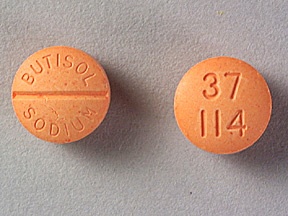
Butabarbital (Oral)
Generic name: butabarbital [ bue-ta-BAR-bi-tal-SOE-dee-um ]
Brand name: Butisol Sodium
Drug class: Barbiturates
Medically reviewed by Drugs.com. Last updated on Oct 1, 2024.
Uses for butabarbital
Butabarbital is used to treat insomnia (trouble sleeping). It is also used before a surgical procedure to make a person sleep (be unconscious).
Butabarbital belongs to the group of medicines called barbiturates. They act in the central nervous system (CNS) to slow down the nervous system. When used to treat insomnia, butabarbital will help you get to sleep faster and sleep throughout the night. In most cases, sleep medicines should only be used for short periods of time, such as 1 or 2 days, and for no longer than 1 or 2 weeks.
This medicine is available only with your doctor's prescription.
Before using butabarbital
In deciding to use a medicine, the risks of taking the medicine must be weighed against the good it will do. This is a decision you and your doctor will make. For this medicine, the following should be considered:
Allergies
Tell your doctor if you have ever had any unusual or allergic reaction to this medicine or any other medicines. Also tell your health care professional if you have any other types of allergies, such as to foods, dyes, preservatives, or animals. For non-prescription products, read the label or package ingredients carefully.
Pediatric
Appropriate studies to date have not demonstrated pediatric-specific problems that would limit the usefulness of butabarbital in children when used before a surgical procedure. However, safety and efficacy have not been established in children to treat insomnia.
Geriatric
Appropriate studies performed to date have not demonstrated geriatric-specific problems that would limit the usefulness of butabarbital in the elderly. However, elderly patients are more sensitive to the effects of this medicine and are more likely to have age-related liver or kidney problems, which may require caution and an adjustment in the dose for patients receiving this medicine.
Breast Feeding
There are no adequate studies in women for determining infant risk when using this medication during breastfeeding. Weigh the potential benefits against the potential risks before taking this medication while breastfeeding.
Interactions with Medicines
Although certain medicines should not be used together at all, in other cases two different medicines may be used together even if an interaction might occur. In these cases, your doctor may want to change the dose, or other precautions may be necessary. When you are taking this medicine, it is especially important that your healthcare professional know if you are taking any of the medicines listed below. The following interactions have been selected on the basis of their potential significance and are not necessarily all-inclusive.
Using this medicine with any of the following medicines is usually not recommended, but may be required in some cases. If both medicines are prescribed together, your doctor may change the dose or how often you use one or both of the medicines.
- Alprazolam
- Amobarbital
- Anisindione
- Aprobarbital
- Barbital
- Benzhydrocodone
- Bromazepam
- Bromopride
- Buprenorphine
- Butalbital
- Butorphanol
- Calcium Oxybate
- Cannabidiol
- Cannabis
- Carbinoxamine
- Carisoprodol
- Cetirizine
- Chloral Hydrate
- Chlordiazepoxide
- Chlorzoxazone
- Clarithromycin
- Clonazepam
- Clorazepate
- Codeine
- Dantrolene
- Daridorexant
- Darunavir
- Dexmedetomidine
- Diazepam
- Dicumarol
- Dihydrocodeine
- Doxorubicin
- Doxorubicin Hydrochloride Liposome
- Doxylamine
- Drospirenone
- Estazolam
- Eterobarb
- Ethchlorvynol
- Ethinyl Estradiol
- Etonogestrel
- Fentanyl
- Flibanserin
- Flunitrazepam
- Flurazepam
- Fospropofol
- Gabapentin
- Gabapentin Enacarbil
- Halazepam
- Heptabarbital
- Hexobarbital
- Hydrocodone
- Hydromorphone
- Ketamine
- Ketazolam
- Lacosamide
- Lemborexant
- Levocetirizine
- Levorphanol
- Lofexidine
- Lorazepam
- Lormetazepam
- Loxapine
- Magnesium Oxybate
- Meclizine
- Medazepam
- Meperidine
- Mephenesin
- Mephobarbital
- Meprobamate
- Metaxalone
- Methadone
- Methocarbamol
- Methohexital
- Metoclopramide
- Midazolam
- Morphine
- Morphine Sulfate Liposome
- Nalbuphine
- Nifedipine
- Nitrazepam
- Norethindrone
- Norgestimate
- Norgestrel
- Olanzapine
- Oxazepam
- Oxycodone
- Oxymorphone
- Pentazocine
- Pentobarbital
- Periciazine
- Phenindione
- Phenobarbital
- Phenprocoumon
- Piperaquine
- Potassium Oxybate
- Prazepam
- Pregabalin
- Primidone
- Procarbazine
- Propofol
- Quazepam
- Remifentanil
- Remimazolam
- Ropeginterferon Alfa-2b-njft
- Scopolamine
- Secobarbital
- Sodium Oxybate
- Sufentanil
- Tapentadol
- Temazepam
- Thiopental
- Tolvaptan
- Topiramate
- Tramadol
- Triazolam
- Ulipristal
- Zolpidem
- Zuranolone
Using this medicine with any of the following medicines may cause an increased risk of certain side effects, but using both drugs may be the best treatment for you. If both medicines are prescribed together, your doctor may change the dose or how often you use one or both of the medicines.
- Ospemifene
- Prednisone
- St John's Wort
- Warfarin
Interactions with Food/Tobacco/Alcohol
Certain medicines should not be used at or around the time of eating food or eating certain types of food since interactions may occur. Using alcohol or tobacco with certain medicines may also cause interactions to occur. The following interactions have been selected on the basis of their potential significance and are not necessarily all-inclusive.
Using this medicine with any of the following may cause an increased risk of certain side effects but may be unavoidable in some cases. If used together, your doctor may change the dose or how often you use this medicine, or give you special instructions about the use of food, alcohol, or tobacco.
- Ethanol
Other Medical Problems
The presence of other medical problems may affect the use of this medicine. Make sure you tell your doctor if you have any other medical problems, especially:
- Alcohol abuse, history of or
- Asthma or
- Depression or
- Drug abuse, history of or
- Mental illness, history of or
- Patients with suicidal thoughts or behavior—Use with caution. May make these conditions worse.
- Kidney disease or
- Liver disease—Use with caution. The effects may be increased because of slower removal of the medicine from the body.
- Liver disease, severe (eg, hepatic coma) or
- Porphyria (enzyme problem), manifest or latent, history of—Should not be used in patients with these conditions.
- Patients with acute or chronic pain (except pain after surgery or chemotherapy)—Use with caution. May cause an opposite effect to one which is normally expected and mask symptoms of other unknown diseases.
Proper use of butabarbital
Take this medicine only as directed by your doctor. Do not take more of it, do not take it more often, and do not take it for a longer time than your doctor ordered. If too much is taken, it may become habit-forming (causing mental or physical dependence).
If you are using butabarbital to treat insomnia:
- Take it just before going to bed, when you are ready to go to sleep. This medicine works very quickly to put you to sleep.
- Do not take this medicine when your schedule does not permit you to get a full night's sleep (about 7 to 8 hours). If you must wake up before this, you may continue to feel drowsy and may experience memory problems, because the effects of the medicine have not had time to wear off.
Take this medicine on an empty stomach.
Shake the oral liquid well before each use. Measure the medicine with a marked measuring spoon, oral syringe, or medicine cup. The average household teaspoon may not hold the right amount of liquid.
Dosing
The dose of this medicine will be different for different patients. Follow your doctor's orders or the directions on the label. The following information includes only the average doses of this medicine. If your dose is different, do not change it unless your doctor tells you to do so.
The amount of medicine that you take depends on the strength of the medicine. Also, the number of doses you take each day, the time allowed between doses, and the length of time you take the medicine depend on the medical problem for which you are using the medicine.
- For oral dosage forms (solution, tablets):
- For daytime sleepiness:
- Adults—15 to 30 milligrams (mg) 3 or 4 times a day.
- Children—Use and dose must be determined by your doctor.
- For insomnia:
- Adults—50 to 100 milligrams (mg).
- Children—Use and dose must be determined by your doctor.
- For sleepiness before surgery:
- Adults—50 to 100 milligrams (mg), 60 to 90 minutes before surgery.
- Children—Dose is based on body weight and must be determined by your doctor. The dose is usually 2 to 6 mg per kilogram (kg) of body weight per day. However, the dose is not more than 100 mg per day.
- For daytime sleepiness:
Missed Dose
If you miss a dose of this medicine, take it as soon as possible. However, if it is almost time for your next dose, skip the missed dose and go back to your regular dosing schedule. Do not double doses.
If you use this medicine to treat insomnia, take it only when you cannot sleep. You do not need to keep a schedule for taking it.
Storage
Store the medicine in a closed container at room temperature, away from heat, moisture, and direct light. Keep from freezing.
Keep out of the reach of children.
Do not keep outdated medicine or medicine no longer needed.
Ask your healthcare professional how you should dispose of any medicine you do not use.
Precautions while using butabarbital
It is very important that your doctor check your progress at regular visits to make sure this medicine is working properly. Blood and urine tests may be needed to check for unwanted effects.
Using this medicine while you are pregnant can harm your unborn baby. Birth control pills may not work as well to prevent pregnancy when used with this medicine. Use another form of birth control (eg, condoms, spermicide) along with your pills. If you think you have become pregnant while using this medicine, tell your doctor right away.
If you think you need to take butabarbital for more than 7 to 10 days, be sure to discuss it with your doctor. Insomnia that lasts longer than this may be a sign of another medical problem.
Butabarbital may cause serious allergic reactions, including anaphylaxis and angioedema, which can be life-threatening and require immediate medical attention. Call your doctor right away if you have a rash, itching, hives, trouble breathing or swallowing, or any swelling of your hands, face, mouth, or throat while you are using this medicine.
This medicine contains a yellow dye called tartrazine, which may cause severe allergic reactions. Tell your doctor if you have any allergies, including an allergy to aspirin, or asthma.
This medicine will add to the effects of alcohol and other CNS depressants (medicines that make you drowsy or less alert). Some examples of CNS depressants are antihistamines or medicine for hay fever, other allergies, or colds, sedatives, tranquilizers, or sleeping medicine, prescription pain medicine or narcotics, medicine for seizures or barbiturates, muscle relaxants, or anesthetics, including some dental anesthetics. Check with your doctor before taking any of the above while you are using this medicine.
This medicine may cause some people, especially older persons, to become drowsy, dizzy, lightheaded, clumsy or unsteady, or less alert than they are normally, which may lead to falls. Even though butabarbital is taken at bedtime, it may cause some people to feel drowsy or less alert on arising. Do not drive or do anything else that could be dangerous until you know how this medicine affects you.
If you develop any unusual and strange thoughts or behavior while you are using butabarbital, be sure to discuss it with your doctor. Some changes that have occurred in people using this medicine are like those seen in people who drink alcohol and then act in a manner that is not normal. Other changes may be more unusual and extreme, such as confusion, worsening of depression, hallucinations (seeing, hearing, or feeling things that are not there), suicidal thoughts, and unusual excitement, nervousness, or irritability.
This medicine may cause you to do things while you are still asleep that you may not remember the next morning. It is possible you could drive a car, sleepwalk, have sex, make phone calls, or prepare and eat food while you are asleep or not fully awake. Tell your doctor right away if you learn that any of these has happened.
Do not change your dose or stop using it without first checking with your doctor. Your doctor may want you to gradually reduce the amount you are using before stopping completely. Stopping this medicine suddenly may cause withdrawal side effects.
If you think you or someone else may have taken an overdose of this medicine, get emergency help at once. Taking an overdose of butabarbital or taking alcohol or other CNS depressants with butabarbital may lead to serious breathing problems and unconsciousness. Some signs of an overdose include: severe drowsiness, severe nausea or vomiting, staggering, and troubled breathing.
Do not take other medicines unless they have been discussed with your doctor. This includes prescription or nonprescription (over-the-counter [OTC]) medicines and herbal or vitamin supplements.
Side Effects of butabarbital
Along with its needed effects, a medicine may cause some unwanted effects. Although not all of these side effects may occur, if they do occur they may need medical attention.
Check with your doctor immediately if any of the following side effects occur:
Rare
- Agitation
- bluish lips or skin
- blurred vision
- chest pain or discomfort
- confusion
- dark urine
- discouragement
- dizziness, faintness, or lightheadedness when getting up suddenly from a lying or sitting position
- extremely shallow or slow breathing
- false beliefs that cannot be changed by facts
- fast heartbeat
- feeling sad or empty
- fever
- hives, itching, skin rash
- hoarseness
- increase in body movements
- irritability
- joint pain, stiffness, or swelling
- lack of appetite
- large, hive-like swelling on face, eyelids, lips, tongue, throat, hands, legs, feet, or genitals
- light-colored stools
- lightheadedness, dizziness, or fainting
- loss of interest or pleasure
- mood or other mental changes
- nausea
- not breathing
- poor insight and judgment
- problems with memory or speech
- redness of the skin
- seeing, hearing, or feeling things that are not there
- shakiness and unsteady walk
- slow or irregular heartbeat
- stomach pain or bloating
- sweating
- swelling of the eyelids, face, lips, hands, or feet
- tightness in the chest
- trouble concentrating
- trouble recognizing objects
- trouble sleeping
- trouble thinking and planning
- trouble walking
- troubled breathing or swallowing
- unsteadiness, trembling, or other problems with muscle control or coordination
- unusual tiredness or weakness
- vomiting
- yellow eyes or skin
Get emergency help immediately if any of the following symptoms of overdose occur:
Symptoms of overdose
- Blurred vision
- chills
- cold, clammy skin
- confusion
- cool hands and feet
- decrease in the amount of urine
- difficult or troubled breathing
- dizziness, faintness, or lightheadedness when getting up suddenly from a lying or sitting position
- fast, pounding, or irregular heartbeat or pulse
- irregular, fast or slow, or shallow breathing
- irritability
- loss of consciousness
- pale or blue lips, fingernails, or skin
- poor judgment
- shivering
- slurred speech
- sweating
- trouble in walking
- trouble sleeping
- uncontrolled eye movements
Some side effects may occur that usually do not need medical attention. These side effects may go away during treatment as your body adjusts to the medicine. Also, your health care professional may be able to tell you about ways to prevent or reduce some of these side effects. Check with your health care professional if any of the following side effects continue or are bothersome or if you have any questions about them:
Less common
- Sleepiness or unusual drowsiness
Rare
- Constipation
- headache
- nervousness
- nightmares
Other side effects not listed may also occur in some patients. If you notice any other effects, check with your healthcare professional.
Call your doctor for medical advice about side effects. You may report side effects to the FDA at 1-800-FDA-1088.
Related/similar drugs
Commonly used brand name(s)
In the U.S.
- Butisol Sodium
Available Dosage Forms:
- Tablet
Therapeutic Class: Sedative
Pharmacologic Class: Butabarbital
More about butabarbital
- Check interactions
- Compare alternatives
- Reviews (5)
- Side effects
- Dosage information
- During pregnancy
- Drug class: barbiturates
- Breastfeeding
Patient resources
Other brands
Related treatment guides
Further information
Always consult your healthcare provider to ensure the information displayed on this page applies to your personal circumstances.