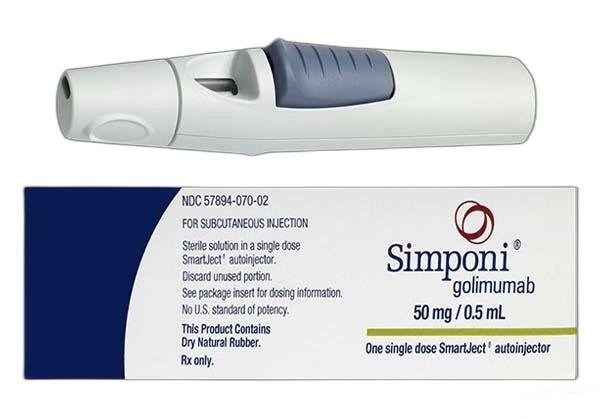
Golimumab
Generic name: golimumab [ goe-LIM-ue-mab ]
Brand names: Simponi, Simponi Aria, Simponi SmartJect
Dosage forms: intravenous solution (50 mg/4 mL), subcutaneous solution (100 mg/mL; 50 mg/0.5 mL)
Drug class: TNF alfa inhibitors
What is golimumab?
Golimumab is used to treat rheumatoid arthritis and ankylosing spondylitis in adults.
Golimumab is also used alone or in combination with other medicines to treat psoriatic arthritis and polyarticular juvenile idiopathic arthritis in adults and children at least 2 years old.
Golimumab is also used alone or in combination with other medicines to treat ulcerative colitis in adults when other medicines have not worked or could not be tolerated.
Golimumab may also be used for purposes not listed in this medication guide.
Golimumab side effects
Get emergency medical help if you have signs of an allergic reaction: hives, difficult breathing, swelling of your face, lips, tongue, or throat.
You may get infections more easily, even serious or fatal infections. Call your doctor right away if you have signs of infection such as:
-
fever, chills, sweating, muscle aches, feeling very tired;
-
cough, bloody mucus, shortness of breath;
-
painful skin sores, warmth, or redness;
-
diarrhea, stomach pain; or
-
increased urination, or burning when you urinate.
Also call your doctor at once if you have:
-
skin growths or changes in skin appearance;
-
swelling in your lower legs;
-
vision changes;
-
numbness or tingly feeling, weakness in your arms or legs;
-
heart problems--swelling, rapid weight gain, feeling short of breath;
-
low blood cell counts--fever, chills, tiredness, mouth sores, skin sores, easy bruising, unusual bleeding, pale skin, cold hands and feet, feeling light-headed or short of breath;
-
liver problems--loss of appetite, stomach pain (upper right side), tiredness, itching, dark urine, clay-colored stools, jaundice (yellowing of the skin or eyes);
-
new or worsening symptoms of lupus--joint pain, and a skin rash on your cheeks or arms that worsens in sunlight; or
-
signs of psoriasis--red or scaly patches of skin, flaking, pus.
Common side effects of golimumab may include:
-
cold symptoms such as stuffy nose, sneezing, sore throat;
-
abnormal liver function tests;
-
skin rash;
-
low blood cell counts; or
-
pain, itching, redness, bruising, tingling or swelling where the medicine was injected.
This is not a complete list of side effects and others may occur. Call your doctor for medical advice about side effects. You may report side effects to FDA at 1-800-FDA-1088.
Related/similar drugs
Warnings
You may get infections more easily, even serious or fatal infections. Call your doctor if you have flu symptoms, cough, night sweats, neck stiffness, confusion, or vision problems.
If you have ever had tuberculosis or hepatitis B, golimumab can cause these conditions to come back or get worse. You should be tested for these conditions before you start golimumab. Your doctor may need to monitor you for signs and symptoms during treatment.
Before taking this medicine
You should not use golimumab if you are allergic to rubber or latex.
Tell your doctor if you have or ever had:
-
an active or chronic infection;
-
a nerve-muscle disorder such as multiple sclerosis or Guillain-Barré syndrome;
-
cancer or lymphoma;
-
congestive heart failure;
-
psoriasis; or
-
recently received or scheduled to receive a live vaccine.
Tell your doctor if you've had or been exposed to tuberculosis, or if you recently traveled. Some infections are more common in certain parts of the world, and you may have been exposed during travel.
Using golimumab may increase your risk of developing other cancers. Ask your doctor about this risk.
It is not known if golimumab will harm an unborn baby. Tell your doctor if you are pregnant or plan to become pregnant.
Tell your baby's doctor if you used golimumab during pregnancy. It could affect your baby's vaccination schedule during the first 6 months of life.
Ask a doctor if it is safe to breastfeed while using this medicine.
How should I use golimumab?
Follow all directions on your prescription label and read all medication guides or instruction sheets. Use the medicine exactly as directed.
If you have ever had tuberculosis or hepatitis B, golimumab can cause these conditions to come back or get worse. You should be tested for these conditions before you start golimumab. Your doctor may need to monitor you for signs and symptoms during treatment.
Golimumab is sometimes given as an infusion into a vein. A healthcare provider will give you this type of injection once every 4 to 8 weeks.
Golimumab may also be injected under the skin once every 2 to 4 weeks. You may be able to give this injection to yourself.
Your healthcare provider will show you where to inject golimumab. Do not inject into the same place two times in a row.
Ask your doctor or pharmacist if you don't understand how to use an injection.
Prepare an injection only when you are ready to give it. Call your pharmacist if the medicine looks cloudy, has changed colors or has particles in it.
Golimumab can weaken your immune system. Your blood will need to be tested often.
Store this medicine in its original container in the refrigerator, do not freeze. Protect from light.
Take the medicine out of the refrigerator and let it reach room temperature for 30 minutes before using. Do not warm the medicine with hot water, sunlight, or a microwave.
Throw away a prefilled syringe or auto-injector after one use, even if there is still medicine left inside.
Do not reuse a needle or syringe. Place them in a puncture-proof "sharps" container and dispose of it following state or local laws. Keep out of the reach of children and pets.
What happens if I miss a dose?
Call your doctor for instructions if you miss a dose.
What happens if I overdose?
Seek emergency medical attention or call the Poison Help line at 1-800-222-1222.
What should I avoid while using golimumab?
Avoid receiving a "live" vaccine, or you could develop a serious infection. Live vaccines include measles, mumps, rubella (MMR), rotavirus, typhoid, yellow fever, varicella (chickenpox), and zoster (shingles).
What other drugs will affect golimumab?
Sometimes it is not safe to use certain medicines at the same time. Some drugs can affect your blood levels of other drugs you use, which may increase side effects or make the medicines less effective.
Tell your doctor about all your other medicines, especially:
-
anakinra;
-
abatacept, etanercept; or
-
adalimumab, certolizumab, infliximab, rituximab, or tocilizumab.
This list is not complete. Other drugs may affect golimumab, including prescription and over-the-counter medicines, vitamins, and herbal products. Not all possible drug interactions are listed here.
Golimumab Biosimilars
Biosimilar and interchangeable products are biological products that are highly similar to and have no clinically meaningful differences from the reference product.
Reference products
These are biological products that have already been approved by the FDA, against which biosimilar products are compared. There are 2 for golimumab.
Simponi (golimumab) - Janssen Biotech, Inc.
| Formulation type | Strength |
|---|---|
| Autoinjector | 100 mg/mL |
| Autoinjector | 50 mg/0.5 mL |
| Pre-Filled Syringe | 100 mg/mL |
| Pre-Filled Syringe | 50 mg/0.5 mL |
View Simponi information in detail.
Simponi Aria (golimumab) - Janssen Biotech, Inc.
| Formulation type | Strength |
|---|---|
| Single-Dose Vial | 50 mg/4 mL (12.5 mg/mL) |
View Simponi Aria information in detail.
Frequently asked questions
More about golimumab
- Check interactions
- Compare alternatives
- Reviews (157)
- Side effects
- Dosage information
- During pregnancy
- Drug class: TNF alfa inhibitors
- Breastfeeding
- En español
Patient resources
Other brands
Professional resources
Other brands
Related treatment guides
Further information
Remember, keep this and all other medicines out of the reach of children, never share your medicines with others, and use this medication only for the indication prescribed.
Always consult your healthcare provider to ensure the information displayed on this page applies to your personal circumstances.
Copyright 1996-2025 Cerner Multum, Inc. Version: 8.01.