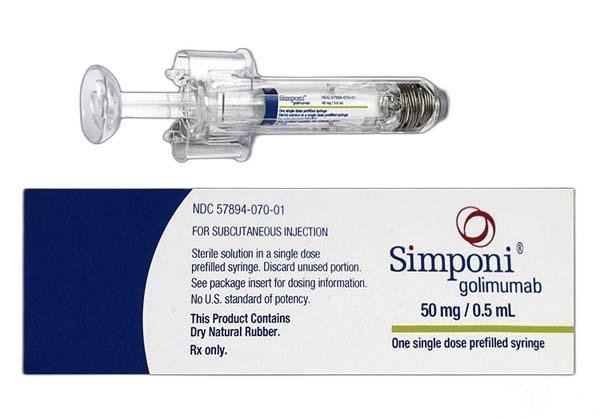
Simponi Side Effects
Generic name: golimumab
Note: This document provides detailed information about Simponi Side Effects associated with golimumab. Some dosage forms listed on this page may not apply specifically to the brand name Simponi.
Applies to golimumab: solution.
Important warnings
This medicine can cause some serious health issues
Intravenous route (solution)
Serious Infections and Malignancy. Serious infections leading to hospitalization or death including tuberculosis (TB), bacterial sepsis, invasive fungal (such as histoplasmosis), and other opportunistic infections have occurred in patients receiving golimumab.Discontinue golimumab if a patient develops a serious infection or sepsis.Perform test for latent TB; if positive, start treatment for TB prior to starting golimumab.Monitor all patients for active TB during treatment, even if initial latent TB test is negative.Lymphoma and other malignancies, some fatal, have been reported in children and adolescent patients treated with TNF blockers, of which golimumab is a member.
Subcutaneous route (solution)
Serious Infections and Malignancy. Serious infections leading to hospitalization or death including tuberculosis (TB), bacterial sepsis, invasive fungal (such as histoplasmosis), and other opportunistic infections have occurred in patients receiving golimumab.Discontinue golimumab if a patient develops a serious infection or sepsis.Perform test for latent TB; if positive, start treatment for TB prior to starting golimumab.Monitor all patients for active TB during treatment, even if initial latent TB test is negative.Lymphoma and other malignancies, some fatal, have been reported in children and adolescent patients treated with TNF blockers, of which golimumab is a member.
Precautions
It is very important that your doctor check your progress at regular visits to make sure that this medicine is working properly. Blood tests may be needed to check for unwanted effects.
This medicine may cause serious allergic reactions, including anaphylaxis, which can be life-threatening and requires immediate medical attention. Call your doctor right away if you have a rash, itching, hoarseness, trouble breathing, trouble swallowing, or any swelling of your hands, face, or mouth after you receive this medicine.
You will need to have a skin test for tuberculosis before you start using this medicine. Tell your doctor if you or anyone in your home has ever had a positive reaction to a tuberculosis skin test.
Golimumab can temporarily lower the number of white blood cells in your blood, increasing the chance of getting an infection. It can also lower the number of platelets, which are necessary for proper blood clotting. If this occurs, there are certain precautions you can take, especially when your blood count is low, to reduce the risk of infection or bleeding:
- If you can, avoid people with infections. Check with your doctor right away if you think you are getting an infection or if you get a fever or chills, cough or hoarseness, lower back or side pain, or painful or difficult urination.
- Check with your doctor right away if you notice any unusual bleeding or bruising, black, tarry stools, blood in the urine or stools, or pinpoint red spots on your skin.
- Be careful when using a regular toothbrush, dental floss, or toothpick. Your medical doctor, dentist, or nurse may recommend other ways to clean your teeth and gums. Check with your medical doctor before having any dental work done.
- Do not touch your eyes or the inside of your nose unless you have just washed your hands and have not touched anything else in the meantime.
- Be careful not to cut yourself when you are using sharp objects such as a safety razor or fingernail or toenail cutters.
- Avoid contact sports or other situations where bruising or injury could occur.
Do not have any live vaccines (immunizations) while you are being treated with golimumab (the active ingredient contained in Simponi). Check with your doctor before having any vaccines. Tell your doctor if you have a baby and you have received this medicine while you are pregnant. Tell your child's doctor before your child receives a vaccine. This medicine may increase the risk for infections in children for up to 6 months after birth.
Do not take other medicines for arthritis unless you talk to your doctor. This includes abatacept (Orencia®), anakinra (Kineret®), adalimumab (Humira®), certolizumab (Cimzia®), etanercept (Enbrel®), infliximab (Remicade®), rituximab (Rituxan®), or tocilizumab (Actemra®). Using any of these together with this medicine may increase your chance of having serious side effects.
Check with your doctor right away if you have pain or tenderness in the upper stomach, pale stools, dark urine, loss of appetite, nausea, vomiting, or yellow eyes or skin. These could be symptoms of a serious liver problem.
Check with your doctor right away if you have more than one of these symptoms: chest pain, decreased urine output, dilated neck veins, extreme fatigue, irregular breathing, irregular heartbeat, swelling of the face, fingers, feet, or lower legs, tightness in the chest, trouble breathing, or weight gain. These may be signs of a heart condition called congestive heart failure (CHF).
Check with your doctor right away if you have more than one of these symptoms: blurred vision, difficulty controlling your bladder or bowels, difficulty with walking, feeling sad or depressed, forgetfulness, muscle cramps, numbness or tingling in your arms, legs, or face, slurred speech or problems with swallowing, or unusual tiredness or weakness. These may be signs of a nervous system disease called multiple sclerosis (MS).
This medicine may increase your risk of getting certain types of cancer, including lymphoma, leukemia, skin cancer, and colon cancer. Some teenagers and young adults with Crohn's disease or ulcerative colitis developed a rare type of cancer called hepatosplenic T-cell lymphoma (HSTCL). Check with your doctor right away if you have unusual bleeding, bruising, or weakness, swollen lymph nodes in the neck, underarms, or groin, or unexplained weight loss.
This medicine may increase your risk of having a lupus-like syndrome. Check with your doctor right away if you have chest pain, fever or chills, a general feeling of discomfort, illness, or weakness, joint pain, a rash on the cheeks or arms that is worse in the sun, or severe tiredness.
This medicine may make your skin more sensitive to sunlight. Wear sunscreen. Do not use sunlamps or tanning beds.
Serious side effects of Simponi
Along with its needed effects, golimumab may cause some unwanted effects. Although not all of these side effects may occur, if they do occur they may need medical attention.
Check with your doctor immediately if any of the following side effects occur while taking golimumab:
More common side effects
- body aches or pain
- chills
- cough
- difficulty with breathing
- ear congestion
- fever
- headache
- loss of voice
- muscle aches
- sneezing
- sore throat
- stuffy or runny nose
- trouble breathing
- unusual tiredness or weakness
Less common side effects
- blurred vision
- burning, crawling, itching, numbness, prickling, "pins and needles", or tingling feelings
- cough with mucus
- diarrhea
- dizziness
- general feeling of discomfort or illness
- hoarseness
- joint pain
- loss of appetite
- nasal congestion
- nausea
- nervousness
- pain or tenderness around the eyes and cheekbones
- painful cold sores or blisters on the lips
- pounding in the ears
- shivering
- slow or fast heartbeat
- sweating
- tender, swollen glands in the neck
- tightness in the chest
- trouble with sleeping
- trouble with swallowing
- voice changes
- vomiting
Rare side effects
- bone pain
- frequent or painful urination
- redness, soreness, or itching of the skin
- severe stomach pain
- sores, welts, or blisters
- yellow eyes or skin
Incidence not known
- hives, skin rash
- puffiness or swelling of the eyelids or around the eyes, face, lips, or tongue
- red, scaling, or crusted skin
- swelling of the face, throat, or tongue
Other side effects of Simponi
Some side effects of golimumab may occur that usually do not need medical attention. These side effects may go away during treatment as your body adjusts to the medicine. Also, your health care professional may be able to tell you about ways to prevent or reduce some of these side effects.
Check with your health care professional if any of the following side effects continue or are bothersome or if you have any questions about them:
Less common side effects
- bleeding, blistering, burning, coldness, discoloration of the skin, feeling of pressure, hives, infection, inflammation, itching, lumps, numbness, pain, rash, redness, scarring, soreness, stinging, swelling, tenderness, tingling, ulceration, or warmth at the injection site
- burning or stinging of the skin
- difficulty having a bowel movement
See also:
Otezla
Otezla (apremilast) is used to treat plaque psoriasis, psoriatic arthritis, and oral ulcers ...
Skyrizi
Skyrizi (risankizumab) is used to treat plaque psoriasis, psoriatic arthritis, ulcerative colitis ...
Entyvio
Entyvio (vedolizumab) is used to treat ulcerative colitis (UC) and Crohn's disease, reducing ...
Omvoh
Omvoh is used to treat moderate to severe ulcerative colitis or Crohn's disease in adults. This ...
Stelara
Stelara (ustekinumab) is used to treat Crohn's disease, ulcerative colitis, plaque psoriasis, and ...
Cosentyx
Cosentyx (secukinumab) is used to treat plaque psoriasis, psoriatic arthritis, ankylosing ...
Humira
Humira is a tumor necrosis factor blocker used to treat many inflammatory conditions in adults ...
Taltz
Taltz (ixekizumab) is used to treat plaque psoriasis, psoriatic arthritis, and ankylosing ...
Hydroxychloroquine
Hydroxychloroquine is a quinoline drug used to treat or prevent malaria. It's also used to treat ...
For healthcare professionals
Applies to golimumab: intravenous solution, subcutaneous solution.
General adverse events
The most common side effects were upper respiratory tract infection, sepsis, increased ALT, increased AST, tuberculosis, and anemia. The most serious side effects were serious infections and malignancies.[Ref]
Respiratory
- Very common (10% or more): Upper respiratory tract infections (nasopharyngitis, pharyngitis, laryngitis, and rhinitis) (up to 16%)
- Common (1% to 10%): Bronchitis, sinusitis
- Uncommon (0.1% to 1%): Lower respiratory tract infection (e.g., pneumonia), asthma and related symptoms (such as wheezing and bronchial hyperactivity), interstitial lung disease
- Rare (less than 0.1%): Tuberculosis[Ref]
Oncologic
- Uncommon (0.1% to 1%): Neoplasms (e.g., skin cancer, squamous cell carcinoma, melanocytic nevus)
- Rare (less than 0.1%): Lymphoma, leukemia, melanoma[Ref]
Other
- Common (1% to 10%): Pyrexia, asthenia
- Rare (less than 0.1%): Impaired healing[Ref]
Cardiovascular
- Common (1% to 10%): Hypertension
- Uncommon (0.1% to 1%): Congestive heart failure (new onset or worsening), arrhythmia, ischemic coronary artery disorders, thrombosis (e.g., deep venous and aortic), Raynaud's phenomenon, flushing, chest discomfort
- Rare (less than 0.1%): Vasculitis (systemic)[Ref]
Nervous system
- Common (1% to 10%): Dizziness, headache
- Uncommon (0.1% to 1%): Demyelinating disorders (central and peripheral), balance disorders, dysgeusia, paresthesia[Ref]
Hepatic
- Common (1% to 10%): Increased ALT and AST
- Uncommon (0.1% to 1%): Cholelithiasis, hepatic disorders
- Rare (less than 0.1%): Hepatitis B reactivation[Ref]
Hematologic
- Common (1% to 10%): Anemia
- Uncommon (0.1% to 1%): Leucopenia, thrombocytopenia, pancytopenia
- Frequency not reported: Aplastic anemia[Ref]
Immunologic
- Common (1% to 10%): Bacterial infections (such as cellulitis), viral infections (such as influenza and herpes), superficial fungal infections, autoantibody positive
- Uncommon (0.1% to 1%): Septic shock, sepsis, opportunistic infections (e.g., invasive fungal infections [histoplasmosis, coccidioidomycosis, pneumocytosis], bacterial, atypical mycobacterial infection and protozoal), abscess
- Rare (less than 0.1%): Sarcoidosis
- Postmarketing reports: Autoimmune lupus-like syndrome[Ref]
Local
- Common (1% to 10%): Injection site reactions (e.g., injection site erythema, urticaria, induration, pain, bruising, irritation, paresthesia)[Ref]
Dermatologic
- Common (1% to 10%): Pruritus, rash
- Uncommon (0.1% to 1%): Psoriasis (new onset or worsening of preexisting psoriasis, palmar/plantar and pustular), urticaria, vasculitis (cutaneous), alopecia, dermatitis
- Rare (less than 0.1%): Skin exfoliation[Ref]
Hypersensitivity
- Common (1% to 10%): Allergic reactions (bronchospasm, urticaria)
- Rare (less than 0.1%): Serious systemic hypersensitivity reactions (including anaphylactic reaction)[Ref]
Endocrine
- Uncommon (0.1% to 1%): Hypothyroidism, hyperthyroidism, goiter[Ref]
Gastrointestinal
- Common (1% to 10%): Constipation, dyspepsia, gastrointestinal and abdominal pain, nausea
- Uncommon (0.1% to 1%): Gastrointestinal inflammatory disorders (e.g., gastritis and colitis), gastroesophageal reflux disease, stomatitis[Ref]
Genitourinary
- Uncommon (0.1% to 1%): Breast disorders, menstrual disorders, bladder disorders[Ref]
Metabolic
- Uncommon (0.1% to 1%): Increased blood glucose, increased lipids[Ref]
Musculoskeletal
- Uncommon (0.1% to 1%): Bacterial arthritis, bone fractures
- Rare (less than 0.1%): Infective bursitis, lupus-like syndrome[Ref]
Ocular
- Uncommon (0.1% to 1%): Blurred vision, decreased visual acuity, conjunctivitis, eye allergy (e.g., pruritus, irritation)[Ref]
Psychiatric
- Uncommon (0.1% to 1%): Depression, insomnia[Ref]
Renal
- Uncommon (0.1% to 1%): Renal disorders
- Rare (less than 0.1%): Pyelonephritis[Ref]
References
1. Cerner Multum, Inc. "UK Summary of Product Characteristics."
2. Cerner Multum, Inc. "Australian Product Information."
3. (2009) "Product Information. Simponi (golimumab)." Centocor Inc
Frequently asked questions
More about Simponi (golimumab)
- Check interactions
- Compare alternatives
- Pricing & coupons
- Reviews (118)
- Drug images
- Dosage information
- During pregnancy
- FDA approval history
- Drug class: TNF alfa inhibitors
- Breastfeeding
Patient resources
Other brands
Professional resources
Other brands
Related treatment guides
Further information
Simponi side effects can vary depending on the individual. Always consult your healthcare provider to ensure the information displayed on this page applies to your personal circumstances.
Note: Medication side effects may be underreported. If you are experiencing side effects that are not listed, submit a report to the FDA by following this guide.