Omalizumab (Monograph)
Brand name: Xolair
Drug class: Interleukin Inhibitor Agents, Miscellaneous
Warning
-
Anaphylaxis (presenting as bronchospasm, hypotension, syncope, urticaria, and/or angioedema of throat or tongue) reported.
-
Can occur as early as after the first dose, but also has occurred after >1 year of therapy.
-
Initiate therapy in a healthcare setting prepared to manage potentially life-threatening anaphylaxis and closely monitor patient for an appropriate period of time following administration.
-
Inform patient of the signs and symptoms of anaphylaxis and instruct patient to seek immediate medical care if symptoms develop.
-
Selection of patients for self-administration of omalizumab should be based on criteria to mitigate risk from anaphylaxis.
Introduction
Antiasthmatic and antiallergic agent; a chimeric human-murine (humanized) IgG1κ anti-IgE monoclonal antibody.
Uses for Omalizumab
Allergic Asthma
Management of moderate to severe persistent allergic (a positive skin test or in vitro reactivity to a perennial aeroallergen) asthma in adults and pediatric patients ≥6 years of age whose symptoms are inadequately controlled with inhaled corticosteroids.
Not indicated for treatment of acute bronchospasm or status asthmaticus.
Several clinical practice guidelines on asthma management are available, including the Global Initiative for Asthma (GINA) guidelines. In GINA, a stepwise approach to treatment is recommended where specific drugs are added or adjusted up or down through a series of steps (1 through 5) to achieve symptom control while keeping the patient on the lowest effective treatment. Biologic agents such as omalizumab are generally recommended as add-on therapy for severe asthma that is not controlled despite optimized maximal therapy. Omalizumab is recommended in current GINA guidelines for such add-on therapy in patients ≥6 years of age with severe allergic asthma.
Chronic Rhinosinusitis with Nasal Polyps
Add-on maintenance therapy in adults with chronic rhinosinusitis with nasal polyps (CRSwNP) who have an inadequate response to nasal corticosteroids.
The Allergy-Immunology Joint Task Force on Practice Parameters has published guidelines for the management of CRSwNP. Biologic therapy is suggested over no biologic usage. While efficacy is variable among the biologics, these experts state that dupilumab and omalizumab are the most beneficial with regard to the majority of patient-reported outcomes.
IgE-mediated Food Allergy
Reduction of allergic reactions (Type I), including anaphylaxis, that may occur with accidental exposure to one or more foods in adults and pediatric patients ≥1 year of age with IgE-mediated food allergy.
Intended for maintenance use to reduce allergic reactions while avoiding food allergens; not indicated for emergency treatment of allergic reactions, including anaphylaxis.
Options for management of food allergy are currently limited. Omalizumab may offer a treatment option that targets the immunological pathways underlying IgE-mediated food allergy by blocking the immune response to multiple food allergens.
Guidelines from the Global Allergy and Asthma European Network state that there is insufficient evidence to make recommendations for or against omalizumab as a treatment for food allergy.
Chronic Spontaneous Urticaria
Treatment of chronic idiopathic urticaria (chronic spontaneous urticaria) in adults and adolescents ≥12 years of age who are symptomatic despite antihistamine therapy.
Some experts recommend addition of omalizumab in patients with persistent moderate to severe chronic idiopathic urticaria inadequately controlled with antihistamines.
Not indicated for treatment of other types of urticaria.
Omalizumab Dosage and Administration
General
Pretreatment Screening
-
Prior to initiating treatment with omalizumab in patients with asthma, CRSwNP, or IgE-mediated food allergy, obtain baseline serum total IgE level (IU/mL) and patient's body weight (kg) for use in guiding initial dose determination.
Patient Monitoring
-
In patients receiving omalizumab for asthma, CRSwNP, or IgE-mediated food allergy, monitor body weight during treatment and adjust doses for any significant changes in body weight.
-
Observe patients closely for an appropriate period of time after administration for anaphylaxis.
Administration
Sub-Q Administration
Administer by sub-Q injection only.
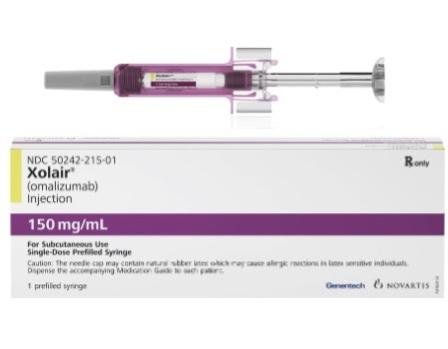
Commercially available as a lyophilized powder that must be reconstituted prior to administration, and as prefilled syringes and autoinjectors.
Lyophilized powder should be prepared and administered by a healthcare provider.
Prefilled syringes and autoinjectors may be self-administered by adolescents ≥12 years of age (with adult supervision) and by adults. Prefilled syringes may be administered by a caregiver to pediatric patients 1–11 years of age; however, the autoinjectors are not intended for use in pediatric patients <12 years of age.
Prefilled Syringes and Autoinjectors
Determine number of prefilled syringes or autoinjectors required based on patient's dosage (see Table 1). The table represents the fewest number of injections; however, other dosing combinations may be used to achieve desired dose.
For pediatric patients 1–11 years of age, consider number of prefilled syringe injections needed and injection volume relative to patient's body weight.
Not all doses in the table are approved for all indications; see specific dosage recommendations for treated indication.
|
Omalizumab Dose |
75 mg |
150 mg |
300 mg |
Total Volume Injected |
|---|---|---|---|---|
|
75 mg |
1 |
0 |
0 |
0.5 mL |
|
150 mg |
0 |
1 |
0 |
1 mL |
|
225 mg |
1 |
1 |
0 |
1.5 mL |
|
300 mg |
0 |
0 |
1 |
2 mL |
|
375 mg |
1 |
0 |
1 |
2.5 mL |
|
450 mg |
0 |
1 |
1 |
3 mL |
|
525 mg |
1 |
1 |
1 |
3.5 mL |
|
600 mg |
0 |
0 |
2 |
4 mL |
Prior to administration, visually inspect prefilled syringe or autoinjector for particulate matter and discoloration. The solution should be clear and colorless to pale brownish yellow; do not use if cloudy, discolored, or contains particles.
Administer sub-Q injections into thigh or abdomen; avoid the 2-inch (5 cm) area directly around navel.
The outer area of the upper arms may be used only if injection is being administered by a caregiver or healthcare provider.
The injection may take up to 15 seconds to administer.
If more than 1 injection is required to complete a full dose, administer each injection at least 1 inch apart from other sites.
Persons with latex allergies should not handle omalizumab prefilled syringes because the needle cap of the 75 mg/0.5 mL and 150 mg/mL prefilled syringes contains a derivative of natural rubber latex, which may cause allergic reactions in latex sensitive individuals.
Lyophilized Powder
Determine number of vials needed based on the patient's dose (see Table 2). Not all doses in the table are approved for all omalizumab indications; see specific dosage recommendations for the treated indication.
|
Omalizumab Dose |
Number of Vials |
Number of Injections |
Total Volume Injected |
|---|---|---|---|
|
75 mg |
1 |
1 |
0.6 mL |
|
150 mg |
1 |
1 |
1.2 mL |
|
225 mg |
2 |
2 |
1.8 mL |
|
300 mg |
2 |
2 |
2.4 mL |
|
375 mg |
3 |
3 |
3.0 mL |
|
450 mg |
3 |
3 |
3.6 mL |
|
525 mg |
4 |
4 |
4.2 mL |
|
600 mg |
4 |
4 |
4.8 mL |
Using a 3 mL syringe with a 1-inch, 18-gauge needle, reconstitute each 150-mg vial with 1.4 mL of sterile water for injection. Gently swirl the vial for approximately 1 minute to evenly wet the powder; do not shake. Then gently swirl vial for 5 to 10 seconds approximately every 5 minutes to dissolve any remaining solids.
The lyophilized product takes 15 to 20 minutes to dissolve. If more than 20 minutes needed for drug to dissolve completely, gently swirl vial for 5 to 10 seconds approximately every 5 minutes until there are no visible gel-like particles in the solution. Do not use if drug does not dissolve completely by 40 minutes.
After reconstitution, solution should be somewhat viscous and appear clear or slightly opalescent. Small bubbles or foam may remain in the vial, but there should be no visible gel-like particles. Do not use if foreign particles present.
Invert vial for 15 seconds to allow solution to drain toward stopper.
Withdraw entire contents of reconstituted vial into a new 3 mL syringe with a 1-inch, 18-gauge needle; replace the 18-gauge needle with a 25-gauge needle for sub-Q injection.
Expel air, large bubbles, and any excess solution to obtain a volume of 1.2 mL corresponding to a dose of 150 mg; to obtain a volume of 0.6 mL corresponding to a dose of 75 mg, expel air, large bubbles, and discard 0.6 mL from the syringe.
The sub-Q injection may take 5-10 seconds to administer because the solution is slightly viscous.
Divide doses of more than 150 mg between 2 or more injection sites. Choose a different injection site for each new injection at least 1 inch from the area used for other injections.
Dosage
In patients with asthma, chronic rhinosinusitis with nasal polyps (CRSwNP), and IgE-mediated food allergy, dosage should be based on the primary diagnosis for which omalizumab is prescribed. Initial dosing in patients with these conditions is determined based on serum total IgE levels and body weight. Dosage of omalizumab in patients with chronic spontaneous urticaria is not dependent on serum IgE level or body weight.
Pediatric Patients
Allergic Asthma
Sub-Q
Pediatric patients ≥6 years of age: 75–375 mg every 2 or 4 weeks based on serum total IgE level measured before the start of treatment and patient's body weight. See Tables 3 and 4 for recommended dosage in pediatric patients ≥12 years of age, and Tables 5, 6, 7, and 8 for recommended dosage in pediatric patients who begin omalizumab between 6 to <12 years of age.
Adjust dosage if body weight changes substantially during therapy. Because total IgE levels are elevated during treatment, IgE levels are not used to guide dosing during treatment.
If therapy is interrupted for ≥1 year, reevaluate total serum IgE concentrations to determine the appropriate dosage. After treatment interruptions of <1 year, base dosage on serum IgE concentrations obtained prior to treatment initiation.
Periodically reassess the need for continued therapy based on disease severity and level of asthma control.
Do not discontinue systemic or inhaled corticosteroids abruptly upon initiation of omalizumab therapy; discontinue corticosteroids gradually under the direct supervision of a physician.
See Table 4
|
Pre-treatment Serum IgE (IU/mL) |
Body Weight 30–60 kg |
Body Weight >60–70 kg |
Body Weight >70–90 kg |
Body Weight >90–150 kg |
|---|---|---|---|---|
|
≥30–100 |
150 mg |
150 mg |
150 mg |
300 mg |
|
>100–200 |
300 mg |
300 mg |
300 mg |
– |
|
>200–300 |
300 mg |
– |
– |
– |
|
>300–700 |
– |
– |
– |
– |
See Table 3
Insufficient data to recommend a dose.
|
Pre-treatment Serum IgE (IU/mL) |
Body Weight 30–60 kg |
Body Weight >60–70 kg |
Body Weight >70–90 kg |
Body Weight >90–150 kg |
|---|---|---|---|---|
|
≥30–100 |
– |
– |
– |
– |
|
>100–200 |
– |
– |
– |
225 mg |
|
>200–300 |
– |
225 mg |
225 mg |
300 mg |
|
>300–400 |
225 mg |
225 mg |
300 mg |
– |
|
>400–500 |
300 mg |
300 mg |
375 mg |
– |
|
>500–600 |
300 mg |
375 mg |
– |
– |
|
>600–700 |
375 mg |
– |
– |
– |
See Table 6
|
Pre-treatment Serum IgE (IU/mL) |
Body Weight 20–25 kg |
Body Weight >25–30 kg |
Body Weight >30–40 kg |
Body Weight >40–50 kg |
Body Weight >50–60 kg |
|---|---|---|---|---|---|
|
≥30–100 |
75 mg |
75 mg |
75 mg |
150 mg |
150 mg |
|
>100–200 |
150 mg |
150 mg |
150 mg |
300 mg |
300 mg |
|
>200–300 |
150 mg |
150 mg |
225 mg |
300 mg |
300 mg |
|
>300–400 |
225 mg |
225 mg |
300 mg |
– |
– |
|
>400–500 |
225 mg |
300 mg |
– |
– |
– |
|
>500–600 |
300 mg |
300 mg |
– |
– |
– |
|
>600–700 |
300 mg |
– |
– |
– |
– |
|
>700–1300 |
– |
– |
– |
– |
– |
See Table 5
Insufficient data to recommend a dose.
|
Pre-treatment Serum IgE (IU/mL) |
Body Weight 20–25 kg |
Body Weight >25–30 kg |
Body Weight >30–40 kg |
Body Weight >40–50 kg |
Body Weight >50–60 kg |
|---|---|---|---|---|---|
|
≥30–300 |
– |
– |
– |
– |
– |
|
>300–400 |
– |
– |
– |
225 mg |
225 mg |
|
>400–500 |
– |
– |
225 mg |
225 mg |
300 mg |
|
>500–600 |
– |
– |
225 mg |
300 mg |
300 mg |
|
>600–700 |
– |
225 mg |
225 mg |
300 mg |
375 mg |
|
>700–800 |
225 mg |
225 mg |
300 mg |
375 mg |
– |
|
>800–900 |
225 mg |
225 mg |
300 mg |
375 mg |
– |
|
>900–1000 |
225 mg |
300 mg |
375 mg |
– |
– |
|
>1000–1100 |
225 mg |
300 mg |
375 mg |
– |
– |
|
>1100–1200 |
300 mg |
300 mg |
– |
– |
– |
|
>1200–1300 |
300 mg |
375 mg |
– |
– |
– |
See Table 8
|
Pre-treatment Serum IgE (IU/mL) |
Body Weight >60–70 kg |
Body Weight >70–80 kg |
Body Weight >80–90 kg |
Body Weight >90–125 kg |
Body Weight >125–150 kg |
|---|---|---|---|---|---|
|
≥30–100 |
150 mg |
150 mg |
150 mg |
300 mg |
300 mg |
|
>100–200 |
300 mg |
300 mg |
300 mg |
– |
– |
|
>200–1300 |
– |
– |
– |
– |
– |
See Table 7
Insufficient data to recommend a dose.
|
Pre-treatment Serum IgE (IU/mL) |
Body Weight 60–70 kg |
Body Weight >70–80 kg |
Body Weight >80–90 kg |
Body Weight >90–125 kg |
Body Weight >125–150 kg |
|---|---|---|---|---|---|
|
≥30–100 |
– |
– |
– |
– |
– |
|
>100–200 |
– |
– |
– |
225 mg |
300 mg |
|
>200–300 |
225 mg |
225 mg |
225 mg |
300 mg |
375 mg |
|
>300–400 |
225 mg |
300 mg |
300 mg |
– |
– |
|
>400–500 |
300 mg |
375 mg |
375 mg |
– |
– |
|
>500–600 |
375 mg |
– |
– |
– |
– |
|
>600–1300 |
– |
– |
– |
– |
– |
IgE-mediated Food Allergy
Sub-Q
Pediatric patients ≥1 year of age: 75–600 mg every 2 or 4 weeks based on serum total IgE level measured before the start of treatment and the patient's body weight (see Tables 11, 12, 13, and 14).
Adjust dosage if body weight changes substantially during therapy. Because total IgE levels are elevated during treatment, IgE levels are not used to guide dosing during treatment.
If therapy is interrupted for ≥1 year, reevaluate total serum IgE concentrations to determine the appropriate dosage. After treatment interruptions of <1 year, base dosage on serum IgE concentrations obtained prior to treatment initiation.
The appropriate duration of therapy has not been evaluated; periodically reassess the need for continued therapy.
See Table 12
|
Pre-treatment Serum IgE (IU/mL) |
Body Weight ≥10–12 kg |
Body Weight >12–15 kg |
Body Weight >15–20 kg |
Body Weight >20–25 kg |
Body Weight >25–30 kg |
Body Weight >30–40 kg |
|---|---|---|---|---|---|---|
|
≥30–100 |
75 mg |
75 mg |
75 mg |
75 mg |
75 mg |
75 mg |
|
>100–200 |
75 mg |
75 mg |
75 mg |
150 mg |
150 mg |
150 mg |
|
>200–300 |
75 mg |
75 mg |
150 mg |
150 mg |
150 mg |
225 mg |
|
>300–400 |
150 mg |
150 mg |
150 mg |
225 mg |
225 mg |
300 mg |
|
>400–500 |
150 mg |
150 mg |
225 mg |
225 mg |
300 mg |
450 mg |
|
>500–600 |
150 mg |
150 mg |
225 mg |
300 mg |
300 mg |
450 mg |
|
>600–700 |
– |
– |
225 mg |
300 mg |
– |
450 mg |
|
>700–1850 |
– |
– |
– |
– |
– |
– |
See Table 11
Insufficient data to recommend a dose.
|
Pre-treatment Serum IgE (IU/mL) |
Body Weight ≥10–12 kg |
Body Weight >12–15 kg |
Body Weight >15–20 kg |
Body Weight >20–25 kg |
Body Weight >25–30 kg |
Body Weight >30–40 kg |
|---|---|---|---|---|---|---|
|
≥30–600 |
– |
– |
– |
– |
– |
– |
|
>600–700 |
150 mg |
150 mg |
– |
– |
225 mg |
|
|
>700–800 |
150 mg |
150 mg |
150 mg |
225 mg |
225 mg |
300 mg |
|
>800–900 |
150 mg |
150 mg |
150 mg |
225 mg |
225 mg |
300 mg |
|
>900–1000 |
150 mg |
150 mg |
225 mg |
225 mg |
300 mg |
375 mg |
|
>1000–1100 |
150 mg |
150 mg |
225 mg |
225 mg |
300 mg |
375 mg |
|
>1100–1200 |
150 mg |
150 mg |
225 mg |
300 mg |
300 mg |
450 mg |
|
>1200–1300 |
150 mg |
225 mg |
225 mg |
300 mg |
375 mg |
450 mg |
|
>1300–1500 |
150 mg |
225 mg |
300 mg |
300 mg |
375 mg |
525 mg |
|
>1500–1850 |
– |
225 mg |
300 mg |
375 mg |
450 mg |
600 mg |
See Table 14
|
Pre-treatment Serum IgE (IU/mL) |
Body Weight >40–50 kg |
Body Weight >50–60 kg |
Body Weight >60–70 kg |
Body Weight >70–80 kg |
Body Weight >80–90 kg |
Body Weight >90–125 kg |
Body Weight >125–150 kg |
|---|---|---|---|---|---|---|---|
|
≥30–100 |
150 mg |
150 mg |
150 mg |
150 mg |
150 mg |
300 mg |
300 mg |
|
>100–200 |
300 mg |
300 mg |
300 mg |
300 mg |
300 mg |
450 mg |
600 mg |
|
>200–300 |
300 mg |
300 mg |
450 mg |
450 mg |
450 mg |
600 mg |
– |
|
>300–400 |
450 mg |
450 mg |
450 mg |
600 mg |
600 mg |
– |
– |
|
>400–500 |
450 mg |
600 mg |
600 mg |
– |
– |
– |
– |
|
>500–600 |
600 mg |
600 mg |
– |
– |
– |
– |
– |
|
>600–700 |
600 mg |
– |
– |
– |
– |
– |
– |
|
>700–1850 |
– |
– |
– |
– |
– |
– |
– |
See Table 13
Insufficient data to recommend a dose.
|
Pre-treatment Serum IgE (IU/mL) |
Body Weight >40–50 kg |
Body Weight >50–60 kg |
Body Weight >60–70 kg |
Body Weight >70–80 kg |
Body Weight >80–90 kg |
Body Weight >90–125 kg |
Body Weight >125–150 kg |
|---|---|---|---|---|---|---|---|
|
≥30–200 |
– |
– |
– |
– |
– |
– |
– |
|
>200–300 |
– |
– |
– |
– |
– |
– |
375 mg |
|
>300–400 |
– |
– |
– |
– |
– |
450 mg |
525 mg |
|
>400–500 |
– |
– |
– |
375 mg |
375 mg |
525 mg |
600 mg |
|
>500–600 |
– |
– |
375 mg |
450 mg |
450 mg |
600 mg |
– |
|
>600–700 |
– |
375 mg |
450 mg |
450 mg |
525 mg |
– |
– |
|
>700–800 |
375 mg |
450 mg |
450 mg |
525 mg |
600 mg |
– |
– |
|
>800–900 |
375 mg |
450 mg |
525 mg |
600 mg |
– |
– |
– |
|
>900–1000 |
450 mg |
525 mg |
600 mg |
– |
– |
– |
– |
|
>1000–1100 |
450 mg |
600 mg |
– |
– |
– |
– |
– |
|
>1100–1200 |
525 mg |
600 mg |
– |
– |
– |
– |
– |
|
>1200–1300 |
525 mg |
– |
– |
– |
– |
– |
– |
|
>1300–1500 |
600 mg |
– |
– |
– |
– |
– |
– |
|
>1500–1850 |
– |
– |
– |
– |
– |
– |
– |
Chronic Spontaneous Urticaria
Sub-Q
Adolescents ≥12 years of age: 150 or 300 mg every 4 weeks. Dosage not dependent on serum IgE concentrations (free or total) or body weight.
Appropriate duration of therapy not evaluated; periodically reassess the need for continued therapy.
Adults
Allergic Asthma
Sub-Q
75–375 mg every 2 or 4 weeks based on serum total IgE level measured before the start of treatment and patient's body weight. See Tables 3 and 4 for recommended dosage in adults with asthma.
Adjust dosage if body weight changes substantially during therapy. Because total IgE levels are elevated during treatment, IgE levels cannot be used to guide dosing during treatment.
Periodically reassess the need for continued therapy based on the patient's disease severity and level of asthma control.
Do not discontinue systemic or inhaled corticosteroids abruptly upon initiation of omalizumab therapy; discontinue corticosteroids gradually under the direct supervision of a physician.
Chronic Rhinosinusitis with Nasal Polyposis
Sub-Q
75–600 mg every 2 or 4 weeks based on serum total IgE level measured before the start of treatment and the patient's body weight (see Tables 9 and 10).
Adjust dosage if body weight changes substantially during therapy. Because total IgE levels are elevated during treatment, IgE levels are not used to guide dosing during treatment.
If therapy is interrupted for ≥1 year, reevaluate total serum IgE concentrations to determine the appropriate dosage. After treatment interruptions of <1 year, base dosage on serum IgE concentrations obtained prior to treatment initiation.
Do not discontinue systemic or inhaled corticosteroids abruptly upon initiation of omalizumab therapy; discontinue corticosteroids gradually under the direct supervision of a physician.
See Table 10
|
Pre-treatment Serum IgE (IU/mL) |
Body Weight >30–40 kg |
Body Weight >40–50 kg |
Body Weight >50–60 kg |
Body Weight >60–70 kg |
Body Weight >70–80 kg |
Body Weight >80–90 kg |
Body Weight >90–120 kg |
Body Weight >125–150 kg |
|---|---|---|---|---|---|---|---|---|
|
≥30–100 |
75 mg |
150 mg |
150 mg |
150 mg |
150 mg |
150 mg |
300 mg |
300 mg |
|
>100–200 |
150 mg |
300 mg |
300 mg |
300 mg |
300 mg |
300 mg |
450 mg |
600 mg |
|
>200–300 |
225 mg |
300 mg |
300 mg |
450 mg |
450 mg |
450 mg |
600 mg |
– |
|
>300–400 |
300 mg |
450 mg |
450 mg |
450 mg |
600 mg |
600 mg |
– |
– |
|
>400–500 |
450 mg |
450 mg |
600 mg |
600 mg |
– |
– |
– |
– |
|
>500–600 |
450 mg |
600 mg |
600 mg |
– |
– |
– |
– |
– |
|
>600–700 |
450 mg |
600 mg |
– |
– |
– |
– |
– |
– |
|
>700–1500 |
– |
– |
– |
– |
– |
– |
– |
– |
See Table 9
Insufficient data to recommend a dose.
|
Pre-treatment Serum IgE (IU/mL) |
Body Weight >30–40 kg |
Body Weight >40–50 kg |
Body Weight >50–60 kg |
Body Weight >60–70 kg |
Body Weight >70–80 kg |
Body Weight >80–90 kg |
Body Weight >90–120 kg |
Body Weight >125–150 kg |
|---|---|---|---|---|---|---|---|---|
|
30–200 |
– |
– |
– |
– |
– |
– |
– |
– |
|
>200–300 |
– |
– |
– |
– |
– |
– |
– |
375 mg |
|
>300–400 |
– |
– |
– |
– |
– |
– |
450 mg |
525 mg |
|
>400–500 |
– |
– |
– |
– |
375 mg |
375 mg |
525 mg |
600 mg |
|
>500–600 |
– |
– |
– |
375 mg |
450 mg |
450 mg |
600 mg |
– |
|
>600–700 |
– |
– |
375 mg |
450 mg |
450 mg |
525 mg |
– |
|
|
>700–800 |
300 mg |
375 mg |
450 mg |
450 mg |
525 mg |
600 mg |
– |
– |
|
>800–900 |
300 mg |
375 mg |
450 mg |
525 mg |
600 mg |
– |
– |
– |
|
>900–1000 |
375 mg |
450 mg |
525 mg |
600 mg |
– |
– |
– |
– |
|
>1000–1100 |
375 mg |
450 mg |
600 mg |
– |
– |
– |
– |
– |
|
>1100–1200 |
450 mg |
525 mg |
600 mg |
– |
– |
– |
– |
– |
|
>1200–1300 |
450 mg |
525 mg |
– |
– |
– |
– |
– |
– |
|
>1300–1500 |
525 mg |
600 mg |
– |
– |
– |
– |
– |
– |
IgE-mediated Food Allergy
Sub-Q
75–600 mg every 2 or 4 weeks based on serum total IgE level measured before the start of treatment and the patient's body weight. See Tables 11, 12, 13, and 14.
Appropriate duration of therapy not evaluated; periodically reassess the need for continued therapy.
Because total IgE levels are elevated during treatment, IgE levels cannot be used to guide dosing during treatment; therefore, retesting of IgE is not necessary unless treatment has been interrupted for ≥1 year. However, omalizumab dosage should be adjusted accordingly if the patient’s body weight changes substantially during therapy.
If omalizumab therapy is interrupted for ≥1 year, reevaluate total serum IgE concentrations to determine the appropriate dosage. After treatment interruptions of <1 year, base dosage on serum IgE concentrations obtained prior to treatment initiation.
Chronic Spontaneous Urticaria
Sub-Q
150 or 300 mg every 4 weeks. Dosage not dependent on serum IgE concentrations (free or total) or body weight.
Appropriate duration of therapy not evaluated; periodically reassess the need for continued therapy.
Special Populations
No special population dosage recommendations at this time.
Cautions for Omalizumab
Contraindications
-
Known history of severe hypersensitivity to omalizumab or any ingredient in the formulation.
Warnings/Precautions
Warnings
Anaphylaxis
Anaphylaxis (presenting as bronchospasm, hypotension, syncope, urticaria, and/or angioedema of throat or tongue) reported. Has occurred after first dose but also >1 year after starting therapy. (See Boxed Warning.)
Initiate omalizumab therapy only in a healthcare setting equipped to manage anaphylaxis.
Observe patients closely for an appropriate period of time after administration.
Inform patients of the signs and symptoms of anaphylaxis and advise them to seek immediate medical care if any manifestations occur.
Once treatment has been established, self-administration using the prefilled syringes and autoinjectors may be considered in selected patients; patient selection should be based on criteria to mitigate the risk from anaphylaxis.
If a severe hypersensitivity reaction occurs, discontinue omalizumab.
Other Warnings and Precautions
Malignancy
Breast, melanoma, non-melanoma skin, prostate, parotid gland neoplasms, and other types of neoplasms observed with <1 year of therapy. Risk of malignancy with longer exposure to omalizumab or use in patients at higher risk for malignancy (e.g., geriatric individuals, current smokers) not known.
FDA's review of data from a 5-year study of omalizumab revealed no difference in cancer rates of patients receiving omalizumab compared with placebo, but a potential increased risk of malignancy cannot be ruled out.
Acute or Worsening Asthma
Not effective in alleviating acute asthma exacerbations; do not use for treatment of acute bronchospasm or status asthmaticus.
Corticosteroid Reduction
Do not discontinue systemic or inhaled corticosteroids abruptly when initiating omalizumab therapy for asthma or CRSwNP. Decrease corticosteroids gradually under the direct supervision of a physician.
In chronic spontaneous urticaria patients, the use of omalizumab in combination with corticosteroids has not been evaluated.
Eosinophilic Conditions
Systemic eosinophilia, vasculitic rash, worsening pulmonary symptoms, cardiac complications, and/or neuropathy sometimes presenting with clinical features of vasculitis consistent with Churg-Strauss syndrome, reported rarely; in almost all cases, these events were associated with reduction of oral corticosteroid therapy. Be alert to the development of such manifestations; causal relationship not established.
Fever, Arthralgia, and Rash
Postmarketing reports of a constellation of signs and symptoms (e.g., arthritis/arthralgia, rash, fever, lymphadenopathy) similar to serum sickness.
Onset of symptoms reported to occur 1–5 days after first or subsequent injections of omalizumab, with recurrence following additional doses in some patients.
If patient develops such signs and symptoms, discontinue omalizumab.
Parasitic (Helminthic) Infections
Increased incidence and risk of helminthic infection. Monitor patients who are at high risk for geohelminthic infections during therapy. Insufficient data available to determine the duration of monitoring for such infections after treatment discontinuance.
Laboratory Test Interferences
Serum total IgE concentrations increase following administration resulting from formation of omalizumab-IgE complexes. Such elevations may persist for up to 1 year following drug discontinuance.
Do not use serum total IgE concentrations obtained <1 year following discontinuance of drug to reassess dosing regimen for patients with asthma, CRSwNP, or IgE-mediated food allergy; these concentrations may not reflect steady-state free IgE concentrations.
Potential Medication Error Related to Emergency Treatment of Anaphylaxis
Do not use for emergency treatment of allergic reactions, including anaphylaxis. Safety and effectiveness of omalizumab for emergency treatment of allergic reactions, including anaphylaxis, have not been established.
Instruct patients that omalizumab is for maintenance use to reduce allergic reactions, including anaphylaxis, while avoiding food allergens.
Immunogenicity
In clinical studies in patients with asthma, antibodies to omalizumab detected in <0.1% of patients receiving the drug.
Although data were incomplete, no antibodies to omalizumab reported in patients receiving the drug in clinical trials for treatment of chronic spontaneous urticaria.
Anti-drug antibodies were not measured in clinical studies of CRSwNP or IgE-mediated food allergy.
Specific Populations
Pregnancy
No increase in the rate of major birth defects or miscarriage observed in a registry study. An increased rate of low birth weight was observed among registry infants; however, confounding factors make it difficult to determine whether this is due to the drug or disease.
Lactation
Not known whether omalizumab is distributed into human milk, or if the drug has any effects on milk production. Since IgG distributes into milk in humans, it is expected that omalizumab will be present in human milk.
Consider developmental and health benefits of breastfeeding along with the mother's clinical need for omalizumab and any potential adverse effects on the breastfed child from the drug or underlying maternal condition.
Pediatric Use
Safety and effectiveness in pediatric patients ≥6 years of age with moderate to severe persistent allergic asthma have been established.
Safety and effectiveness in pediatric patients with CRSwNP have not been established.
Safety and effectiveness in pediatric patients ≥1 year of age with IgE-mediated food allergy have been established.
Safety and effectiveness in pediatric patients ≥12 years of age with chronic spontaneous urticaria have been established.
Geriatric Use
Insufficient experience in patients ≥65 years of age to determine whether they respond differently from younger adults.
Common Adverse Effects
Adverse effects (≥1%) reported in adults and adolescents ≥12 years of age with asthma: arthralgia, general pain, leg pain, fatigue, dizziness, fracture, arm pain, pruritus, dermatitis, earache.
Adverse effects (≥3%) reported in pediatric patients 6 to <12 years of age with asthma: nasopharyngitis, headache, pyrexia, upper abdominal pain, pharyngitis streptococcal, otitis media, viral gastroenteritis, arthropod bites, epistaxis.
Adverse reactions (≥3%) reported in patients with CRSwNP: headache, injection site reaction, arthralgia, upper abdominal pain, dizziness.
Adverse reactions (≥3%) reported in patients with IgE-mediated food allergy: injection site reactions, pyrexia.
Adverse effects (≥2%) reported in patients with chronic spontaneous urticaria: nausea, nasopharyngitis, sinusitis, upper respiratory tract infection, viral upper respiratory tract infection, arthralgia, headache, cough.
Drug Interactions
No formal drug interaction studies to date.
Omalizumab Pharmacokinetics
Absorption
Bioavailability
Absorbed slowly; peak serum concentrations attained after an average of 7–8 days. Absolute bioavailability averages 62%.
Onset
Maximum suppression of serum free IgE concentrations observed 3 days after first dose in patients with chronic spontaneous urticaria.
Duration
Free and total IgE concentrations returned toward pretreatment values (i.e., free IgE concentrations increased, total IgE concentrations decreased) over 16-week follow-up period following discontinuance of omalizumab in patients with chronic spontaneous urticaria.
Elimination
Metabolism
Degradation of omalizumab (IgG1κ monoclonal antibody) by the reticuloendothelial system and endothelial cells in the liver, and clearance of omalizumab-IgE complexes by the reticuloendothelial system.
Elimination Route
Eliminated in part into the bile as unchanged drug.
Half-life
26 days in asthmatic patients.
24 days in patients with chronic spontaneous urticaria.
Stability
Storage
Parenteral
Powder for Sub-Q Injection
Store at 2–8°C in the original carton. When reconstituted with sterile water for injection, solutions prepared in single-use vials are stable for ≤8 hours at 2–8°C or ≤4 hours at room temperature. Protect reconstituted vials from sunlight.
Prefilled Syringes and Autoinjectors
Store at 2–8°C in the original carton; protect from direct sunlight. Can remove from and place back in refrigerator if needed; total combined time out of refrigerator should not exceed 2 days. Do not use if prefilled syringe or autoinjector is left at temperatures >25°C. Do not freeze; discard if frozen.
Actions
-
Binds specifically to circulating IgE and blocks its binding with the high-affinity IgE receptor (FcεRI) on the surface of mast cells, basophils, and dendritic cells. Inhibition of such binding interferes with the synthesis and release of mediators of the allergic response (e.g., leukotrienes, cytokines, chemokines).
-
Reduces the number of FcεRI on basophils and submucosal cells in atopic patients.
-
Reduces mean serum concentrations of free (unbound) IgE in patients with allergic asthma at recommended dosages.
-
Attenuates the early- and late-phase inflammatory response and the influx of eosinophils into the airways following allergen challenge.
-
Mechanism of action for chronic spontaneous urticaria not fully understood; may involve down-regulation of FcεRIs on surface of mast cells and basophils as a result of drug binding to IgE and decreasing circulating IgE.
Advice to Patients
-
Advise patients to read the FDA-approved patient labeling (Medication Guide and Instructions for Use).
-
Inform patients of the risk of life-threatening anaphylaxis with omalizumab and that reports of anaphylaxis have occurred up to 4 days after administration of omalizumab. Initiate omalizumab only in a healthcare setting by healthcare providers. Observe patients closely following administration. Inform patients of the signs and symptoms of anaphylaxis and instruct them to seek immediate medical care should such signs or symptoms occur.
-
Advise patients, parents, or caregivers that omalizumab should not be used for the emergency treatment of allergic reactions, including anaphylaxis.
-
Advise patients of the importance of adherence to dosing schedules of concomitant therapy for asthma, CRSwNP, IgE-mediated food allergy or allergen immunotherapy, or chronic spontaneous urticaria unless otherwise instructed by a clinician.
-
Inform patients of possible delay in the effectiveness of omalizumab upon treatment initiation.
-
Instruct patients or caregivers who plan to self-administer omalizumab using the prefilled syringe or autoinjector on proper injection technique and assess their ability to administer subcutaneous injections. For patients who require more than 1 injection to complete their prescribed dose, instruct patients to administer all injections consecutively and in one sitting.
-
Inform patients that the needle cover on the prefilled syringe contains dry natural rubber (a derivative of latex), which may cause allergic reactions in individuals sensitive to latex.
-
Advise patients to inform their clinicians of existing or contemplated concomitant therapy, including prescription and OTC drugs, as well as any concomitant illnesses.
-
Advise women to inform their clinicians if they are or plan to become pregnant or plan to breast-feed.
-
Inform patients of other important precautionary information.
Additional Information
The American Society of Health-System Pharmacists, Inc. represents that the information provided in the accompanying monograph was formulated with a reasonable standard of care, and in conformity with professional standards in the field. Readers are advised that decisions regarding use of drugs are complex medical decisions requiring the independent, informed decision of an appropriate health care professional, and that the information contained in the monograph is provided for informational purposes only. The manufacturer's labeling should be consulted for more detailed information. The American Society of Health-System Pharmacists, Inc. does not endorse or recommend the use of any drug. The information contained in the monograph is not a substitute for medical care.
Preparations
Excipients in commercially available drug preparations may have clinically important effects in some individuals; consult specific product labeling for details.
Please refer to the ASHP Drug Shortages Resource Center for information on shortages of one or more of these preparations.
|
Routes |
Dosage Forms |
Strengths |
Brand Names |
Manufacturer |
|---|---|---|---|---|
|
Parenteral |
For injection, for subcutaneous use |
150 mg |
Xolair |
Genentech |
|
Parenteral |
Injection, for subcutaneous use |
75 mg/0.5 mL |
Xolair (available as single-dose prefilled syringes or autoinjectors) |
Genentech |
|
150 mg/mL |
Xolair (available as single-dose prefilled syringes or autoinjectors) |
Genentech |
||
|
300 mg/2 mL |
Xolair (available as single-dose prefilled syringes or autoinjectors) |
Genentech |
AHFS DI Essentials™. © Copyright 2025, Selected Revisions January 10, 2025. American Society of Health-System Pharmacists, Inc., 4500 East-West Highway, Suite 900, Bethesda, Maryland 20814.
Reload page with references included
Related/similar drugs
Biological Products Related to omalizumab
Find detailed information on biosimilars for this medication.
Frequently asked questions
- What are the most common skin conditions? (with photos)
- Is Xolair an immunosuppressant?
- How long before Xolair starts working?
- How does Xolair work?
- Does Xolair cause weight gain?
- What is omalizumab's mechanism of action?
- Can Xolair be self-administered at home?
- Omalizumab and Covid-19 vaccine, what should I know?
- Is Xolair effective for food allergies?
More about omalizumab
- Check interactions
- Compare alternatives
- Reviews (272)
- Side effects
- Dosage information
- During pregnancy
- Support group
- Drug class: selective immunosuppressants
- Breastfeeding
- En español