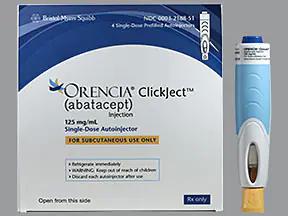
Abatacept (Monograph)
Brand name: Orencia
Drug class: Disease-modifying Antirheumatic Drugs, Miscellaneous
Introduction
Biologic response modifier and disease-modifying antirheumatic drug (DMARD); a recombinant fusion protein.
Uses for Abatacept
Rheumatoid Arthritis
Management of moderately to severely active rheumatoid arthritis in adults.
Guidelines generally support the use of abatacept as add-on therapy to methotrexate in patients who do not meet treatment goals with methotrexate alone.
Juvenile Idiopathic Arthritis
Management of moderately to severely active polyarticular juvenile idiopathic arthritis in pediatric patients ≥2 years of age.
Guidelines generally support the use of abatacept as add-on therapy in patients with juvenile idiopathic arthritis and moderate to high disease activity despite the use of methotrexate.
Psoriatic Arthritis
Management of active psoriatic arthritis in adults and pediatric patients ≥2 years of age. Guidelines generally recommend alternative therapies (e.g., tumor necrosis factor [TNF] blocking agents, secukinumab, ixekizumab, brodalumab, ustekinumab) for treatment of psoriatic arthritis before abatacept; abatacept may be considered in patients with failure to respond to first-line therapies or with other comorbidities.
Acute Graft-Versus-Host Disease Prophylaxis
Prophylaxis of acute graft-versus-host disease (GVHD) in adults and pediatric patients ≥2 years of age undergoing hematopoietic stem cell transplantation (HSCT) from a matched or 1 allele-mismatched unrelated donor.
Place in therapy for abatacept for this indication has not yet been defined.
Abatacept Dosage and Administration
General
Pretreatment Screening
-
Evaluate for active and latent tuberculosis infection prior to initiation of therapy; initiate antimycobacterial therapy, if indicated.
-
Evaluate for viral hepatitis infection prior to initiating abatacept.
Patient Monitoring
-
Monitor patients for infections, including Epstein-Barr virus (EBV) reactivation and cytomegalovirus (CMV) infection or reactivation, during treatment with abatacept for prophylaxis of graft-versus-host disease (GVHD) following hematopoietic stem cell transplantation (HSCT).
-
Perform periodic skin examinations during treatment with abatacept, particularly in patients at risk for skin cancer.
Premedication and Prophylaxis
-
Prior to initiation of abatacept for GVHD and for 6 months following HSCT, administer appropriate prophylaxis for EBV reactivation and consider additional prophylaxis for CMV infection or reactivation.
Other General Considerations
-
Abatacept may be used as monotherapy or in combination with certain other drugs when used to treat rheumatoid arthritis, juvenile idiopathic arthritis, or psoriatic arthritis; must be used in combination with a calcineurin inhibitor and methotrexate when used for prophylaxis of acute GVHD.
-
Concomitant use of abatacept and other potent immunosuppressants (e.g., biologic disease-modifying antirheumatic drugs [DMARDs], Janus kinase inhibitors) is not recommended.
-
Update immunizations according to current immunization guidelines in adults and pediatric patients prior to initiating therapy.
Administration
Administer by IV infusion or sub-Q injection depending on indication and patient age.
Administer by IV infusion or sub-Q injection for rheumatoid arthritis or psoriatic arthritis in adults and for polyarticular juvenile idiopathic arthritis in pediatric patients ≥6 years of age.
Administer by sub-Q injection only in children 2 to <6 years of age with polyarticular juvenile idiopathic arthritis.
Administer by sub-Q injection only in children ≥2 years of age with psoriatic arthritis.
Administer by IV infusion only for prophylaxis of GVHD in adults and pediatric patients ≥2 years of age.
IV Administration
Commercially available for IV use as a lyophilized powder that must be reconstituted and diluted prior to administration.
Administer by IV infusion. Complete infusion within 24 hours of reconstitution.
Administer with an in-line, sterile, nonpyrogenic, low-protein-binding filter with a pore diameter ≤1.2 µm.
Consult manufacturer’s labeling for additional information on reconstitution, dilution, and administration.
Reconstitution
Reconstitute the appropriate number of vials containing 250 mg of abatacept lyophilized powder with 10 mL of sterile water for injection to provide a solution containing 25 mg/mL.
Use only the silicone-free disposable syringe provided by the manufacturer and an 18- to 21-gauge needle. If a siliconized syringe is inadvertently used, discard the solution since translucent particles may develop. If silicone-free disposable syringe is dropped or becomes contaminated, use a new silicone-free disposable syringe; may obtain additional syringes from manufacturer (800-673-6242 [800-ORENCIA]).
Direct sterile water for injection toward the side of the vial during reconstitution; swirl gently to minimize foaming. Do not shake; avoid prolonged or vigorous agitation. Upon dissolution, insert a vented needle into the vial to dissipate foam. Must be diluted further before IV administration.
Dilution
Remove the volume of diluent equal to the total required volume of reconstituted abatacept solution from a 100 mL bag of 0.9% sodium chloride injection.
Using same silicone-free disposable syringe used for reconstitution, slowly add reconstituted abatacept to the bag to a total volume of 100 mL. Mix gently; do not shake. Final concentration depends on amount of abatacept added but will be not exceed 10 mg/mL.
Discard any unused portion of reconstituted solution.
Rate of Administration
When used to treat rheumatoid arthritis, juvenile idiopathic arthritis, or adults with psoriatic arthritis, infuse over 30 minutes.
When used for prophylaxis of acute GVHD, infuse over 60 minutes.
Subcutaneous Administration
Commercially available for sub-Q use in single-use prefilled syringes and auto-injectors. Prefilled syringes and auto-injectors are not intended for IV administration.
Intended for sub-Q use under the guidance and supervision of a clinician, but may be self-administered if the clinician determines that the patient and/or their caregiver is competent to safely administer the drug by sub-Q injection after appropriate training and with medical follow-up as necessary. Pediatric patients may self-administer the sub-Q formulation if both the clinician and caregiver determine that self-administration is appropriate. Manufacturer states that the ability of pediatric patients to use the auto-injector has not been tested.
Allow the refrigerated prefilled syringe or auto-injector to sit at room temperature for 30 minutes prior to administration; do not warm the solution in any other way (e.g., microwave, immersion in warm water). Do not remove needle cover while drug is warming to room temperature.
Administer sub-Q injections into anterior thigh or abdomen; do not make abdominal injections within 5.08 cm (2 inches) of the umbilicus. May be administered into the upper outer arm by a caregiver. Inject the full amount of solution in the prefilled syringe or auto-injector. Rotate injection sites. Do not make injections into areas where the skin is tender, bruised, red, scaly, or hard, or into scars or stretch marks.
Dosage
Pediatric Patients
Juvenile Idiopathic Arthritis
IV
Pediatric patients ≥6 years of age weighing <75 kg: 10 mg/kg at 0, 2, and 4 weeks, then every 4 weeks.
Pediatric patients ≥6 years of age weighing ≥75 kg: Use adult dosage (maximum dose 1 g).
Sub-Q
Initiate sub-Q regimen without an IV loading dose.
Pediatric patients ≥2 years of age weighing 10 to <25 kg: 50 mg once weekly.
Pediatric patients ≥2 years of age weighing 25 to <50 kg: 87.5 mg once weekly.
Pediatric patients ≥2 years of age weighing ≥50 kg: 125 mg once weekly.
Psoriatic Arthritis
Sub-Q
Pediatric patients ≥2 years of age weighing 10 to <25 kg: 50 mg once weekly.
Pediatric patients ≥2 years of age weighing 25 to <50 kg: 87.5 mg once weekly.
Pediatric patients ≥2 years of age weighing ≥50 kg: 125 mg once weekly.
Prophylaxis of Acute GVHD
IV
Pediatric patients ≥6 years of age: 10 mg/kg (maximum dose 1 g) on the day before HSCT and on days 5, 14, and 28 after HSCT.
Pediatric patients 2 to <6 years of age: 15 mg/kg on the day before HSCT followed by 12 mg/kg on days 5, 14, and 28 after HSCT.
Adults
Rheumatoid Arthritis
IV
Adults weighing <60 kg: 500 mg at 0, 2, and 4 weeks, then every 4 weeks.
Adults weighing 60–100 kg: 750 mg at 0, 2, and 4 weeks, then every 4 weeks.
Adults weighing >100 kg: 1 g at 0, 2, and 4 weeks, then every 4 weeks.
Sub-Q
125 mg once weekly.
May administer a single optional loading dose by IV infusion within one day prior to the initial sub-Q dose; if IV loading dose is used, recommended dose is 500 mg in those weighing <60 kg, 750 mg in those weighing 60–100 kg, and 1 g in those weighing >100 kg.
To switch from IV to sub-Q therapy, administer initial sub-Q dose in place of next scheduled IV dose.
Psoriatic Arthritis
IV
Adults weighing <60 kg: 500 mg at 0, 2, and 4 weeks, then every 4 weeks.
Adults weighing 60–100 kg: 750 mg at 0, 2, and 4 weeks, then every 4 weeks.
Adults weighing >100 kg: 1 g at 0, 2, and 4 weeks, then every 4 weeks.
Sub-Q
125 mg once weekly.
IV loading dose is not required.
To switch from IV to sub-Q therapy, administer initial sub-Q dose in place of next scheduled IV dose.
Prophylaxis of Acute GVHD
IV
10 mg/kg (maximum dose: 1 g) on the day before HSCT and on days 5, 14, and 28 after HSCT.
Special Populations
Dosage in Hepatic Impairment
No specific dosage recommendations at this time.
Dosage in Renal Impairment
No specific dosage recommendations at this time.
Geriatric Patients
No specific dosage recommendations at this time.
Cautions for Abatacept
Contraindications
-
None known.
Warnings/Precautions
Hypersensitivity Reactions
Hypersensitivity reactions (e.g., anaphylaxis, angioedema), including life-threatening or fatal events, reported. Fatal anaphylaxis has occurred after the initial IV infusion and angioedema has occurred after the initial dose or with subsequent doses; onset of angioedema has occurred within hours of administration but sometimes has been delayed (i.e., by days).
Other allergic reactions (e.g., hypotension, urticaria, dyspnea) also reported.
Ensure appropriate measures for treatment of hypersensitivity reactions are readily available for use. If anaphylactic or other serious hypersensitivity reaction occurs, immediately stop administration and permanently discontinue use.
Infectious Complications
Possibility exists for agents that inhibit T-cell activation, including abatacept, to affect host defenses against infection.
Serious and sometimes fatal infections (including sepsis, pneumonia, cellulitis, urinary tract infections, bronchitis, diverticulitis, and acute pyelonephritis) reported, particularly in patients receiving concomitant immunosuppressive agents.
Concomitant use of abatacept and TNF blocking agents, other biologic antirheumatic therapies, or JAK inhibitors is not recommended. Monitor patients being switched from TNF blocking agents to abatacept for infection.
Discontinue abatacept if serious infection develops. Closely monitor patients who develop new infections.
Use caution in patients with a history of recurring infections, underlying conditions that may predispose them to infections, or chronic, latent, or localized infections.
Evaluate all patients for active or latent tuberculosis prior to initiation of abatacept therapy. When indicated, initiate appropriate antimycobacterial regimen for the treatment of latent tuberculosis infection prior to abatacept.
Use of antirheumatic drugs also associated with reactivation of HBV infection in patients who are chronic carriers of the virus (i.e., hepatitis B surface antigen-positive [HBsAg-positive]). Screen patients at risk prior to initiation of therapy.
Immunization
Vaccine efficacy may be reduced. Patients may receive inactivated vaccines, but avoid live virus vaccines during abatacept therapy or within 3 months after discontinuance of the drug.
Update immunizations according to current administration guidelines for pediatric patients and adults prior to initiating abatacept therapy.
It is not known whether in utero exposure to abatacept may affect immune response of infants to live vaccines. Consider risks and benefits of administering live vaccines to infants exposed to the drug in utero.
Exacerbation of COPD
Possible exacerbations of COPD, cough, rhonchi, and dyspnea.
Use with caution; careful monitoring recommended for worsening of respiratory function.
Malignancies and Lymphoproliferative Disorders
Possibility exists for agents that inhibit T-cell activation, including abatacept, to affect host defenses against malignancies.
Lymphoma and lung cancer reported more frequently in patients with rheumatoid arthritis receiving IV abatacept versus control. Rheumatoid arthritis patients, especially those with highly active disease, may be at increased risk of lymphoma.
Other malignancies (e.g., myelodysplastic syndrome, melanoma, breast, bile duct, bladder, cervical, endometrial, ovarian, prostate, renal, thyroid, uterine, and nonmelanoma skin cancer) also reported.
Role of abatacept in the development and course of malignancies not fully determined.
Periodic dermatologic evaluations recommended for all patients receiving abatacept, particularly those at increased risk for skin cancer.
Cytomegalovirus and Epstein-Barr Virus Reactivation in Acute GVHD Prophylaxis after Hematopoietic Stem Cell Transplant
Posttransplant lymphoproliferative disorder (PTLD) has occurred in patients treated with abatacept for prophylaxis of acute graft-versus-host disease (GVHD) during HSCT from unrelated donor. All PTLD events related to infection with Epstein-Barr virus (EBV). Monitor for evidence of EBV reactivation and provide prophylaxis against EBV for 6 months after HSCT.
Invasive cytomegalovirus (CMV) disease has occurred in patients treated with abatacept for prophylaxis of acute GVHD during unrelated HSCT. Monitor for evidence of CMV infection or reactivation for 6 months posttransplantation, regardless of baseline serology; consider CMV prophylaxis.
Blood Glucose Testing
Parenteral preparations containing maltose, including abatacept lyophilized powder for IV infusion, may cause falsely elevated results in blood glucose determinations that use glucose dehydrogenase pyrroloquinolinequinone (GDH-PQQ).
Abatacept injection for sub-Q use does not contain maltose; therefore, no special glucose monitoring precautions required in patients receiving this formulation.
Immunogenicity
Development of antibodies to abatacept, including neutralizing antibodies, reported; no apparent effect on safety, efficacy, or pharmacokinetics of the drug. No serious acute infusion-related reactions observed in pediatric patients who resumed abatacept therapy following treatment interruption for up to 6 months.
Specific Populations
Pregnancy
No adequate and well-controlled studies of abatacept in pregnant women. Available data are insufficient to inform a drug-associated risk.
Not known whether abatacept crosses the placenta in humans.
No embryotoxicity or fetal malformations observed in animal studies; however, effects on immune function (i.e., increase in T-cell-dependent antibody response, thyroiditis) observed in female offspring in a prenatal and postnatal development study in rats. Unknown whether immunologic effects in rats are indicative of risk for autoimmune disease development in humans exposed to abatacept in utero. Exposure to abatacept in juvenile rats (may be more representative of the fetal human immune system) resulted in immune system abnormalities including inflammation of the thyroid and pancreas.
Response to live vaccines in infants exposed to abatacept in utero is unknown; consider risks and benefits.
Lactation
Distributed into milk in rats; not known whether abatacept distributes into human milk, affects nursing infants, or affects milk production.
Pediatric Use
Safety and efficacy for the management of polyarticular juvenile idiopathic arthritis established in pediatric patients ≥2 years of age; may be used as monotherapy or in combination with methotrexate.
Use of IV abatacept for management of polyarticular juvenile idiopathic arthritis is supported by a randomized-withdrawal study evaluating efficacy, safety, and pharmacokinetics of IV abatacept in 190 pediatric patients 6–17 years of age; IV administration not evaluated in children <6 years of age.
Use of sub-Q abatacept for management of polyarticular juvenile idiopathic arthritis is supported by an open-label pharmacokinetic and safety study of sub-Q abatacept in 205 pediatric patients 2–17 years of age and evidence of efficacy for IV abatacept in pediatric patients with juvenile idiopathic arthritis and for sub-Q abatacept in adults with rheumatoid arthritis.
Adverse effects reported in children treated with abatacept in the management of polyarticular juvenile idiopathic arthritis were similar to those reported in adults with RA.
Safety and efficacy of abatacept for use in polyarticular juvenile idiopathic arthritis not established in pediatric patients <2 years of age.
Safety and efficacy for prophylaxis of acute GVHD (when used in combination with a calcineurin inhibitor and methotrexate) established in patients ≥2 years of age undergoing HSCT from matched or 1-allele mismatched unrelated donor.
Use of IV abatacept (in combination with a calcineurin inhibitor and methotrexate) for prophylaxis of acute GVHD in pediatric patients ≥6 years of age undergoing HSCT is supported by studies in adults and pediatric patients ≥6 years of age. Use of IV abatacept for the prophylaxis of acute GVHD in pediatric patients 2 to <6 years of age is supported by pharmacokinetic modeling and simulations of drug exposure. Safety and efficacy of abatacept for prophylaxis of acute GVHD not established in pediatric patients <2 years of age.
Safety and efficacy of abatacept for treatment of psoriatic arthritis established in pediatric patients ≥2 years of age; may be used as monotherapy or in combination with methotrexate.
Use of sub-Q abatacept for treatment of psoriatic arthritis in pediatric patients ≥2 years of age is supported by studies in adults with psoriatic arthritis; pharmacokinetic data from adults with rheumatoid arthritis or psoriatic arthritis and pediatric patients with polyarticular juvenile idiopathic arthritis; and safety data from pediatric studies of patients with polyarticular juvenile idiopathic arthritis using sub-Q abatacept. Efficacy and safety of IV abatacept in pediatric patients with psoriatic arthritis not established.
In juvenile rats, administration of abatacept prior to immune system maturity was associated with increased incidence of fatal infections, changes in T-cell subsets, and inhibition of T-cell-dependent antibody responses; lymphocytic inflammation of the thyroid and pancreatic islets also observed. Relevance of these findings to humans is unknown.
Review vaccination status of the child and administer all age-appropriate vaccines prior to initiation of abatacept.
Response to live vaccines in infants exposed to abatacept in utero is unknown; consider risks and benefits.
Geriatric Use
No overall differences in efficacy or safety observed between geriatric patients ≥65 years of age and younger adults with rheumatoid arthritis, but increased sensitivity of some older patients cannot be ruled out. Insufficient experience when used for prophylaxis of acute GVHD in patients ≥65 years of age to determine whether efficacy or safety are similar to younger adults.
Possible increased incidence of infections and malignancies in geriatric patients; use with caution.
Common Adverse Effects
Rheumatoid arthritis (≥10%): upper respiratory infection, nasopharyngitis, headache, nausea. Adverse effects generally similar following IV infusion or sub-Q injection.
Prophylaxis of acute GVHD (≥10%): anemia, hypertension, CMV reactivation or infection, pyrexia, pneumonia, epistaxis, decreased CD4 lymphocyte count, hypermagnesemia, acute kidney injury.
Polyarticular juvenile idiopathic arthritis: adverse effects with IV abatacept are generally similar in frequency and type to those seen in adult patients with rheumatoid arthritis treated with IV abatacept. Adverse effects with sub-Q abatacept generally consistent with adverse effects with IV abatacept.
Psoriatic arthritis: safety profile of abatacept comparable when given IV or sub-Q, and also consistent with safety profile in patients with rheumatoid arthritis.
Drug Interactions
Vaccines
Avoid live virus vaccines. No data available on secondary transmission of infection by live virus vaccines in abatacept-treated patients.
Since abatacept may interfere with the immune response to antigens, vaccine efficacy may be reduced in patients receiving the drug.
Specific Drugs and Laboratory Tests
|
Drug or Test |
Interaction |
Comments |
|---|---|---|
|
Biologic antirheumatic drugs (e.g., TNF blocking agents) |
Insufficient experience to assess safety and efficacy of concomitant use TNF blocking agents: Increased incidence of infection and serious infection, with no substantial increase in efficacy, observed with concomitant use compared with use of TNF blocking agent alone |
Concomitant use not recommended |
|
Corticosteroids |
No effect on clearance of abatacept |
|
|
JAK inhibitors |
Insufficient experience to establish safety and efficacy of concomitant use |
Concomitant use not recommended |
|
Methotrexate |
No effect on clearance of abatacept |
|
|
NSAIAs |
No effect on clearance of abatacept |
|
|
Tests for glucose |
Maltose contained in abatacept lyophilized powder for IV infusion may interfere with blood glucose monitoring systems based on glucose dehydrogenase pyrroloquinolinequinone (GDH-PQQ) and cause falsely elevated blood glucose results |
Abatacept for IV infusion: Use only glucose-specific test methods not affected by maltose (e.g., glucose dehydrogenase nicotine adenine dinucleotide [GDH-NAD], glucose oxidase, glucose hexokinase) Abatacept injection for sub-Q use: Does not contain maltose; no special glucose monitoring precautions required |
Abatacept Pharmacokinetics
Absorption
Bioavailability
Following multiple IV infusions in adults with rheumatoid arthritis, steady-state serum concentrations reached by day 60. No apparent systemic accumulation. AUC and peak serum concentrations are dose proportional over dose range of 2–10 mg/kg.
Steady-state concentrations reached by day 57 in adults with psoriatic arthritis receiving recommended IV weight-based dosages or weekly 125-mg sub-Q doses.
Following sub-Q administration, pharmacokinetics are linear and absolute bioavailability is approximately 79%.
Elimination
Half-life
Terminal half-life following IV or sub-Q administration is approximately 13–14 days in adults with rheumatoid arthritis. Terminal half-life following IV administration is approximately 20 days in patients ≥6 years of age undergoing HSCT from a matched or 1-allele mismatched unrelated donor.
Special Populations
Age and gender (adjusted for body weight) do not affect clearance.
Clearance increases with increasing body weight.
Clearance reduced by 29% in patients undergoing 7/8 human leukocyte antigen (HLA)-matched HSCT compared to those undergoing 8/8 HLA-matched HSCT.
Pharmacokinetics not evaluated in patients with hepatic or renal impairment.
Stability
Storage
Parenteral
Powder for Injection, for IV Infusion
2–8°C in the original container; protect from light.
Store fully diluted solution at either room temperature or between 2–8°C. Discard if not used within 24 hours of reconstitution.
Injection, for Sub-Q Use
2–8°C in the original carton; protect from light. Do not freeze. During travel, store in cool carrier at 2–8°C.
Actions
-
Inhibits T-cell activation by binding to CD80 and CD86, further blocking interaction with CD28.
-
Decreases T-cell proliferation and inhibits production of TNFα, interferon-γ and IL–2.
-
Suppresses inflammation, decreases anti-collagen antibody production, and reduces antigen specific production of interferon-γ.
Advice to Patients
-
Advise patients to read a copy of the manufacturer’s patient information.
-
Advise patients that concomitant use of abatacept and other potent immunosuppressive agents (e.g., biologic DMARDs, JAK inhibitors) is not recommended.
-
Immediately inform a clinician if signs or symptoms of an allergic reaction (e.g., urticaria, difficulty breathing, swelling of the face, eyelids, or lips) occur on the day of or the day after abatacept administration.
-
Risk of serious infectious complications. Inform clinicians promptly if any signs or symptoms of infection occur.
-
Inform patients to avoid live vaccines during abatacept therapy and for 3 months following discontinuance of the drug.
-
Advise patients that the IV formulation of abatacept contains maltose and may cause falsely elevated glucose readings when blood glucose monitoring systems based on glucose dehydrogenase pyrroloquinolinequinone (GDH-PQQ) are used; importance of using glucose-specific test methods not affected by maltose.
-
Stress importance of women informing clinicians if they are or plan to become pregnant or plan to breast-feed.
-
Instruct the patient and/or caregiver regarding proper dosage and administration of abatacept, including the use of aseptic technique, and proper disposal of prefilled syringes and auto-injectors if it is determined that the patient and/or caregiver is competent to safely administer sub-Q injections of the drug.
-
Inform clinicians of existing or contemplated concomitant therapy, including prescription and OTC drugs, as well as any other illnesses (e.g., COPD; concomitant or recurrent infections; history of cancer, tuberculosis, or HBV infection).
-
Inform patients of other important precautionary information.
Additional Information
The American Society of Health-System Pharmacists, Inc. represents that the information provided in the accompanying monograph was formulated with a reasonable standard of care, and in conformity with professional standards in the field. Readers are advised that decisions regarding use of drugs are complex medical decisions requiring the independent, informed decision of an appropriate health care professional, and that the information contained in the monograph is provided for informational purposes only. The manufacturer’s labeling should be consulted for more detailed information. The American Society of Health-System Pharmacists, Inc. does not endorse or recommend the use of any drug. The information contained in the monograph is not a substitute for medical care.
Preparations
Excipients in commercially available drug preparations may have clinically important effects in some individuals; consult specific product labeling for details.
Please refer to the ASHP Drug Shortages Resource Center for information on shortages of one or more of these preparations.
|
Routes |
Dosage Forms |
Strengths |
Brand Names |
Manufacturer |
|---|---|---|---|---|
|
Parenteral |
For injection, for IV infusion |
250 mg |
Orencia (available as a single-dose vial with a silicone-free disposable syringe) |
Bristol-Myers Squibb |
|
Injection, for subcutaneous use |
50 mg/0.4 mL |
Orencia (available as disposable prefilled syringe) |
Bristol-Myers Squibb |
|
|
87.5 mg/0.7 mL |
Orencia (available as disposable prefilled syringe) |
Bristol-Myers Squibb |
||
|
125 mg/mL |
Orencia (available as disposable prefilled syringe and prefilled auto-injector [ClickJect] ) |
Bristol-Myers Squibb |
AHFS DI Essentials™. © Copyright 2025, Selected Revisions August 10, 2024. American Society of Health-System Pharmacists, Inc., 4500 East-West Highway, Suite 900, Bethesda, Maryland 20814.
Reload page with references included
Related/similar drugs
Biological Products Related to abatacept
Find detailed information on biosimilars for this medication.
Frequently asked questions
More about abatacept
- Check interactions
- Compare alternatives
- Reviews (75)
- Side effects
- Dosage information
- During pregnancy
- Drug class: antirheumatics
- Breastfeeding
- En español