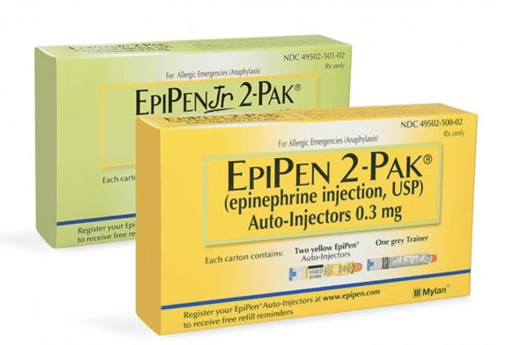
Epinephrine injection
Generic name: epinephrine injection [ EP-i-NEF-rin ]
Brand names: Adrenalin, Auvi-Q, EpiPen, Symjepi
Dosage form: Injection vials, Auto-Injector
Drug classes: Adrenergic bronchodilators, Catecholamines, Vasopressors
What is epinephrine injection?
Epinephrine injection is used to treat severe allergic reactions (anaphylaxis) to insect stings or bites, foods, drugs, and other allergens. Epinephrine is also used to treat low blood pressure that is caused by septic shock.
Epinephrine injection works to reverse wheezing, severe skin itching, hives, and other symptoms of an allergic reaction and also helps with severely low blood pressure. Epinephrine is a is a hormone and neurotransmitter that acts on alpha and beta receptors to cause the muscles in the airways to relax, and it causes the blood vessels to narrow. Epinephrine is from the drug class of medicine called sympathomimetics.
Epinephrine auto-injectors may be kept on hand for self-injection by a person with a history of severe allergic reactions. An Auto-Injector is a hand-held device that automatically injects a measured dose of medicine, it is easier to use in an emergency compared to using vials and needles.
Epinephrine is also known as adrenaline and adrenalin.
Warnings
Seek emergency medical attention after any use of epinephrine to treat a severe allergic reaction. After the injection, you will need to receive further treatment and observation.
Before taking this medicine
Before using epinephrine auto injector or injection, tell your doctor if any past use of epinephrine injection caused an allergic reaction to get worse.
Tell your doctor if you have ever had:
- heart disease or high blood pressure;
- asthma;
- Parkinson's disease;
- depression or mental illness;
- a thyroid disorder; or
- diabetes.
Having an allergic reaction while pregnant or nursing could harm both mother and baby. You may need to use epinephrine during pregnancy or while you are breastfeeding. Seek emergency medical attention right away after using the injection.
If possible, during an emergency, tell your medical caregivers if you are pregnant or breastfeeding.
How should I use epinephrine injection?
Follow all directions on your prescription label and read all medication guides or instruction sheets before you need to use it Ask your doctor or pharmacist if you need help. Use the medicine exactly as directed.
Epinephrine is usually injected as needed at the first sign of a serious allergic reaction.
Epinephrine is injected into the skin or muscle of your outer thigh. In an emergency, this injection can be given through your clothing.
This medicine may come with a "trainer pen." The trainer pen contains no medicine and no needle. It is only for non-emergency use to practice giving yourself an epinephrine injection.
Seek emergency medical attention after any use of epinephrine. The effects of epinephrine may wear off after 10 or 20 minutes. You will need to receive further treatment and observation.
Also seek emergency medical attention if you accidentally inject yourself while giving epinephrine to another person.
Do not give this medicine to a child without medical advice.
The auto-injector device is a disposable single-use system. Use an auto-injector only one time.
Do not try to reinsert an auto-injector a second time. If the needle is bent from the first use, it may cause serious injury to your skin.
Do not use the injection if the expiration date on the label has passed. Call your pharmacist for a new prescription.
Do not reuse a needle or syringe. Place them in a puncture-proof "sharps" container and dispose of it following state or local laws. Keep out of the reach of children and pets.
What should I avoid while using epinephrine injection?
Do not inject epinephrine into a vein or into the muscles of your buttocks, or it may not work as well. Inject it only into the fleshy outer portion of the thigh.
Accidentally injecting epinephrine into your hands or feet may result in a loss of blood flow to those areas, and resulting numbness. You should seek emergency help immediately.
Dosing Information
Usual Adult Dose for Anaphylaxis
Auto-Injector:
30 kg or greater: 0.3 mg IM or subcutaneously into the outer thigh (upper leg), repeat as needed.
Comments:
- The manufacturer's product information for the specific auto-injector being used should be consulted for administration instructions.
- More than 2 sequential doses should only be administered under direct medical supervision.
- The auto-injectors are intended for immediate administration as emergency supportive therapy only and not as a replacement or substitute for immediate medical care.
Injectable Solution of 1 mg/mL (1:1000):
30 kg or greater: 0.3 to 0.5 mg (0.3 to 0.5 mL) of undiluted drug IM or subcutaneously into the outer thigh (upper leg), repeat every 5 to 10 minutes as needed.
- Maximum dose per injection: 0.5 mg (0.5 mL).
Comments:
- For IM administration, use a long enough needle (at least 1/2 inch to 5/8 inch) to ensure injection into the muscle.
- Repeated injections should not be administered at the same site as resulting vasoconstriction may cause tissue necrosis.
- The patient should be monitored clinically for reaction severity and cardiac effects with repeat doses titrated to effect.
Injectable Solution of 0.1 mg/mL (1:10,000):
0.1 to 0.25 mg (1 to 2.5 mL) IV slowly once.
Convenience Kit 1 mg/mL (1:1000):
0.2 to 1 mg IM or subcutaneous.
Usual Pediatric Dose for Anaphylaxis
Auto-Injector:
7.5 to 15 kg: 0.1 mg IM or subcutaneously into the outer thigh (upper leg), repeat as needed.
15 to 30 kg: 0.15 mg IM or subcutaneously into the outer thigh (upper leg), repeat as needed.
30 kg or greater: 0.3 mg IM or subcutaneously into the outer thigh (upper leg), repeat as needed.
Comments:
- Since the lowest dose of the auto-injector is 0.1 mg, consider using other injectable forms of this drug if doses lower than 0.1 mg are necessary.
- More than 2 sequential doses should only be administered under direct medical supervision.
- The manufacturer product information for the specific auto-injector being used should be consulted for administration instructions.
Injectable Solution of 1 mg/mL (1:1000):
Less than 30 kg: 0.01 mg/kg (0.01 mL/kg) of undiluted drug IM or subcutaneously into the outer thigh (upper leg); repeat every 5 to 10 minutes as needed
- Maximum dose per injection: 0.3 mg (0.3 mL)
30 kg or greater: 0.3 to 0.5 mg (0.3 to 0.5 mL) of undiluted drug IM or subcutaneously into the outer thigh (upper leg), repeat every 5 to 10 minutes as needed
- Maximum dose per injection: 0.5 mg (0.5 mL)
Comments:
- For IM administration, use a long enough needle (at least 1/2 inch to 5/8 inch) to ensure injection into the muscle.
- Repeated injections should not be administered at the same site as resulting vasoconstriction may cause tissue necrosis.
- The patient should be monitored clinically for reaction severity and cardiac effects with repeat doses titrated to effect.
Injectable Solution of 0.1 mg/mL (1:10,000):
- Neonate: 0.01 mg/kg IV slowly once
- Infant: 0.05 mg IV slowly once; may repeat at 20 to 30 minute intervals as needed
Uses: For the emergency treatment of allergic reactions (Type I) including anaphylaxis to stinging or biting insects, allergen immunotherapy, foods, drugs, diagnostic testing substances, and other allergens, as well as idiopathic anaphylaxis or exercise-induced anaphylaxis; and for immediate administration in patients who are determined to be at increased risk for anaphylaxis, including those with a history of anaphylactic reactions.
What happens if I miss a dose?
Since epinephrine is used when needed, it does not have a daily dosing schedule.
What happens if I overdose?
Seek emergency medical attention or call the Poison Help line at 1-800-222-1222.
Overdose symptoms may include numbness or weakness, severe headache, blurred vision, pounding in your neck or ears, sweating, chills, chest pain, fast or slow heartbeats, severe shortness of breath, or cough with foamy mucus.
Epinephrine injection side effects
Before using epinephrine, tell your doctor if any past use of epinephrine injection caused an allergic reaction to get worse.
Call your doctor at once if you notice pain, swelling, warmth, redness, or other signs of infection around the area where you gave an injection.
Side effects may be more likely in older adults.
Common side effects of epinephrine injection may include:
- breathing problems;
- fast, irregular, or pounding heartbeats;
- pale skin, sweating;
- nausea and vomiting;
- dizziness;
- weakness or tremors;
- headache; or
- feeling restless, fearful, nervous, anxious, or excited.
This is not a complete list of side effects, and others may occur. Call your doctor for medical advice about side effects. You may report side effects to FDA at 1-800-FDA-1088.
Related/similar drugs
What other drugs will affect epinephrine injection?
Tell your doctor about all your other medicines, especially:
- asthma medicine;
- an antidepressant;
- cold or allergy medicine (Benadryl and others);
- heart or blood pressure medicine;
- thyroid medication; or
- ergot medicine--dihydroergotamine, ergotamine, ergonovine, methylergonovine.
This list is not complete. Other drugs may affect epinephrine, including prescription and over-the-counter medicines, vitamins, and herbal products. Not all possible drug interactions are listed here.
Storage
Store at room temperature away from moisture, heat, and light. Do not refrigerate this medication, and do not store it in a car.
Popular FAQ
Can you use an expired EpiPen in an emergency?
If someone is having an anaphylactic reaction, and all you have on hand is a recently expired EpiPen, then use it so long as it is not discolored and does not contain any particles. There is minimal risk in using a recently expired EpiPen, but the benefits are significant. But check the clear viewing window of the pen and if you notice it is discolored or contains particles then don’t use it as the solution may have oxidized, making it less effective. Continue reading
Can you bring an EpiPen on a plane?
You can bring your EpiPen onto a plane – they are a common medical device and they should not cause any fuss when you are going through airport security. You can carry them in your handbag, laptop bag, or other carry-on luggage. It is a very good idea to take your EpiPen with you on the plane because the small confines of an aircraft increase your odds of being exposed to a trigger allergen while you are flying and having an anaphylactic reaction. Continue reading
What's the mechanism of action for epinephrine?
Epinephrine works by activating both alpha and beta receptors found in your body in response to a severe allergy (called anaphylaxis). By acting on alpha receptors, it helps to maintain your blood pressure and heart function, and by acting on beta receptors, it relaxes your lung airways to help relieve shortness of breath and wheezing. Continue reading
Does epinephrine cause vasoconstriction?
Yes, epinephrine causes vasoconstriction (tightening of the blood vessels). This results in increased blood pressure. Continue reading
How much does Auvi-Q cost compared to EpiPen?
The cash price for a 2-pack of Auvi-Q autoinjector is around $300 compared to $650 for an EpiPen 2-pack. Prices can vary depending upon the pharmacy you visit and if you have any coupons or manufacturer discounts. Auvi-Q and EpiPen are brand names for epinephrine autoinjectors. Continue reading
How does neffy work?
Neffy works in the same way as epinephrine injections, activating both alpha and beta receptors to narrow blood vessels. This helps to maintain blood pressure and heart function, and relaxes smooth muscles in the airways of the lungs to make breathing easier. neffy may also relax the smooth muscles of the stomach and intestine to relieve digestive symptoms often associated with anaphylaxis, such as nausea. Continue reading
More FAQ
More about epinephrine
- Check interactions
- Compare alternatives
- Pricing & coupons
- Reviews (60)
- Latest FDA alerts (4)
- Side effects
- Dosage information
- During pregnancy
- Support group
- Drug class: adrenergic bronchodilators
- Breastfeeding
Patient resources
- Epinephrine (Inhalation) advanced reading
- Epinephrine Auto-Injector and Prefilled Syringe
- Epinephrine Inhalation Aerosol
- Epinephrine Injection Solution
Other brands
EpiPen, Adrenalin, neffy, Auvi-Q, ... +5 more
Professional resources
- EPINEPHrine Bitartrate, EPINEPHrine Hydrochloride, Epinephryl Borate (Mydriatic) (EENT) monograph
- EPINEPHrine Hydrochloride (Vasoconstrictor) (EENT) (AHFS Monograph)
- Epinephrine (AHFS Monograph)
- Epinephrine Concentrate Injection (FDA)
- Epinephrine Injection (FDA)
Other brands
EpiPen, Adrenalin, neffy, Auvi-Q, ... +5 more
Related treatment guides
Further information
Remember, keep this and all other medicines out of the reach of children, never share your medicines with others, and use this medication only for the indication prescribed.
Always consult your healthcare provider to ensure the information displayed on this page applies to your personal circumstances.
Copyright 1996-2025 Cerner Multum, Inc. Version: 17.02.