Kegel Exercises For Men
GENERAL INFORMATION:
What is it? Kegel exercises help to strengthen the pelvic muscles. Kegel exercises may help to bring back or improve bladder control in people with urinary incontinence (in-KON-ti-nens) (urine leakage). These exercises are done by contracting (tightening) and relaxing the pelvic muscles. Kegel exercises are also called pelvic floor muscle training or pelvic floor exercises. They must be done correctly and regularly in order to help strengthen the pelvic muscles.
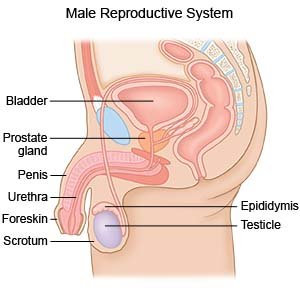
What are pelvic muscles? Pelvic muscles are attached to the area between your pelvic (hip) bones. These muscles act like a strong floor that helps hold your pelvic organs in place. Examples of pelvic organs are the bladder (holds urine) and rectum (holds bowel movements). Certain conditions may cause the pelvic muscles to weaken. Some of these conditions include being overweight, aging, or prostate surgery. When your pelvic muscles become weak, you may have urinary incontinence or other problems.
What are the correct muscles to use during Kegel exercises? Some people use the wrong muscles when doing Kegel exercises. Instead of using the pelvic muscles, they use their back, abdominal, or upper leg muscles. If you use the wrong muscles, the Kegel exercises will not help you. To make sure you are using the right muscles, try the following:
- Sit on the toilet, or stand in front of the toilet. While passing urine, tighten your muscles to stop the flow of urine. Do this several times until you know what it feels like to tighten the correct muscles. Once you have found the right muscles to use, only do Kegel exercises when you are not urinating.
- Lie down and put one finger in your rectum. Tighten your muscles as if trying to stop urine and a bowel movement from coming out. The rectal muscle should tighten around your finger.
How are Kegel exercises done? Kegel exercises can be done any time and anywhere. You can do them in the morning, noon or night. The exercises can be done while sitting, standing, lying on your back or taking a bath. Always urinate (empty your bladder) before starting. Do these exercises each day as directed by your caregiver.
- Slow contractions:
- Contract the muscles around your anus (rear-end). This should feel like you are trying to hold back urine or gas.
- Hold these muscles for a count of 10.
- Slowly release these muscles and relax for a count of 10. Repeat the cycle again.
- Do a set of 10 contractions at least three times every day, or as often as your caregiver suggests.
- Contract the muscles around your anus (rear-end). This should feel like you are trying to hold back urine or gas.
- Quick contractions: Do 5 to 10 quick, strong contractions after you are finished doing the slow contractions. These exercises may help you prevent an accident by quickly stopping urine leaks.
- Remember: Keep your abdominal (stomach), back, and leg muscles relaxed during Kegel exercises. You should feel only the muscles between your legs (pelvic muscles) contracting. Try not to hold your breath while doing these exercises.
What can I do if my muscles are too weak to hold contractions? At the beginning, many people cannot contract their muscles for a count of 10. Start Kegel exercises by squeezing and relaxing pelvic muscles for four to five seconds each. You can increase your count as your muscle tone improves.
How can I remember to do my Kegel exercises regularly? Do your exercises at the same times every day. For example, you can do Kegel exercises when you wake up in the morning, after lunch, and at bedtime. You may want to keep a Kegel exercise diary. Write down how many times each day you do Kegel exercises and how many exercises you do each time.
What else should I know about Kegel exercises?
- It may take 3 to 6 months after starting Kegel exercises to see a difference in bladder control. You may begin to notice improved bladder control after 6 to 8 weeks.
- Do not stop doing Kegel exercises until you have talked to your caregiver. Kegel exercises may be useful for the rest of your life.
- Tighten your pelvic muscles before sneezing, coughing, or lifting to prevent urine leakage.
What are other methods that can be used to strengthen the pelvic muscles? There are other methods that may be used along with Kegel exercises or separately to strengthen your pelvic muscles. Following are some methods that may be suggested by your caregiver:
- Biofeedback: Your caregiver may do biofeedback to help you use the correct muscles. The caregiver may put electrodes on your abdomen and rectal area, or a sensor inside your rectum. Electrodes and sensors are patches or inserts with wires that are attached to a machine. The electrodes or sensors detect your muscle activity and strength and send this information to the machine. This information may help you locate and contract the correct muscles during Kegel exercises.
- Electrical stimulation: Electrical stimulation exercises and strengthens your pelvic muscles through contractions. An electrode sends an electrical current or pulse that contracts your pelvic muscles for you.
Call your caregiver if:
- You cannot feel your muscles tightening and relaxing. Call if you think you are using the wrong muscles to do Kegel exercises.
- Your incontinence is getting worse.
CARE AGREEMENT:
You have the right to help plan your care. To help with this plan, you must learn about incontinence and Kegel exercises. You can then discuss choices with your caregivers. Work with them to decide what choices may be best for you. You always have the right to refuse and make your own decisions.
| Link to this page | ![]() |
Printable Version | ![]() |
Email Page |