Fulvestrant (Monograph)
Brand name: Faslodex
Drug class: Antineoplastic Agents
VA class: AN500
Chemical name: 4′-[2-[[(2aE,4E,5′S,6S,6′R,7R,8E,11R,13R,15S,17aR,20R,20aR,20bS)-6′-Ethyl-3′,4′,5′,6,6′,7,10,11,14,15,17a,20,20a,20b-tetradecahydro-20,20b-dihydroxy-5′,6,8,19-furo[4,3,2-pq][2,6]benzodioxacyclooctadecin-13,2′[2H]pyran]-7-yl]oxy]ethyl]-N-methylmethanesulfonanilide
Molecular formula: C32H47F5O3S
CAS number: 129453-61-8
Introduction
Antineoplastic agent; estrogen antagonist.
Uses for Fulvestrant
Breast Cancer
Treatment of hormone receptor-positive metastatic breast cancer in postmenopausal women with disease progression following antiestrogen (e.g., tamoxifen) therapy.
Efficacy in premenopausal women (e.g., those with functioning ovaries, as evidenced by menstruation and/or premenopausal LH, FSH, and estradiol concentrations) with advanced breast cancer not established.
Fulvestrant Dosage and Administration
General
-
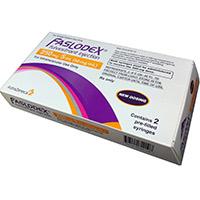
Commercially available as two 5-mL prefilled syringes, each containing 250 mg of fulvestrant, with safety needles.
-
Consult manufacturer’s prescribing information for details on assembly and proper use of safety needle.
Administration
IM Administration
Administer IM slowly (over 1–2 minutes per injection) at the dorsogluteal site or into the upper outer quadrant of the gluteal muscle.
Administer 500-mg dose as 2 concurrent 250-mg (5-mL) injections, which may be administered bilaterally.
Prior to administration, remove injection from refrigeration and keep at room temperature for up to 1 hour or roll gently between the hands.
Dosage
Adults
Breast Cancer
IM
500 mg on days 1, 15, and 29 and then once monthly thereafter. This regimen associated with longer progression-free survival and similar adverse effects compared with previously recommended regimen (250 mg once monthly without a loading dose regimen).
Special Populations
Hepatic Impairment
Mild hepatic impairment (Child-Pugh class A): No dosage adjustment required.
Moderate hepatic impairment (Child-Pugh class B): 250 mg (as single injection) on days 1, 15, and 29 and then once monthly thereafter. (See Hepatic Impairment under Cautions.)
Severe hepatic impairment (Child-Pugh class C): Safety and efficacy not established.
Geriatric Patients
Dosage adjustments not required.
Cautions for Fulvestrant
Contraindications
-
Known hypersensitivity to fulvestrant or any ingredient in the formulation (e.g., benzyl alcohol).
Warnings/Precautions
Sensitivity Reactions
Hypersensitivity reactions, including urticaria and angioedema, reported.
Fetal/Neonatal Morbidity and Mortality
May cause fetal harm; teratogenicity and embryolethality demonstrated in animals.
Avoid pregnancy during therapy. If used during pregnancy or patient becomes pregnant, apprise of potential fetal hazard.
Hematologic Disorders
Use with caution in patients with bleeding diatheses or thrombocytopenia and in those receiving anticoagulant therapy because of IM administration.
Specific Populations
Pregnancy
Category D. (See Fetal/Neonatal Morbidity and Mortality under Cautions.)
Lactation
Distributed into milk in rats; not known whether fulvestrant is distributed into human milk. Discontinue nursing or the drug.
Pediatric Use
Used in a limited number of girls 1–8 years of age with progressive precocious puberty associated with McCune-Albright syndrome† [off-label]; however, efficacy not established. Common adverse effects included injection site reactions (e.g., inflammation, pain, hematoma, pruritus, rash), abdominal pain, contusion, tachycardia, vasodilation (hot flush), extremity pain, and vomiting. Effects on bone mineral density not elucidated.
Geriatric Use
Slightly lower objective response rates in patients ≥65 years of age than in younger adults. No substantial difference in pharmacokinetics relative to younger adults.
Hepatic Impairment
Systemic exposure increased in patients with moderate hepatic impairment (Child-Pugh class B). (See Hepatic Impairment under Dosage and Administration and see Special Populations under Pharmacokinetics). Safety and efficacy not established in patients with severe hepatic impairment (Child-Pugh class C).
Renal Impairment
Not studied in patients with renal impairment; however plasma fulvestrant concentrations in women with Clcr ≥30 mL/minute were similar to those in women with normal renal function.
Common Adverse Effects
Adverse GI effects (e.g., nausea, vomiting, constipation, diarrhea, abdominal pain ), headache, pain (e.g., back pain, bone pain, musculoskeletal pain, extremity pain, pelvic pain ), asthenia, vasodilation (hot flushes), pharyngitis, dyspnea, injection site reactions (e.g., pain ), increased cough, anorexia, peripheral edema, rash, chest pain, flu syndrome, dizziness, insomnia, fever, paresthesia, urinary tract infection, depression, anxiety, sweating, fatigue, arthralgia, joint disorder.
Drug Interactions
Metabolized by CYP3A4 and non-CYP routes.
Does not inhibit CYP1A2, 2C9, 2C19, 2D6, or 3A4 in vitro.
Drugs Affecting Hepatic Microsomal Enzymes
Inhibitors of CYP3A4: Pharmacokinetic interactions unlikely. No dosage adjustment needed.
Inducers of CYP3A4: Pharmacokinetic interactions unlikely. No dosage adjustment needed.
Specific Drugs
|
Drug |
Interaction |
Comments |
|---|---|---|
|
Ketoconazole |
Pharmacokinetic interactions unlikely |
|
|
Midazolam |
Pharmacokinetic interactions unlikely |
|
|
Rifampin |
Pharmacokinetic interactions unlikely |
Fulvestrant Pharmacokinetics
Absorption
Bioavailability
Following IM administration of 500 mg every 2 weeks for the first month of therapy, steady-state plasma concentrations are attained within the first month. Following IM injection of 250 mg once every month (without loading dose regimen), steady-state plasma concentrations are attained after 3–6 doses.
Distribution
Extent
Distributed principally into the extravascular space.
Has been shown to cross the placenta and distribute into milk in rats.
Plasma Protein Binding
99% (mainly VLDL, LDL, and HDL lipoprotein fractions).
Elimination
Metabolism
Metabolized mainly in the liver. Fulvestrant metabolism appears to involve combinations of a number of possible biotransformation pathways analogous to those of endogenous steroids. Identified metabolites are either less active or exhibit similar activity to fulvestrant in antiestrogen models.
In vitro studies indicate that CYP3A4 is the only enzyme involved in fulvestrant oxidation; however, the relative contribution of CYP and non-CYP routes in vivo currently is not known.
Elimination Route
Rapidly cleared by the hepatobiliary route with excretion primarily via feces (approximately 90%); renal elimination is negligible (<1%).
Half-life
Approximately 40 days.
Special Populations
Mild hepatic impairment (Child-Pugh class A) does not substantially alter systemic exposure or clearance. Moderate hepatic impairment (Child-Pugh class B) increases systemic exposure by 70%.
Stability
Storage
Parenteral
Injection
Refrigerate at 2–8°C. Protect from light; store in original carton until time of use.
Actions
-
An estrogen antagonist; a 7α-alkylsulfinyl analog of estradiol.
-
Does not possess estrogen-agonist activity.
-
Competitively binds to and down-regulates estrogen receptors in human breast cancer cells. Reductions in estrogen-receptor levels, as well as associated reductions in progesterone-receptor levels and associated antiproliferative effects, appear to be dose related.
-
Inhibits the growth of tamoxifen-resistant as well as estrogen-sensitive human breast cancer (MCF-7) cell lines in vitro and in vivo.
-
May block the uterotropic action of estradiol.
-
Does not exhibit peripheral steroidal effects in postmenopausal women.
Advice to Patients
-
Necessity of advising women of childbearing potential to use an effective method of contraception while receiving therapy. Importance of women informing clinicians immediately if they are or plan to become pregnant or plan to breast-feed. Advise pregnant women of risk to the fetus.
-
Importance of discontinuing the drug and informing clinician if an allergic or hypersensitivity reaction occurs.
-
Importance of informing clinicians of existing or contemplated concomitant therapy, including prescription and OTC drugs and dietary or herbal supplements, as well as any concomitant illnesses.
-
Importance of informing patients of other important precautionary information. (See Cautions.)
Preparations
Excipients in commercially available drug preparations may have clinically important effects in some individuals; consult specific product labeling for details.
Please refer to the ASHP Drug Shortages Resource Center for information on shortages of one or more of these preparations.
|
Routes |
Dosage Forms |
Strengths |
Brand Names |
Manufacturer |
|---|---|---|---|---|
|
Parenteral |
Injection, for IM use only |
50 mg/mL (250 mg) |
Faslodex (two 5-mL prefilled disposable syringes) |
AstraZeneca |
AHFS DI Essentials™. © Copyright 2025, Selected Revisions August 8, 2012. American Society of Health-System Pharmacists, Inc., 4500 East-West Highway, Suite 900, Bethesda, Maryland 20814.
† Off-label: Use is not currently included in the labeling approved by the US Food and Drug Administration.
Reload page with references included
Related/similar drugs
Frequently asked questions
- How long can you take Faslodex?
- Is Faslodex a form of chemotherapy?
- How long does it take for Faslodex to start working?
More about fulvestrant
- Check interactions
- Compare alternatives
- Reviews (53)
- Side effects
- Dosage information
- During pregnancy
- Drug class: estrogen receptor antagonists
- Breastfeeding
- En español