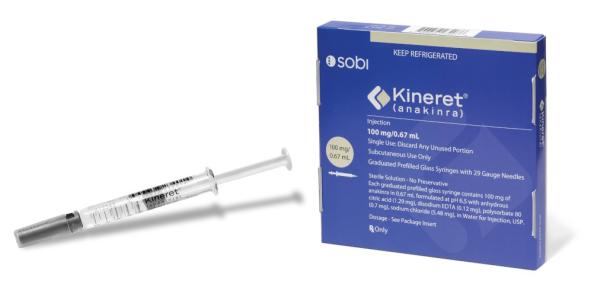
Kineret
Generic name: anakinra [ an-na-KIN-rah ]
Drug classes: Antirheumatics, Interleukin inhibitors
What is Kineret?
Kineret is a FDA approved medicine used to treat moderate to severe rheumatoid arthritis in adults, neonatal onset multisystem inflammatory disease (NOMID) in newborn babies, and deficiency of interleukin-1 receptor antagonist (DIRA) in adults and children.
Kineret also has emergency use authorization (EUA) for the treatment of COVID-19 in specific hospitalized patients.
Kineret works to reduce the body's immune response and inflammation by blocking the IL-1 receptor as it is an interleukin-1 (IL-1) receptor antagonist.
Kineret is given as a subcutaneous injection daily or sometimes twice daily.
Kineret (anakinra) is used to control symptoms in:
- Active rheumatoid arthritis that is moderate to severe, in adult patients who have tried disease modifying antirheumatic drugs (DMARDs) and they have not worked.
- Neonatal-onset multisystem inflammatory disease (NOMID) in new born babies. NOMID is a rare genetic condition that is a form of cryopyrin-associated periodic syndromes (CAPS). NOMID causes uncontrolled inflammation in many parts of the body, including the skin, joints, and central nervous system.
- Deficiency of Interleukin-1 Receptor Antagonist (DIRA) in adults and children. DIRA is a very rare genetic condition that causes a severe inflammatory reaction during the first days of life and can lead to organ failure throughout the body.
-
The US Food and Drug Administration (FDA) has authorized emergency use of anakinra for the treatment of COVID-19 in hospitalized adults who tested positive for COVID-19 with pneumonia requiring supplemental oxygen, who are at risk of having severe respiratory failure, and are likely to have an increased risk of worsening of the disease (measured by abnormal blood levels of a certain protein).
Related/similar drugs
hydroxychloroquine, Paxlovid, Humira, Enbrel, Remicade, Lagevrio, molnupiravir
Warnings
The US Food and Drug Administration (FDA) has authorized emergency use of Kineret for the treatment of COVID-19 in hospitalized adults who tested positive for COVID-19 with pneumonia requiring supplemental oxygen, who are at risk of having severe respiratory failure, and are likely to have an increased risk of worsening of the disease (measured by abnormal blood levels of a certain protein).
You should not use Kineret if you are allergic to medicines that contain E. coli bacteria proteins, or if you have an active infection.
Before using Kineret, tell your doctor if you have asthma, kidney disease, a latex allergy, a weak immune system, an active or chronic infection, or signs of infection such as fever, chills, or open sores on your skin.
Kineret can lower blood cells that help your body fight infections. Your blood may need to be tested often. Avoid being near people who are sick or have infections. Stop using this medicine and call your doctor right away if you have signs of infection such as: fever, chills, flu symptoms, mouth sores, weight loss, or feeling tired or short of breath.
You may have a higher risk of infection if you are also using adalimumab (Humira), certolizumab (Cimzia), etanercept (Enbrel), golimumab (Simponi), infliximab (Remicade), adalimumab (Humira), cancer medicines, steroids, or medicines to prevent organ transplant rejection.
Do not give Kineret to anyone under 18 years old without medical advic
Before taking this medicine
You should not use Kineret if you are allergic to anakinra or if you have:
-
an active infection; or
-
an allergy to any medicine that contains E. coli bacteria proteins.
To make sure Kineret is safe for you, tell your doctor if you have:
-
kidney disease;
-
an active or chronic infection;
-
fever, chills, or open sores on your skin;
-
a weak immune system (caused by disease or by using certain medicines):
-
tuberculosis; or
-
if you are scheduled to receive a vaccine.
Tell your doctor if you are pregnant or plan to become pregnant. Having rheumatoid arthritis or CAPS during pregnancy may increase the risk of premature birth or low birth weight. The benefit of treating rheumatoid arthritis or CAPS may outweigh any risks to the baby.
It may not be safe to breastfeed while using this medicine. Ask your doctor about any risk.
Do not give this medicine to a child without medical advice. Kineret is not approved to treat rheumatoid arthritis in anyone younger than 18 years old.
How should I use Kineret?
Use Kineret exactly as prescribed by your doctor. Follow all directions on your prescription label and read all medication guides or instruction sheets.
Kineret is injected under the skin. A healthcare provider may teach you how to properly use the medication by yourself.
Kineret is given either once per day or once every other day. Follow your doctor's dosing instructions very carefully. Inject your dose at the same time of day when you use the medicine.
Your healthcare provider will show you where on your body to inject Kineret. Use a different place each time you give an injection. Each injection should be given at least 1 inch away from where you last injected the medicine.
Read and carefully follow any Instructions for Use provided with your medicine. Ask your doctor or pharmacist if you don't understand all instructions.
Do not shake the prefilled syringe or you may ruin the medicine.
Prepare an injection only when you are ready to give it. Do not use if the medicine looks cloudy, has changed colors, or has particles in it. Call your pharmacist for new medicine.
Call your doctor if your arthritis symptoms do not improve, or if they get worse while using Kineret.
Anakinra affects your immune system. You may get infections more easily. You will need frequent medical tests before and while using Kineret and for several months after you stop using it.
Store in the refrigerator, do not freeze. Protect from light. Throw away any unused medicine after the expiration date on the label has passed.
Each prefilled syringe is for one use only. Throw it away after one use, even if there is still medicine left inside.
Use a needle and syringe only once and then place them in a puncture-proof "sharps" container. Follow state or local laws about how to dispose of this container. Keep it out of the reach of children and pets.
Dosing information
Usual Adult Dose of Kineret for Rheumatoid Arthritis:
100 mg subcutaneously once daily at approximately the same time each day
Comments:
-Alternating the injection site is recommended to avoid discomfort at the site of injection.
Use: To reduce symptoms and slow the progression of structural damage in moderately to severely active rheumatoid arthritis (RA) in patients who have failed 1 or more disease modifying antirheumatic drugs (DMARDs)
Usual Adult Dose of Kineret for Interleukin-1 Receptor Antagonist Deficiency:
Initial dose: 1 to 2 mg/kg subcutaneously daily
Dose escalation: Adjust doses in 0.5 to 1 mg/kg increments
Maximum dose: 8 mg/kg subcutaneously daily
Use: For the treatment of Deficiency of Interleukin-1 Receptor Antagonist (DIRA)
Usual Pediatric Dose of Kineret for Cryopyrin-Associated Periodic Syndrome:
Initial dose: 1 to 2 mg/kg subcutaneously daily
Dose escalation: Adjust doses in 0.5 to 1 mg/kg increments
Maximum dose: 8 mg/kg subcutaneously daily
NOTE: Once daily administration is generally recommended, but the dose may be split into twice daily administrations.
Comments:
-The therapeutic response is primarily reflected by reduction in symptoms such as fever, rash, joint pain, and headache, but also in inflammatory serum markers (CRP/SAA levels), or occurrence of flares.
Use: Cryopyrin-Associated Periodic Syndromes (CAPS): Treatment of Neonatal-Onset Multisystem Inflammatory Disease (NOMID)
Usual Pediatric Dose of Kineret for Interleukin-1 Receptor Antagonist Deficiency:
1 month and older:
Initial dose: 1 to 2 mg/kg subcutaneously daily
Dose escalation: Adjust doses in 0.5 to 1 mg/kg increments
Maximum dose: 8 mg/kg subcutaneously daily
Use: For the treatment of Deficiency of Interleukin-1 Receptor Antagonist (DIRA) in children 1 month and older
Usual dose of Kineret for adults with COVID-19:
Recommended dosage of Kineret is 100 mg administered daily by subcutaneous injection for 10 days.
Dose for patients with severe renal insufficiency or end stage renal disease (creatinine clearance < 30 mL/min, estimated from serum creatinine levels) consider a dose of 100 mg of Kineret administered every other day for 5 total doses over 10 days.
What happens if I miss a dose?
Call your doctor for instructions if you miss a dose.
What happens if I overdose?
Seek emergency medical attention or call the Poison Help line at 1-800-222-1222.
What should I avoid while using Kineret?
Do not receive a "live" vaccine while using Kineret, or you could develop an infection. Live vaccines include measles, mumps, rubella (MMR), rotavirus, typhoid, yellow fever, varicella (chickenpox), zoster (shingles), and nasal flu (influenza) vaccine.
Avoid being near people who are sick or have infections. Tell your doctor at once if you develop signs of infection.
Kineret side effects
Get emergency medical help if you have signs of an allergic reaction to Kineret: hives, sweating, severe itching; wheezing, difficult breathing; fast or pounding heartbeats; dizziness, fainting; swelling of your face, lips, tongue, or throat.
If you are using Kineret for DIRA, you may have an increased risk of allergic reactions, especially in the first weeks of treatment.
Call your doctor at once if you have:
-
fever or chills;
-
low white blood cell counts - mouth sores, skin sores, sore throat; or
-
signs of tuberculosis - fever, cough, night sweats, loss of appetite, weight loss, and feeling very tired.
Common Kineret side effects may include:
-
abnormal liver function tests;
-
rash;
-
worsening arthritis symptoms;
-
joint pain;
-
flu symptoms;
-
cold symptoms such as stuffy nose, sneezing, sore throat; or
-
redness, bruising, itching, stinging, or swelling where the injection was given.
This is not a complete list of side effects and others may occur. Call your doctor for medical advice about side effects. You may report side effects to FDA at 1-800-FDA-1088.
What other drugs will affect Kineret?
You may have a higher risk of infection from Kineret if you are also using:
-
certolizumab;
-
golimumab;
-
adalimumab; or
-
cancer medicines, steroids, or medicines to prevent organ transplant rejection.
This list is not complete. Other drugs may interact with anakinra, including prescription and over-the-counter medicines, vitamins, and herbal products. Not all possible drug interactions are listed here.
Popular FAQ
Yes, Kineret should be stored in the refrigerator between 36°F to 46°F (2°C to 8°C), but do not freeze it. It’s best to keep it in its original package and away from light, too. Do not shake the glass syringe that contains the medicine.
Your healthcare provider will teach you how and where to inject Kineret, so you can use it at home. It is given as an injection just under the skin (subcutaneously), usually in the area of the upper arm, stomach, thigh or buttock.
Kineret (anakinra) is classified as an interleukin antagonist. It works by blocking the activity of interleukin (IL-1), a substance in the body that can lead to pain, swelling and stiffness. Kineret is approved to treat rheumatoid arthritis and other inflammatory conditions. It is given as an injection under the skin.
Dizziness is not listed as a common side effect of Kineret, but other side effects of Kineret, such as nausea or flu-like symptoms, can make you feel dizzy, and some people may report these as such.
Rarely, dizziness could be a sign of an allergic reaction, but this will usually be accompanied by other symptoms such as swelling of your face, lips, mouth, or tongue; trouble breathing; wheezing; sweating; severe itching; skin rash; hives; redness; or a fast heartbeat (tachycardia). Stop using Kineret immediately and call your healthcare provider or get emergency help right away.
Kineret is considered an immunosuppressant because it suppresses the immune system by blocking the activity of interleukin-1 alpha (IL-1 alpha) which is an immune signaling molecule (also called a cytokine) that is induced in response to inflammatory stimuli. By reducing the effects of IL-1 dampens down inflammation.
Because Kineret affects your immune system, it can increase your risk of infections such as cellulitis or pneumonia and you may have a harder time fighting off these infections. Always tell your doctor if you develop signs of an infection.
Kineret is injected under the skin (subcutaneously) in the outer area of the upper arms, the stomach (abdomen) area (except the 2-inch area around the belly button, the front (top) of the middle thighs, or the upper outer areas of the buttocks. Choose a new site each time you use Kineret.
Kineret may be used to treat several different conditions that have inflammation as a characteristic, such as:
- Rheumatoid Arthritis (RA): Kineret may be used to reduce the signs and symptoms and slow the progression of structural damage in moderately to severely active RA, in adults aged 18 years or older who have failed 1 or more disease-modifying antirheumatic drugs (DMARDs). May be used alone or in combination with DMARDs other than Tumor Necrosis Factor (TNF) blocking agents
- Cryopyrin-Associated Periodic Syndromes (CAPS): These are rare hereditary inflammatory disorders with three phenotypes: familial cold autoinflammatory syndrome, Muckle-Wells syndrome, and neonatal-onset multisystem inflammatory disease (NOMID). Kineret may be used to treat NOMID.
- Deficiency of Interleukin-1 Receptor Antagonist (DIRA): DIRA is a rare life-threatening autoinflammatory disease caused by autosomal recessive mutations in IL1RN. Kineret may be used to treat this.
Kineret may take some time to start working and you should not be discouraged if you do not see immediate results. Most people who experienced an improvement noticed some symptom reduction by 3 months, but it may take up to 6 months for the full effects to be seen.
Although weight gain is not listed as a side effect of Kineret in the product information, it does appear that some people gain weight while taking Kineret. An analysis of data reported that, in general, 1% of people taking Kineret experienced weight gain and it was more likely to occur in women aged 50 to 59 years old who had been taking Kineret for 1 to 6 months. Other literature reports weight gain in approximately 10% of people taking Kineret, particularly those who are on treatment for longer or who are being treated for CAPS (Cryopyrin-Associated Periodic Syndromes).
Certain subsets of people may also be more likely to gain weight. In a case series of 18 people aged 4 to 32 years with NOMID (Neonatal-Onset Multisystem Inflammatory Disease), one-third (6 people) experienced a significant weight increase (reported as a BMI increase of greater than 2 percentiles).
Experts are unsure why Kineret causes weight gain but suggest that inherent adiponectin level differences exist and likely play a role in the body composition when inflammation is controlled and the metabolism shifts from catabolism to anabolism. Low adiponectin levels at baseline and a dysregulated leptin response to weight gain may identify patients who are at risk for significant weight gain when treated with Kineret.
References
More about Kineret (anakinra)
- Check interactions
- Compare alternatives
- Pricing & coupons
- Reviews (9)
- Drug images
- Side effects
- Dosage information
- During pregnancy
- FDA approval history
- Drug class: antirheumatics
- Breastfeeding
- En español
Professional resources
Related treatment guides
Further information
Remember, keep this and all other medicines out of the reach of children, never share your medicines with others, and use Kineret only for the indication prescribed.
Always consult your healthcare provider to ensure the information displayed on this page applies to your personal circumstances.
Copyright 1996-2024 Cerner Multum, Inc. Version: 7.01.