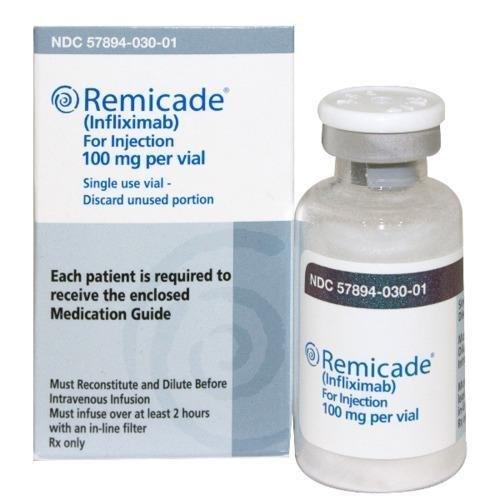
Remicade
Generic name: infliximab [ in-FLIX-ih-mab ]
Drug classes: Antirheumatics, TNF alfa inhibitors
What is Remicade?
Remicade reduces the effects of a substance in the body that can cause inflammation.
Remicade is used to treat rheumatoid arthritis, psoriatic arthritis, ankylosing spondylitis and severe or disabling plaque psoriasis in adults.
Remicade is also used to treat ulcerative colitis and Crohn's disease in adults and children at least 6 years old.
Infliximab is often used when other medicines have not been effective.
Warnings
You should not use Remicade if you are allergic to infliximab, or if you are also being treated with anakinra (Kineret) or abatacept (Orencia).
Using Remicade may increase your risk of developing certain types of cancer, including a rare fast-growing type of lymphoma that can be fatal. Ask your doctor about your specific risk.
Remicade affects your immune system. You may get infections more easily, even serious or fatal infections. Before you start using Remicade, your doctor may perform tests to make sure you do not have certain infections. Call your doctor if you have a fever, tiredness, flu symptoms, cough, or skin pain.
Before taking this medicine
Tell your doctor if you have ever had tuberculosis (TB), or anyone in your household has tuberculosis. Also tell your doctor if you have recently traveled. Tuberculosis and some fungal infections are more common in certain parts of the world, and you may have been exposed during travel.
To make sure Remicade is safe for you, tell your doctor if you have ever had:
-
heart failure or other heart problems;
-
an active infection (fever, cough, flu symptoms, open sores or skin wounds);
-
diabetes;
-
liver failure, hepatitis B, or other liver problems;
-
chronic obstructive pulmonary disease (COPD);
-
heart problems;
-
cancer;
-
a weak immune system;
-
seizures;
-
numbness or tingling anywhere in your body;
-
a nerve-muscle disorder, such as multiple sclerosis or Guillain-Barré syndrome;
-
phototherapy for psoriasis;
-
vaccination with BCG (Bacille Calmette-Guérin); or
-
if you are scheduled to receive any vaccines.
Make sure your child is current on all vaccines before he or she starts treatment with Remicade.
Remicade may cause a rare type of lymphoma (cancer) of the liver, spleen, and bone marrow that can be fatal. This has occurred mainly in teenagers and young men with Crohn's disease or ulcerative colitis. However, anyone with an inflammatory autoimmune disorder may have a higher risk of lymphoma. Talk with your doctor about your own risk.
Remicade may cause other types of cancer, such as skin cancer or cancer of the cervix. Ask your doctor about this risk.
If you use infliximab while you are pregnant, make sure any doctor caring for your new baby knows that you used the medicine during pregnancy. Being exposed to infliximab in the womb could affect your baby's vaccination schedule during the first 6 months of life.
You should not breastfeed while you are receiving infliximab.
Remicade is not for use in children younger than 6 years old.
Related/similar drugs
Entyvio, Bimzelx, Otezla, Stelara, Tremfya, Sotyktu, Cimzia
How is Remicade given?
Before you start treatment with Remicade, your doctor may perform tests to make sure you do not have tuberculosis or other infections.
Remicade is given as an infusion into a vein. A healthcare provider will give you this injection.
This medicine must be given slowly, and the infusion can take at least 2 hours to complete.
You may be watched closely after receiving infliximab, to make sure the medicine has not caused any serious side effects.
Infliximab affects your immune system. You may get infections more easily, even serious or fatal infections. Your doctor will need to examine you on a regular basis, and you may need frequent TB tests.
Serious infections may be more likely in older adults.
If you need surgery, tell the surgeon ahead of time that you are using Remicade.
If you've ever had hepatitis B, using infliximab can cause this virus to become active or get worse. You may need frequent liver function tests while using this medicine and for several months after you stop.
What happens if I miss a dose?
Call your doctor for instructions if you miss an appointment for your Remicade injection.
What happens if I overdose?
Seek emergency medical attention or call the Poison Help line at 1-800-222-1222.
What should I avoid while receiving Remicade?
Avoid activities that may increase your risk of bleeding injury.
Do not receive a "live" vaccine while using infliximab, or you could develop a serious infection. Live vaccines include measles, mumps, rubella (MMR), polio, rotavirus, typhoid, yellow fever, and varicella (chickenpox).
Remicade side effects
Some side effects may occur during the injection. Tell your caregiver if you feel dizzy, nauseated, light-headed, itchy or tingly, short of breath, or have a headache, fever, chills, muscle or joint pain, pain or tightness in your throat, chest pain, or trouble swallowing during the injection. Infusion reactions may also occur within 1 or 2 hours after injection.
Get emergency medical help if you have signs of an allergic reaction to Remicade: hives; chest pain, difficult breathing; fever, chills, severe dizziness; swelling of your face, lips, tongue, or throat.
Serious and sometimes fatal infections may occur during treatment with Remicade. Call your doctor right away if you have signs of infection such as: fever, extreme tiredness, flu symptoms, cough, or skin symptoms (pain, warmth, or redness).
Also call your doctor if you have:
-
skin changes, new growths on the skin;
-
pale skin, easy bruising or bleeding;
-
delayed allergic reaction (up to 12 days after receiving Remicade) - fever, sore throat, trouble swallowing, headache, joint or muscle pain, skin rash, or swelling in your face or hands;
-
liver problems - right-sided upper stomach pain, loss of appetite, yellowing of your skin or eyes (jaundice), and not feeling well;
-
lupus-like syndrome - joint pain or swelling, chest discomfort, feeling short of breath, skin rash on your cheeks or arms (worsens in sunlight);
-
nerve problems - numbness or tingling, problems with vision, weakness in your arms or legs, seizure;
-
new or worsening psoriasis - skin redness or scaly patches, raised bumps filled with pus;
-
signs of heart failure - shortness of breath with swelling of your ankles or feet, rapid weight gain;
-
signs of a stroke - sudden numbness or weakness, trouble speaking or understanding what is said to you, problems with vision or balance, severe headache;
-
signs of lymphoma - fever, night sweats, weight loss, stomach pain or swelling, chest pain, cough, trouble breathing, swollen glands (in your neck, armpits, or groin); or
-
signs of tuberculosis - fever, cough, night sweats, loss of appetite, weight loss, feeling constantly tired.
Serious infections may be more likely in adults who are 65 years or older.
Common Remicade side effects may include:
-
stuffy nose, sinus pain;
-
fever, chills, sore throat;
-
cough, chest pain, shortness of breath;
-
high or low blood pressure;
-
headache, feeling light-headed;
-
rash, itching; or
-
stomach pain.
This is not a complete list of side effects and others may occur. Call your doctor for medical advice about side effects. You may report side effects to FDA at 1-800-FDA-1088.
What other drugs will affect Remicade?
Tell your doctor about all your other medicines, especially:
-
any "biologic" medications to treat your condition - adalimumab, certolizumab, etanercept, golimumab, natalizumab, rituximab, and others; or
-
any other medicines to treat Crohn's disease, ulcerative colitis, rheumatoid arthritis, ankylosing spondylitis, psoriatic arthritis, or psoriasis.
This list is not complete. Other drugs may interact with infliximab, including prescription and over-the-counter medicines, vitamins, and herbal products. Not all possible drug interactions are listed here.
Popular FAQ
What are monoclonal antibodies?
Monoclonal antibodies (mAbs) are man-made proteins that mimic the natural antibodies produced by our immune systems. Monoclonal antibodies can be formulated into medicines to treat various types of illnesses, such as cancer, rheumatoid arthritis or psoriasis. Continue reading
What are biosimilar drugs and how do they compare to biologics?
A biosimilar is a biological product that is similar to a reference biologic (usually the originally approved product) and for which there are no clinically meaningful differences in terms of safety, purity, and potency. One example is Amjevita (adalimumab-atto), the first biosimilar approved for Humira (adalimumab) in 2016. Continue reading
What is the difference between Inflectra and Remicade?
Inflectra (infliximab-dyyb) is a biosimilar to Remicade (infliximab). They belong to the same class of drugs called tumor necrosis factor (TNF) alfa inhibitors. Inflectra can be prescribed for the same uses as Remicade, including rheumatoid arthritis, Crohn’s disease, ankylosing spondylitis, ulcerative colitis, psoriatic arthritis, and plaque psoriasis. Continue reading
What is the difference between Renflexis and Remicade?
Renflexis (infliximab-abda) is a tumor necrosis factor (TNF) blocker that is biosimilar to Remicade (infliximab). A biosimilar has no clinically meaningful differences in terms of safety and effectiveness from the reference product.
Renflexis is given as an intravenous (IV) infusion similar to Remicade, and is used for the same conditions, including rheumatoid arthritis, Crohn's disease and psoriatic arthritis. Biosimilars may lead to cost-savings due to a lower price and are preferred by some insurance companies. Continue reading
More FAQ
- What are the new drugs for rheumatoid arthritis (RA)?
- What are the new drugs for plaque psoriasis?
- How many biosimilars have been approved in the United States?
- What causes Plaque Psoriasis?
- What is the difference between Ixifi and Remicade?
References
More about Remicade (infliximab)
- Check interactions
- Compare alternatives
- Pricing & coupons
- Reviews (212)
- Drug images
- Side effects
- Dosage information
- During pregnancy
- Support group
- FDA approval history
- Drug class: antirheumatics
- Breastfeeding
- En español
Patient resources
Other brands
Inflectra, Avsola, Renflexis, Zymfentra, Ixifi
Professional resources
Other brands
Inflectra, Avsola, Renflexis, Zymfentra
Related treatment guides
Further information
Remember, keep this and all other medicines out of the reach of children, never share your medicines with others, and use Remicade only for the indication prescribed.
Always consult your healthcare provider to ensure the information displayed on this page applies to your personal circumstances.
Copyright 1996-2024 Cerner Multum, Inc. Version: 20.02.