
Pregnancy
Medically reviewed by Drugs.com. Last updated on Aug 4, 2025.
A normal pregnancy lasts about 40 weeks. The first trimester lasts from your last period through the 12th week of pregnancy. The second trimester lasts from the 13th week through the 23rd week. The third trimester lasts from the 24th week until your baby is born. If you know the date of your last period, your healthcare provider can estimate your due date. You may give birth to your baby any time from 37 weeks to 2 weeks after your due date.
DISCHARGE INSTRUCTIONS:
Seek care immediately if:
- You develop a severe headache that does not go away.
- You have new or increased vision changes, such as blurred or spotted vision.
- You have new or increased swelling in your face or hands.
- You have pain or cramping in your abdomen or low back.
- You have vaginal bleeding.
Call your doctor or obstetrician if:
- You have abdominal cramps, pressure, or tightening.
- You have a change in vaginal discharge.
- You cannot keep food or drinks down, and you are losing weight.
- You have chills or a fever.
- You have vaginal itching, burning, or pain.
- You have yellow, green, white, or foul-smelling vaginal discharge.
- You have pain or burning when you urinate, less urine than usual, or pink or bloody urine.
- You have questions or concerns about your condition or care.
Medicines:
- Prenatal vitamins provide some of the extra vitamins and minerals you need during pregnancy. Prenatal vitamins may also help to decrease the risk for certain birth defects.
- Take your medicine as directed. Contact your healthcare provider if you think your medicine is not helping or if you have side effects. Tell your provider if you are allergic to any medicine. Keep a list of the medicines, vitamins, and herbs you take. Include the amounts, and when and why you take them. Bring the list or the pill bottles to follow-up visits. Carry your medicine list with you in case of an emergency.
Related medications
Prenatal care:
Prenatal care is a series of visits with your healthcare provider throughout your pregnancy. Prenatal care can help prevent problems during pregnancy and childbirth. At each prenatal visit, your provider will weigh you and check your blood pressure. He or she will also check your baby's heartbeat and growth. You may also need the following at some visits:
- A pelvic exam allows your healthcare provider to see your cervix (the bottom part of your uterus). Your healthcare provider will use a speculum to open your vagina. He or she will check the size and shape of your uterus. At your first prenatal visit, you may also have a Pap smear. This is a test to check your cervix for abnormal cells.
- Blood tests may be done to check for any of the following:
- Gestational diabetes or anemia (low iron level)
- Blood type or Rh factor, or certain birth defects
- Immunity to certain diseases, such as chickenpox or rubella
- An infection, such as a sexually transmitted infection, HIV, or hepatitis B
- Hepatitis B may need to be prevented or treated. Hepatitis B is inflammation of the liver caused by the hepatitis B virus (HBV). HBV can spread from a mother to her baby during delivery. You will be checked for HBV as early as possible in the first trimester of each pregnancy. You need the test even if you received the hepatitis B vaccine or were tested before. You may need to have an HBV infection treated before you give birth.
- Urine tests may also be done to check for sugar and protein. These can be signs of gestational diabetes or preeclampsia. Urine tests may also be done to check for signs of infection.
- A gestational diabetes screen may be done. Your healthcare provider may order either a 1-step or 2-step oral glucose tolerance test (OGTT).
- 1-step OGTT: Your blood sugar level will be tested after you have not eaten for 8 hours (fasting). You will then be given a glucose drink. Your level will be tested again 1 hour and 2 hours after you finish the drink.
- 2-step OGTT: You do not have to fast for the first part of the test. You will have the glucose drink at any time of day. Your blood sugar level will be checked 1 hour later. If your blood sugar is higher than a certain level, another test will be ordered. You will fast and your blood sugar level will be tested. You will have the glucose drink. Your blood will be tested again 1 hour, 2 hours, and 3 hours after you finish the glucose drink.
- A fetal ultrasound shows pictures of your baby inside your uterus. The pictures are used to check your baby's development, movement, and position.
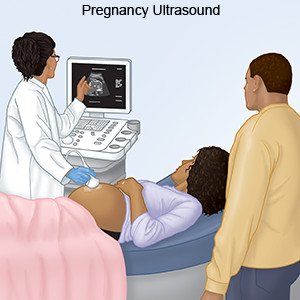
- Genetic disorder screening tests may be offered to you. These tests check your baby's risk for genetic disorders such as Down syndrome. A screening test may include blood tests and an ultrasound. Blood tests may be used to check your DNA or your partner's DNA. Genetic tests are not always accurate or complete. Your baby may be born with a genetic disorder that did not show up in the tests. Talk to your healthcare provider about any concerns you have with genetic testing.
Body changes that may occur during your pregnancy:
- Breast changes you will experience include tenderness and tingling during the early part of your pregnancy. Your breasts will become larger. You may need to use a support bra. You may see a thin, yellow fluid, called colostrum, leak from your nipples during the second trimester. Colostrum is a liquid that changes to milk about 3 days after you give birth.
- Skin changes and stretch marks may occur during your pregnancy. You may have red marks, called stretch marks, on your skin. Stretch marks will usually fade after pregnancy. Use lotion if your skin is dry and itchy. The skin on your face, around your nipples, and below your belly button may darken. Most of the time, your skin will return to its normal color after your baby is born.
- Morning sickness is nausea and vomiting that can happen at any time of day. Avoid fatty and spicy foods. Eat small meals throughout the day instead of large meals. Ginger may help to decrease nausea. Ask your healthcare provider about other ways of decreasing nausea and vomiting.
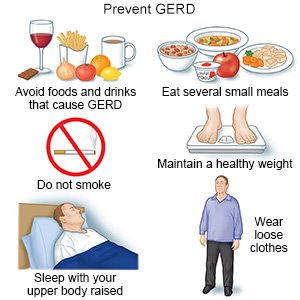
- Heartburn may be caused by changes in your hormones during pregnancy. Your growing uterus may also push your stomach upward and force stomach acid to back up into your esophagus. Eat 4 or 5 small meals each day instead of large meals. Avoid spicy foods. Avoid eating right before bedtime.
- Constipation may develop during your pregnancy. To treat constipation, eat foods high in fiber such as fiber cereals, beans, fruits, vegetables, whole-grain breads, and prune juice. Get regular exercise and drink plenty of water. Your healthcare provider may also suggest a fiber supplement to soften your bowel movements. Talk to your healthcare provider before you use any medicines to decrease constipation.

- Hemorrhoids are enlarged veins in the rectal area. They may cause pain, itching, and bright red bleeding from your rectum. To decrease your risk for hemorrhoids, prevent constipation and do not strain to have a bowel movement. If you have hemorrhoids, soak in a tub of warm water to ease discomfort. Ask your healthcare provider how you can treat hemorrhoids.
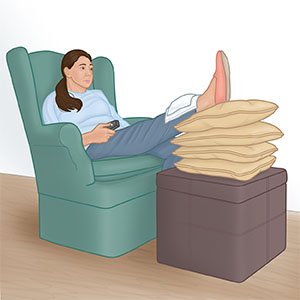
- Leg cramps and swelling may be caused by low calcium levels or the added weight of pregnancy. Raise your legs above the level of your heart to decrease swelling. During a leg cramp, stretch or massage the muscle that has the cramp. Heat may help decrease pain and muscle spasms. Apply heat on your muscle for 20 to 30 minutes every 2 hours for as many days as directed.
- Back pain may occur as your baby grows. Do not stand for long periods of time or lift heavy items. Use good posture while you stand, squat, or bend. Wear low-heeled shoes with good support. Rest may also help to relieve back pain. Ask your healthcare provider about exercises you can do to strengthen your back muscles.
Stay healthy during your pregnancy:
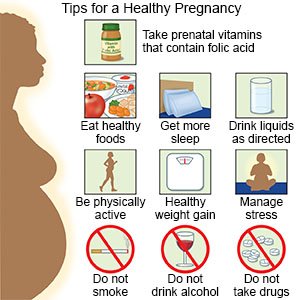 |
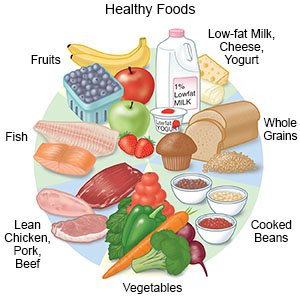
- Eat a variety of healthy foods. Healthy foods include fruits, vegetables, whole-grain breads, low-fat dairy foods, beans, lean meats, and fish. Drink liquids as directed. Ask how much liquid to drink each day and which liquids are best for you. Limit caffeine to less than 200 milligrams each day. Limit your intake of fish to 2 servings each week. Choose fish low in mercury such as canned light tuna, shrimp, crab, salmon, cod, or tilapia. Do not eat fish high in mercury such as swordfish, tilefish, king mackerel, and shark.
- Take prenatal vitamins as directed. Prenatal vitamins provide some of the extra vitamins and minerals you need during pregnancy. The vitamins will contain 400 to 800 micrograms (mcg) of folic acid to help prevent certain conditions, such as spina bifida. You may have started taking prenatal vitamins or folic acid supplements 1 month or more before you became pregnant. Continue taking them for the first 2 to 3 months (8 to 12 weeks) of pregnancy.

- Ask how much weight you should gain during your pregnancy. Too much or too little weight gain can be unhealthy for you and your baby.
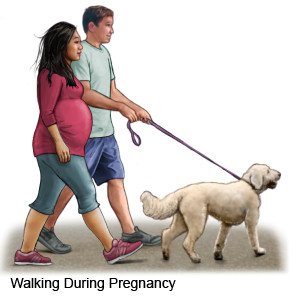
- Talk to your healthcare provider about exercise. Moderate exercise can help you stay fit. Your healthcare provider will help you plan an exercise program that is safe for you during pregnancy.
- Do not smoke. Smoking increases your risk for a miscarriage and heart and blood vessel problems. Smoking can cause your baby to be born too early or weigh less at birth. Quit smoking as soon as you think you might be pregnant. Ask your healthcare provider for information if you need help quitting.
- Do not drink alcohol. Alcohol passes from your body to your baby through the placenta. It can affect your baby's brain development and cause fetal alcohol syndrome (FAS). FAS is a group of conditions that causes mental, behavior, and growth problems.
- Talk to your healthcare provider before you take any medicines. Many medicines may harm your baby if you take them when you are pregnant. Do not take any medicines, vitamins, herbs, or supplements without first talking to your healthcare provider. Never use illegal or street drugs (such as marijuana or cocaine) while you are pregnant.
Safety tips:
- Avoid hot tubs and saunas. Do not use a hot tub or sauna while you are pregnant, especially during your first trimester. Hot tubs and saunas may raise your baby's temperature and increase the risk for birth defects.
- Avoid toxoplasmosis. This is an infection caused by eating raw meat or being around infected cat feces. It can cause birth defects, miscarriages, and other problems. Wash your hands after you touch raw meat. Make sure any meat is well-cooked before you eat it. Avoid raw eggs and unpasteurized milk. Use gloves or ask someone else to clean your cat's litter box while you are pregnant.
- Ask your healthcare provider about travel. The most comfortable time to travel is during the second trimester. Ask your healthcare provider if you can travel after 36 weeks. You may not be able to travel in an airplane after 36 weeks. He or she may also recommend that you avoid long road trips.
Follow up with your doctor or obstetrician as directed:
Go to all of your prenatal visits during your pregnancy. Write down your questions so you remember to ask them during your visits.
© Copyright Merative 2025 Information is for End User's use only and may not be sold, redistributed or otherwise used for commercial purposes.
The above information is an educational aid only. It is not intended as medical advice for individual conditions or treatments. Talk to your doctor, nurse or pharmacist before following any medical regimen to see if it is safe and effective for you.
Learn more about Pregnancy
Care guides
Further information
Always consult your healthcare provider to ensure the information displayed on this page applies to your personal circumstances.