
Implantable Cardioverter Defibrillator
Medically reviewed by Drugs.com. Last updated on Aug 4, 2025.
What do I need to know about an implantable cardioverter defibrillator (ICD)?
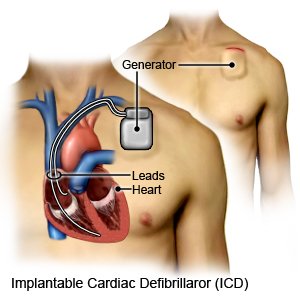
An ICD is a small device that monitors your heart rate and rhythm. It is placed inside your chest or abdomen. An ICD may be used if you have a life-threatening arrhythmia. An arrhythmia is an irregular heart rate or a heart rate that is too fast or too slow. Some arrhythmias may cause your heart to stop beating suddenly. An ICD can give a shock to your heart to make it start beating again. It can also make your heartbeat faster or slower.
 |
How do I prepare for insertion of an ICD?
- Your surgeon will talk to you about how to prepare for the procedure. Your surgeon may tell you not to eat or drink anything after midnight on the day of your procedure. Arrange to have someone drive you home and stay with you after the procedure.
- Tell your surgeon about all medicines you currently take. Your surgeon will tell you if you need to stop any medicine for the procedure, and when to stop. Your surgeon will tell you which medicines to take or not take on the day of your procedure.
- Tell your surgeon about all your allergies, including antibiotics. You may be given an antibiotic through your IV to help prevent a bacterial infection.
- Make arrangements at home and work, if needed. You will not be able to lift anything heavy for several days after the procedure. Someone may need to help you around the house during this time. Ask your surgeon when you can return to work after the procedure. You may need to arrange for time off.
What will happen during insertion of an ICD?
- You may be given general anesthesia to keep you asleep and free from pain during the procedure. You may also be given a sedative and local anesthesia to numb the procedure area. With local anesthesia, you may still feel pressure or pushing during the procedure, but you should not feel any pain. Your surgeon will make an incision in your chest or abdomen. A lead will be placed into a vein near your collarbone or neck and guided into your heart. You may have multiple leads placed into your heart.
- The other end of the leads will be attached to the generator and placed in a pocket under your skin. This pocket is usually in the shoulder area, but may be in the abdominal area. The generator has a metal shell with a battery and a small computer. The computer will monitor your heart rate and rhythm. If the computer senses an irregular heartbeat, it will send electricity from the generator through the leads to your heart. These electrical shocks will make your heart beat normally.
- Your surgeon will close the incision with stitches or staples. A bandage or tape may be placed over your incision.
Related medications
What will the shocks from an ICD feel like?
You may not notice the low-energy shocks from your ICD, or they may feel like a flutter in your chest. The high-energy shocks are very short. They may feel like thumping or a painful kick in the chest. Your healthcare provider may give you medicine to decrease the number of high-energy shocks.
What should I expect after ICD insertion?
- You will be taken to a recovery room where you will rest until you are awake.
- You will be on a heart monitor. A heart monitor is an EKG that stays on continuously to record your heart's electrical activity.
- You may need a chest x-ray to make sure the ICD is in the right place.
- You may be able to leave when you are awake and your pain is controlled. You may go to a hospital room to spend the night.
What are the risks of ICD insertion?
You may bleed more than expected or develop a blood clot after the procedure. You may develop an infection. The leads could poke a hole in your heart, lung, or vein. The leads may also cause arrhythmias when they are placed. Blood may collect in the pocket where the generator is placed and cause pain or an infection. The leads may disconnect or break, and you may need another procedure. You may also need another procedure to replace the entire ICD. Your ICD may not shock your heart when it needs it. It may also shock more than it should.
Care Agreement
You have the right to help plan your care. Learn about your health condition and how it may be treated. Discuss treatment options with your healthcare providers to decide what care you want to receive. You always have the right to refuse treatment. The above information is an educational aid only. It is not intended as medical advice for individual conditions or treatments. Talk to your doctor, nurse or pharmacist before following any medical regimen to see if it is safe and effective for you.© Copyright Merative 2025 Information is for End User's use only and may not be sold, redistributed or otherwise used for commercial purposes.
Learn more about Implantable Cardioverter Defibrillator
Care guides
Further information
Always consult your healthcare provider to ensure the information displayed on this page applies to your personal circumstances.