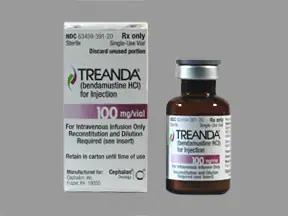
Treanda
Generic name: bendamustine [ BEN-da-MUS-teen ]
Drug class: Alkylating agents
What is Treanda?
Treanda is a cancer medicine that interferes with the growth and spread of cancer cells in the body.
Treanda is used to treat chronic lymphocytic leukemia.
Treanda is also used to treat indolent B-cell non-Hodgkin lymphoma after other medicines have been tried without successful treatment of this condition.
Warnings
Before you receive Treanda, tell your doctor if you have a weak immune system, fever or other signs of infection, a metabolic disorder or electrolyte imbalance, liver or kidney disease, or if you smoke.
Tell your caregiver right away if you have a fever, chills, itching, or a skin rash during or shortly after the injection.
Treanda can lower blood cells that help your body fight infections and help your blood to clot. You may get an infection or bleed more easily. Call your doctor if you have unusual bruising or bleeding, or signs of infection (fever, chills, body aches).
Before taking this medicine
You should not be treated with Treanda if you are allergic to bendamustine, polyethylene glycol, propylene glycol or mannitol (Osmitrol).
To make sure Treanda is safe for you, tell your doctor if you have:
-
a weak immune system;
-
fever or other signs of infection;
-
tuberculosis;
-
herpes zoster (also called shingles);
-
a metabolic disorder or electrolyte imbalance;
-
liver disease;
-
kidney disease; or
-
if you smoke.
Using Treanda may increase your risk of developing certain types of cancer. Ask your doctor about this risk.
Bendamustine can harm an unborn baby or cause birth defects if the mother or the father is using Treanda.
-
If you are a woman, do not use bendamustine if you are pregnant. You may need to have a negative pregnancy test before starting this treatment. Use effective birth control to prevent pregnancy while you are using Treanda and for at least 6 months after your last dose.
-
If you are a man, use effective birth control if your sex partner is able to get pregnant. Keep using birth control for at least 3 months after your last dose.
-
Tell your doctor right away if a pregnancy occurs while either the mother or the father is using Treanda.
Bendamustine may affect fertility (ability to have children) in men. However, it is important to use birth control to prevent pregnancy because bendamustine can harm an unborn baby.
Do not breastfeed while using Treanda and for at least 1 week after your last dose.
How is Treanda given?
Treanda is given as an infusion into a vein. A healthcare provider will give you this injection.
Treanda is usually given for 2 days in a row every 21 to 28 days. You may receive up to 8 treatments total, depending on the condition being treated. Follow your doctor's instructions.
You may be given other medications to help prevent certain side effects of bendamustine.
Tell your caregivers if you feel any burning, pain, or swelling around the IV needle when Treanda is injected.
Bendamustine can lower blood cells that help your body fight infections and help your blood to clot. You may get infections more easily, even serious or fatal infections. Your blood will need to be tested often. Your cancer treatments may be delayed based on the results of these tests.
If you've ever had hepatitis B, using Treanda can cause this virus to become active or get worse. You may need frequent liver function tests while using this medicine and for several months after you stop.
Dosing information
Usual Adult Dose for Chronic Lymphocytic Leukemia:
Recommended dose: 100 mg/m2 administered intravenously on days 1 and 2 of a 28 day cycle, up to 6 cycles. Treanda is intended for administration as an intravenous infusion over 30 minutes.
Consider using allopurinol as prevention for patients at high risk of tumor lysis syndrome for the first few weeks of treatment.
Treanda administration should be delayed in the event of grade 4 hematologic toxicity or clinically significant greater than or equal to grade 2 nonhematologic toxicity. Once nonhematologic toxicity has recovered to less than or equal to grade 1 and/or the blood counts have improved [Absolute Neutrophil Count (ANC) greater than or equal to 1 x 10^9/L, platelets greater than or equal 75 x 10^9/L], Treanda can be reinitiated at the discretion of the treating physician. Dose delays may be warranted.
Dose modifications for hematologic toxicity: for grade 3 or greater toxicity, reduce the dose to 50 mg/m2 on days 1 and 2 of each cycle; if grade 3 or greater toxicity recurs, reduce the dose to 25 mg/m2 on days 1 and 2 of each cycle.
Dose modifications for nonhematologic toxicity: for clinically significant grade 3 or greater toxicity, reduce the dose to 50 mg/m2 on days 1 and 2 of each cycle.
Dose reescalation in subsequent cycles may be considered at the discretion of the treating physician.
Usual Adult Dose for non-Hodgkin's Lymphoma:
Recommended dose: 120 mg/m2 intravenously on days 1 and 2 of a 21 day cycle for up to 8 cycles. Treanda is intended for administration as an intravenous infusion over 60 minutes.
Treanda administration should be delayed in the event of a grade 4 hematologic toxicity or clinically significant greater than or equal to grade 2 nonhematologic toxicity. Once nonhematologic toxicity has recovered to less than or equal to grade 1 and/or the blood counts have improved [Absolute Neutrophil Count (ANC) greater than or equal to 1 x 10^9/L, platelets greater than or equal 75 x 10^9/L], Treanda can be reinitiated at the discretion of the treating physician. In addition, dose reduction may be warranted.
Dose modifications for hematologic toxicity: for grade 4 or greater toxicity, reduce the dose to 90 mg/m2 on days 1 and 2 of each cycle; if grade 4 or greater toxicity recurs, reduce the dose to 60 mg/m2 on days 1 and 2 of each cycle.
Dose modifications for nonhematologic toxicity: for grade 3 or greater toxicity, reduce the dose to 90 mg/m2 on days 1 and 2 of each cycle; if grade 3 or greater toxicity recurs, reduce the dose to 60 mg/m2 on Days 1 and 2 of each cycle.
What happens if I miss a dose?
Call your doctor for instructions if you miss an appointment for your Treanda injection.
What happens if I overdose?
Seek emergency medical attention or call the Poison Help line at 1-800-222-1222.
What should I avoid while receiving Treanda?
Avoid driving or hazardous activity until you know how bendamustine will affect you. Your reactions could be impaired.
Bendamustine can pass into body fluids (urine, feces, vomit). For at least 48 hours after you receive a dose, avoid allowing your body fluids to come into contact with your hands or other surfaces. Caregivers should wear rubber gloves while cleaning up a patient's body fluids, handling contaminated trash or laundry or changing diapers. Wash hands before and after removing gloves. Wash soiled clothing and linens separately from other laundry.
Treanda side effects
Get emergency medical help if you have signs of an allergic reaction to Treanda (hives, difficult breathing, swelling in your face or throat) or a severe skin reaction (fever, sore throat, burning in your eyes, skin pain, red or purple skin rash that spreads and causes blistering and peeling).
Seek medical treatment if you have a serious drug reaction that can affect many parts of your body. Symptoms may include: skin rash, fever, swollen glands, muscle aches, severe weakness, unusual bruising, or yellowing of your skin or eyes.
Bendamustine may cause a brain infection that can lead to disability or death. Tell your doctor if you have problems with speech, thought, vision, or muscle movement. These symptoms can get worse quickly.
Call your doctor at once if you have:
-
fever, chills, or itching during or shortly after the injection;
-
pain, swelling, redness, skin changes, or signs of infection where the medicine was injected;
-
liver problems - right-sided upper stomach pain, vomiting, loss of appetite, yellowing of your skin or eyes, and not feeling well;
-
low blood cell counts - fever, chills, tiredness, mouth sores, skin sores, easy bruising, unusual bleeding, pale skin, cold hands and feet, feeling light-headed or short of breath; or
-
signs of tumor cell breakdown - confusion, weakness, muscle cramps, nausea, vomiting, fast or slow heart rate, decreased urination, tingling in your hands and feet or around your mouth.
Your cancer treatments may be delayed if you have certain side effects.
Common Treanda side effects may include:
-
fever, cough, mouth sores, trouble breathing;
-
low blood cell counts;
-
nausea, vomiting, diarrhea, constipation;
-
headache, tiredness;
-
rash; or
-
loss of appetite, weight loss.
This is not a complete list of side effects and others may occur. Call your doctor for medical advice about side effects. You may report side effects to FDA at 1-800-FDA-1088.
Related/similar drugs
What other drugs will affect Treanda?
Sometimes it is not safe to use certain medications at the same time. Some drugs can affect your blood levels of other drugs you take, which may increase side effects or make the medications less effective.
Tell your doctor about all your other medicines, especially:
This list is not complete. Other drugs may interact with bendamustine, including prescription and over-the-counter medicines, vitamins, and herbal products. Not all possible drug interactions are listed here.
Frequently asked questions
- How is Bendeka different to Treanda?
- Why has Bendeka replaced Treanda?
- Does Treanda cause hair loss?
- What is Treanda used for and how does it work?
- Are lung nodules common after Bendeka & Rituxan therapy?
- How often is Bendeka given and how long does treatment last?
More about Treanda (bendamustine)
- Check interactions
- Compare alternatives
- Pricing & coupons
- Reviews (1)
- Drug images
- Side effects
- Dosage information
- Patient tips
- During pregnancy
- Generic availability
- FDA approval history
- Drug class: alkylating agents
- Breastfeeding
- En español
Patient resources
Other brands
Professional resources
Other brands
Related treatment guides
Further information
Remember, keep this and all other medicines out of the reach of children, never share your medicines with others, and use Treanda only for the indication prescribed.
Always consult your healthcare provider to ensure the information displayed on this page applies to your personal circumstances.
Copyright 1996-2025 Cerner Multum, Inc. Version: 10.01.