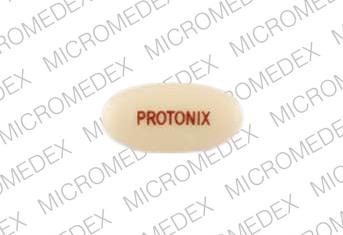
Protonix Side Effects
Generic name: pantoprazole
Medically reviewed by Drugs.com. Last updated on Oct 31, 2023.
Note: This document provides detailed information about Protonix Side Effects associated with pantoprazole. Some dosage forms listed on this page may not apply specifically to the brand name Protonix.
Applies to pantoprazole: oral packet, oral powder for suspension, oral tablet delayed release, oral tablet enteric coated.
Other dosage forms:
Serious side effects of Protonix
Along with its needed effects, pantoprazole (the active ingredient contained in Protonix) may cause some unwanted effects. Although not all of these side effects may occur, if they do occur they may need medical attention.
Check with your doctor immediately if any of the following side effects occur while taking pantoprazole:
Less common
- blurred vision
- dry mouth
- flushed, dry skin
- fruit-like breath odor
- increased hunger
- increased thirst
- increased urination
- nausea
- stomach pain
- sweating
- trouble breathing
- unexplained weight loss
- vomiting
Incidence not known
- absence of or decrease in body movements
- black, tarry stools
- blindness
- blistering, peeling, or loosening of the skin
- bloating
- bloody or cloudy urine
- bloody, black, or tarry stools
- blurred vision
- chest pain or tightness
- chills
- clay-colored stools
- confusion
- constipation
- continuous ringing or buzzing or other unexplained noise in the ears
- cough
- dark urine
- decreased vision
- diarrhea
- difficulty with speaking
- difficulty with swallowing
- dizziness or lightheadedness
- drowsiness
- fast heartbeat
- feeling of constant movement of self or surroundings
- fever
- greatly decreased frequency of urination or amount of urine
- headache
- hearing loss
- high fever
- hives, itching, or skin rash
- indigestion
- joint pain
- large, hive-like swelling on the face, eyelids, lips, tongue, throat, hands, legs, feet, or genitals
- light-colored stools
- loss of appetite
- mood or mental changes
- muscle cramp, pain, stiffness, spasms, or twitching
- muscle cramps in the hands, arms, feet, legs, or face
- numbness and tingling around the mouth, fingertips, or feet
- painful or difficult urination
- pains in the stomach, side, or abdomen, possibly radiating to the back
- pale skin
- puffiness or swelling of the eyelids or around the eyes, face, lips, or tongue
- red skin lesions, often with a purple center
- red, irritated eyes
- seizures
- sensation of spinning
- sore throat
- sores, ulcers, or white spots on the lips or in the mouth
- stomach pain, continuing
- swelling of the feet or lower legs
- swollen glands
- trembling
- unexplained bleeding or bruising
- unpleasant breath odor
- unusual tiredness or weakness
- vomiting of blood
- yellow eyes or skin
Other side effects of Protonix
Some side effects of pantoprazole may occur that usually do not need medical attention. These side effects may go away during treatment as your body adjusts to the medicine. Also, your health care professional may be able to tell you about ways to prevent or reduce some of these side effects.
Check with your health care professional if any of the following side effects continue or are bothersome or if you have any questions about them:
Less common
- belching
- bloated or full feeling
- excess air or gas in the stomach or bowels
- passing gas
- trouble sleeping
Incidence not known
- decreased interest in sexual intercourse
- inability to have or keep an erection
- increased watering of the mouth
- loss in sexual ability, desire, drive, or performance
For healthcare professionals
Applies to pantoprazole: intravenous powder for injection, intravenous solution, oral delayed release tablet, oral granule enteric coated, oral suspension.
General
The most commonly reported side effects were headache, diarrhea, and injection site thrombophlebitis (in IV formulations).[Ref]
Nervous system
- Very common (10% or more): Headache (Up to 26.4%), taste pervasion (Up to 18.2%)
- Common (1% to 10%): Dizziness, metallic/bitter taste, somnolence
- Rare (0.01% to 0.1%): Taste disorders
- Very rare (less than 0.01%): Change to the sense of taste, reduced movement, speech disorder
- Frequency not reported: Paresthesia, vertigo
- Postmarketing reports: Ageusia, dysgeusia[Ref]
Headache was a very commonly reported side effect in pediatric patients 2 to 16 years of age. In adults, headache occurred most frequently in patients given quadruple therapy (pantoprazole, bismuth, metronidazole, tetracycline) for H pylori infections, but was also very common in triple therapy (pantoprazole, amoxicillin, clarithromycin).
Taste pervasion most frequently occurred in patients given triple therapy, but it was also very common in patients given quadruple therapy.[Ref]
Respiratory
- Very common (10% or more): Nasopharyngitis (up to 13.6%), pharyngolaryngeal pain (up to 13.2%)
- Common (1% to 10%): Cough, nasal congestion, pharyngitis
- Very rare (less than 0.01%): Change to the sense of smell, dyspnea
- Frequency not reported: Upper respiratory tract infection[Ref]
Nasopharyngitis and pharyngolaryngeal pain occurred in pediatric patients between the ages of 2 to 16 years.[Ref]
Gastrointestinal
- Very common (10% or more): Diarrhea (Up to 11.6%)
- Common (1% to 10%): Abdominal pain, benign fundic gland polyps/fundic gland polyps, buccal inflammation, constipation, dry mouth, dyspepsia, fecal discoloration, flatulence, heartburn, nausea, oral moniliasis, pruritus ani, tongue discoloration, tongue pain, upper abdominal pain, vomiting
- Uncommon (0.1% to 1%): Abdominal discomfort/distention, bloating, loose stools
- Rare (0.01% to 0.1%): Colon polyp, rectal disorder
- Very rare (less than 0.01%): Increased saliva
- Frequency not reported: Clostridium difficile-associated diarrhea, severe eructation[Ref]
Diarrhea occurred most frequently in patients given quadruple therapy (pantoprazole, bismuth, metronidazole, tetracycline) for Helicobacter pylori infections, but was also very common in triple therapy (pantoprazole, amoxicillin, clarithromycin).
Nausea, vomiting, abdominal pain, dry mouth, and constipation were more commonly reported in patients given triple therapy, compared to patients given quadruple therapy.
Fecal and/or tongue discoloration occurred more commonly in patients given quadruple therapy versus patients given triple therapy.[Ref]
Other
- Common (1% to 10%): Tiredness
- Uncommon (0.1% to 1%): Asthenia, fatigue, malaise
- Rare (0.01% to 0.1%): Body temperature increased, fever
- Very rare (less than 0.01%): Pain, tinnitus
- Frequency not reported: Facial edema[Ref]
Psychiatric
- Common (1% to 10%): Depression (and all aggravations)
- Uncommon (0.1% to 1%): Sleep disorders
- Rare (0.01% to 0.1%): Confusion (and all aggravations), disorientation (and all aggravations), hallucination (and all aggravations)
- Very rare (less than 0.01%): Anxiety
- Postmarketing reports: Insomnia[Ref]
Confusion, depression, hallucinations, and disorientation, especially in predisposed patients, occurred with use, and was aggravated in patients with preexisting conditions.[Ref]
Hepatic
- Common (1% to 10%): Increased liver enzymes (transaminases, GGT)
- Rare (0.01% to 0.1%): Increased bilirubin
- Very rare (less than 0.01%): Cholestatic hepatitis, hepatitis, hepatocellular failure, jaundice
- Frequency not reported: Hepatic effects, hepatocellular injury, liver function tests abnormal
- Postmarketing reports: Hepatocellular damage[Ref]
Severe hepatocellular damage leading to jaundice/hepatic failure is predicted to have a frequency of 1 in 1,000,000 patients.[Ref]
Dermatologic
- Common (1% to 10%): Exanthema/exanthemata, rash
- Uncommon (0.1% to 1%): Eruption, increased sweating, pruritus
- Rare (0.01% to 0.1%): Urticaria
- Very rare (less than 0.01%): Erythema multiforme, flushing, Lyell syndrome, photosensitivity/photosensitivity reaction, severe skin reactions, Stevens-Johnson syndrome, toxic epidermal necrolysis (TEN)
- Frequency not reported: Cutaneous lupus erythematosus, facial edema, fatal skin reactions, fatal TEN, subacute cutaneous lupus erythematosus[Ref]
Cardiovascular
- Common (1% to 10%): Chest pain
- Rare (0.01% to 0.1%): Hypertension, peripheral edema, thrombophlebitis
- Very rare (less than 0.01%): Circulatory collapse, flushing, hot flushes, substernal chest pain
- Frequency not reported: Generalized edema[Ref]
Musculoskeletal
- Common (1% to 10%): Arthralgia
- Uncommon (0.1% to 1%): Fracture of the hip/wrist/spine
- Rare (0.01% to 0.1%): Myalgia
- Very rare (less than 0.01%): Skeletal pain
- Frequency not reported: Bone fracture, elevated creatine phosphokinase (CPK)/elevated creatine kinase (CK), muscle spasm, systemic lupus erythematosus
- Postmarketing reports: Rhabdomyolysis[Ref]
Muscle spasm occurred as a consequence of electrolyte disturbances.[Ref]
Metabolic
- Common (1% to 10%): Anorexia
- Rare (0.01% to 0.1%): Hyperlipidemia, increased cholesterol, increased triglycerides, lipid increases, weight changes
- Frequency not reported: Cyanocobalamin (vitamin B12) deficiency), electrolyte disturbances, hypocalcemia, hypokalemia, hypomagnesemia, hyponatremia, potential for exacerbation of zinc deficiency[Ref]
Hypocalcemia occurred in association with hypomagnesemia.
Anorexia commonly occurred in patients with H pylori.[Ref]
Local
- Common (1% to 10%): Injection site thrombophlebitis
- Frequency not reported: Injection site reactions[Ref]
Immunologic
- Common (1% to 10%): Influenza-like symptoms, moniliasis
- Rare (0.01% to 0.1%): Sepsis[Ref]
Hypersensitivity
- Rare (0.01% to 0.1%): Anaphylactic reactions, anaphylactic shock, angioedema/Quincke's edema, hypersensitivity, hypersensitivity reactions
- Frequency not reported: Allergic reactions
- Postmarketing reports: Anaphylaxis[Ref]
Hematologic
- Rare (0.01% to 0.1%): Agranulocytosis, anemia
- Very rare (less than 0.01%): Increased coagulation time, leukopenia, pancytopenia, thrombocytopenia[Ref]
Ocular
- Uncommon (0.1% to 1%): Blurred vision, visual disturbances
- Very rare (less than 0.01%): Conjunctivitis[Ref]
Endocrine
- Rare (0.01% to 0.1%): Gynecomastia[Ref]
Renal
- Very rare (less than 0.01%): Interstitial nephritis (with possible progression to renal failure)
- Frequency not reported: Acute interstitial nephritis[Ref]
References
1. (2001) "Product Information. Protonix (pantoprazole)." Wyeth-Ayerst Laboratories
2. "Product Information. Protonix IV (pantoprazole)." Wyeth-Ayerst Laboratories
3. Cerner Multum, Inc. "UK Summary of Product Characteristics."
4. Cerner Multum, Inc. "Australian Product Information."
Frequently asked questions
- Pantoprazole vs. omeprazole: What's the difference between them?
- Can you take pantoprazole 40 mg twice a day?
- How long can I take pantoprazole?
- Does pantoprazole cause bloating?
More about Protonix (pantoprazole)
- Check interactions
- Compare alternatives
- Pricing & coupons
- Reviews (83)
- Drug images
- Dosage information
- Patient tips
- During pregnancy
- Generic availability
- Support group
- Drug class: proton pump inhibitors
- Breastfeeding
- En español
Patient resources
- Protonix drug information
- Protonix (Pantoprazole Intravenous) (Advanced Reading)
- Protonix (Pantoprazole Delayed-Release Granules)
- Protonix (Pantoprazole Delayed-Release Tablets)
Professional resources
Other formulations
Related treatment guides
Further information
Protonix side effects can vary depending on the individual. Always consult your healthcare provider to ensure the information displayed on this page applies to your personal circumstances.
Some side effects may not be reported. You may report them to the FDA.