Roflumilast (Topical) (Monograph)
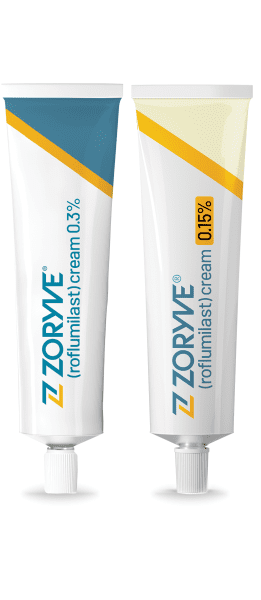
Brand name: Zoryve
Drug class: Phosphodiesterase-4 Inhibitors
Introduction
Roflumilast is a phosphodiesterase (PDE) type 4 inhibitor.
Uses for Roflumilast (Topical)
Plaque Psoriasis
Roflumilast is indicated for topical treatment of plaque psoriasis, including intertriginous areas, in patients 12 years of age and older. Guidelines for the management of psoriasis with topical and alternative agents state that topical agents are most often used for patients with mild to moderate disease; recommendations are not provided for use of roflumilast, which was approved after publication of the guideline.
Roflumilast (Topical) Dosage and Administration
General
Pretreatment Screening
-
Prior to initiating roflumilast, evaluate patients for presence of hepatic dysfunction; roflumilast is contraindicated in patients with moderate (Child-Pugh class B) or severe (Child-Pugh class C) hepatic impairment.
Other General Considerations
-
In patients who are breastfeeding, use roflumilast on the smallest area of skin and for the shortest duration possible to minimize potential exposure to the breastfed infant via breast milk. Advise breastfeeding patients not to apply roflumilast directly to the nipple or areola to avoid direct infant exposure.
Administration
Oral Administration
For topical use only. Not for ophthalmic, oral, or intravaginal use. Rub in cream completely until no longer visible on skin. Wash hands after application, unless roflumilast is for treatment of the hands.
Dosage
Pediatric Patients
Plaque Psoriasis
Topical
Pediatric patients ≥12 years of age: Apply once daily to affected areas, including intertriginous areas.
Adults
Plaque Psoriasis
Topical
Apply once daily to affected areas, including intertriginous areas.
Special Populations
Hepatic Impairment
Contraindicated in moderate (Child-Pugh class B) or severe (Child-Pugh class C) hepatic impairment.
Renal Impairment
No specific dosage recommendations.
Geriatric Patients
No dosage adjustment necessary; however, greater sensitivity of some older individuals cannot be ruled out.
Cautions for Roflumilast (Topical)
Contraindications
-
Moderate to severe liver impairment (Child-Pugh B or C).
Warnings/Precautions
Specific Populations
Pregnancy
No adequate human data available on roflumilast use in pregnancy. In animal studies, oral roflumilast administered during the period of organogenesis produced no fetal structural abnormalities at doses up to 9 and 8 times the maximum recommended human dose. Do not use roflumilast during labor and delivery; animal studies showed that oral roflumilast disrupted the labor and delivery process in mice.
Lactation
No data regarding the presence of roflumilast in human milk, the effects on the breastfed infant, or the effects on milk production.
Excreted into milk of lactating rats and therefore, likely to be present in human milk. Consider the developmental and health benefits of breastfeeding along with the mother's clinical need for roflumilast and any potential adverse effects on the breastfed infant or from the underlying maternal condition.
To minimize potential exposure to the breastfed infant via breast milk, use on the smallest area of skin and for the shortest duration possible while breastfeeding. To avoid direct infant exposure, advise breastfeeding patients not to apply roflumilast directly to the nipple and areola.
Pediatric Use
Safety and effectiveness established in pediatric patients ages 12 years and older for the treatment of plaque psoriasis.
Safety and effectiveness in pediatric patients below the age of 12 years have not been established.
Geriatric Use
In clinical trials, 106 subjects with psoriasis exposed to roflumilast or vehicle were 65 years of age or older. No overall differences in safety or effectiveness observed between older subjects and younger subjects, but greater sensitivity of some older individuals cannot be ruled out.
Hepatic Impairment
The AUC and Cmax values of roflumilast and roflumilast N-oxide were increased in subjects with moderate (Child-Pugh B) hepatic impairment when roflumilast was orally administered. Contraindicated in patients with moderate to severe hepatic impairment (Child-Pugh B or C).
Renal Impairment
Topical roflumilast has not been evaluated in patients with renal impairment. No clinically significant differences in the pharmacokinetics of roflumilast or its roflumilast N-oxide metabolite observed in patients with severe renal impairment following oral administration.
Common Adverse Effects
Adverse effects reported in ≥1% of patients with plaque psoriasis in clinical studies and with an incidence exceeding that of vehicle include diarrhea, headache, insomnia, application site pain, upper respiratory tract infections, and urinary tract infections.
Drug Interactions
Extensive metabolism via Phase 1 CYP enzyme and Phase II conjugation reactions. In vitro, metabolized by CYP1A2 and CYP3A4. N-oxide metabolite only major metabolite observed in human plasma. Therapeutic plasma concentrations of roflumilast and its N-oxide metabolite do not inhibit CYP1A2, 2A6, 2B6, 2C8, 2C9, 2C19, 2D6, 2E1, 3A4/5, or 4A9/11; therefore, interactions with these enzymes unlikely. In vitro, no induction of CYP1A2, 2A6, 2C9, 2C19, or 3A4/5, and only weak induction of CYP2B6.
No formal drug interaction studies conducted with topical roflumilast.
Drugs Affecting Hepatic Microsomal Enzymes
Inhibitors of CYP3A4 and CYP1A2: Based on drug interaction studies, the coadministration of roflumilast with systemic CYP3A4 inhibitors or dual inhibitors that inhibit both CYP3A4 and CYP1A2 simultaneously (e.g., erythromycin, ketoconazole, fluvoxamine, enoxacin, cimetidine) may increase roflumilast systemic exposure and can result in increased adverse effects of roflumilast. Weigh the risks of concurrent use of roflumilast against the potential benefits.
Specific Drugs and Foods
|
Drug |
Interaction |
Comments |
|---|---|---|
|
Cimetidine |
Coadministration with oral roflumilast increased roflumilast Cmax and AUC by 46% and 85%, respectively; also decreased the Cmax and increased the AUC of roflumilast N-oxide metabolite by 4% and 27%, respectively |
Risks of concurrent use should be weighed against benefits. |
|
Enoxacin |
Coadministration with oral roflumilast increased roflumilast Cmax and AUC by 20% and 56%, respectively; also decreased the Cmax and increased the AUC of the roflumilast N-oxide metabolite by 14% and 23%, respectively |
Risks of concurrent use should be weighed against benefits. |
|
Erythromycin |
Coadministration with oral roflumilast increased roflumilast Cmax and AUC by 40% and 70%, respectively; decreased the Cmax and increased the AUC of the roflumilast N-oxide metabolite by 34% and 4%, respectively |
Risks of concurrent use should be weighed against benefits. |
|
Fluvoxamine |
Coadministration with oral roflumilast increased roflumilast Cmax and AUC by 12% and 156%, respectively; also decreased the roflumilast N-oxide metabolite Cmax by 210% and increased the AUC by 52% |
Risks of concurrent use should be weighed against benefits. |
|
Ketoconazole |
Coadministration with oral roflumilast increased roflumilast Cmax and AUC by 23% and 99%, respectively, and reduced the Cmax and increased the AUC of the roflumilast N-oxide metabolite by 38% and 3%, respectively |
Risks of concurrent use should be weighed against benefits. |
|
Oral contraceptives (containing gestodene and ethinyl estradiol) |
Coadministration with oral roflumilast resulted in a 38% increase and 12% decrease in the Cmax of roflumilast and roflumilast N-oxide, respectively Roflumilast and roflumilast N-oxide metabolite AUCs increased by 51% and 14%, respectively |
Risks of concurrent use should be weighed against benefits. |
Roflumilast (Topical) Pharmacokinetics
Absorption
After topical application of 3–6.5 grams daily for 15 days, the mean ± SD systemic exposure (AUC0-24) in adults was 72.7 ± 53.1 and 628 ± 648 h•ng/mL for roflumilast and the N-oxide metabolite, respectively. In adolescents, the mean AUC0-24 was 25.1 ± 24 and 140 ± 179 h•ng/mL for roflumilast and the N-oxide metabolite, respectively.
Distribution
Extent
Not known if excreted into human milk.
Plasma Protein Binding
Approximately 99% and 97% for roflumilast and its N-oxide metabolite, respectively.
Elimination
Metabolism
Metabolized by CYP1A2 and CYP3A4. Major N-oxide metabolite is pharmacologically active.
Elimination Route
Not detectable in urine; N-oxide metabolite detectable in trace amounts (<1%) after oral administration; other conjugated metabolites detectable in urine.
Half-life
Following topical administration, the half-lives of roflumilast and the N-oxide metabolite are 4 and 4.6 days, respectively.
Special Populations
No clinically significant differences in pharmacokinetics observed based on age (range 12–88 years), sex, race, or ethnicity.
Stability
Storage
Store between 20–25°C; excursions permitted between 15–30°C.
Topical
Cream
0.3%: 3 mg of roflumilast per gram in 60-gram tubes.
Actions
-
Roflumilast and its active metabolite, roflumilast N-oxide, are inhibitors of PDE4. Inhibition of PDE4 (a major cyclic 3′,5′-adenosine monophosphate (cyclic AMP) metabolizing enzyme) activity by roflumilast and roflumilast N-oxide leads to the accumulation of intracellular cyclic AMP. The specific mechanism(s) by which roflumilast exerts its therapeutic action in plaque psoriasis are not well defined.
Advice to Patients
-
Advise the patient or caregiver to read the FDA-approved patient labeling (Patient Information).
-
Advise the patient to apply roflumilast to the affected areas once daily. The cream should be rubbed in completely until it is no longer visible on the skin.
Advise the patient or caregiver to wash their hands after application of roflumilast cream, unless roflumilast is used for treatment of the hands.
-
Importance of informing clinicians of existing or contemplated concomitant therapy, including prescription and OTC drugs and dietary or herbal supplements, as well as any concomitant illnesses.
-
Importance of women informing clinicians if they are or plan to become pregnant or plan to breast-feed. Advise breastfeeding women not to apply roflumilast directly to the nipple and areola to avoid direct infant exposure.
-
Importance of informing patients of other important precautionary information.
Additional Information
The American Society of Health-System Pharmacists, Inc. represents that the information provided in the accompanying monograph was formulated with a reasonable standard of care, and in conformity with professional standards in the field. Readers are advised that decisions regarding use of drugs are complex medical decisions requiring the independent, informed decision of an appropriate health care professional, and that the information contained in the monograph is provided for informational purposes only. The manufacturer’s labeling should be consulted for more detailed information. The American Society of Health-System Pharmacists, Inc. does not endorse or recommend the use of any drug. The information contained in the monograph is not a substitute for medical care.
Preparations
Excipients in commercially available drug preparations may have clinically important effects in some individuals; consult specific product labeling for details.
Please refer to the ASHP Drug Shortages Resource Center for information on shortages of one or more of these preparations.
|
Routes |
Dosage Forms |
Strengths |
Brand Names |
Manufacturer |
|---|---|---|---|---|
|
Topical |
Cream |
0.3% |
Zoryve |
Arcutis Biotherapeutics |
AHFS DI Essentials™. © Copyright 2025, Selected Revisions February 27, 2023. American Society of Health-System Pharmacists, Inc., 4500 East-West Highway, Suite 900, Bethesda, Maryland 20814.
Reload page with references included
Related/similar drugs
More about roflumilast topical
- Check interactions
- Compare alternatives
- Reviews (59)
- Side effects
- Dosage information
- During pregnancy
- Drug class: selective phosphodiesterase-4 inhibitors
- Breastfeeding
- En español