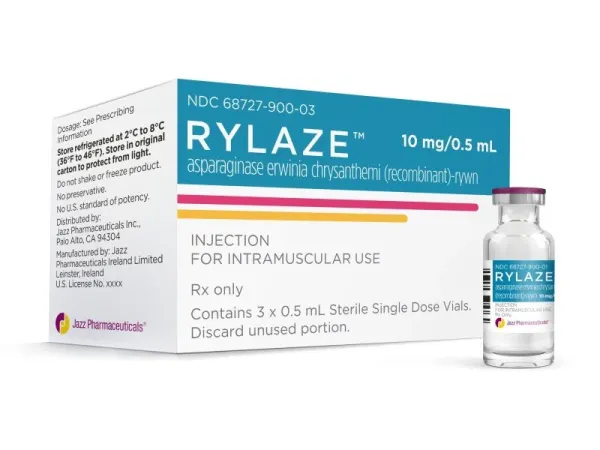
Asparaginase (Erwinia chrysanthemi) (Monograph)
Brand name: Erwinaze
Drug class: Antineoplastic Agents
Molecular formula: C1546H2510N432O476S9 (monomer)
CAS number: 1349719-22-7
Introduction
Antineoplastic agent; enzyme derived from Erwinia chrysanthemi (formerly Erwinia carotovora; also known as Pectobacterium chrysanthemi).
Uses for Asparaginase (Erwinia chrysanthemi)
Acute Lymphocytic Leukemia (ALL)
Component of combination chemotherapy for treatment of ALL in patients who are hypersensitive to E. coli-derived asparaginase preparations; designated an orphan drug by FDA for this use.
Asparaginase (Erwinia chrysanthemi) Dosage and Administration
General
-
Administer in a setting with resuscitation equipment and other agents necessary to treat anaphylaxis. (See Hypersensitivity Reactions under Cautions.)
-
In patients receiving the drug by IV infusion, consider monitoring serum trough asparaginase activity; if desired asparaginase concentrations not achieved, consider switching to IM administration. (See Plasma Concentrations under Pharmacokinetics.)
-
Consult specialized references for procedures for proper handling and disposal of antineoplastics.
Administration
Administer by IM injection or IV infusion.
IM Administration
Do not give >2 mL at one injection site.
Reconstitution
Discard powder for injection if foreign particulate matter or discoloration present prior to reconstitution.
Add 1 or 2 mL of sterile, preservative-free 0.9% sodium chloride injection to a vial containing 10,000 units of asparaginase (Erwinia chrysanthemi) to provide a solution containing 10,000 or 5000 units/mL, respectively. Based on indicated dosage of drug, reconstitute appropriate number of vials.
Slowly inject diluent against inner wall of vial; do not forcefully inject directly onto or into powder. Dissolve contents by gently mixing or swirling vial; do not shake or invert vial.
Withdraw appropriate dose from vial into a polypropylene syringe within 15 minutes of reconstitution. Administer reconstituted solution within 4 hours or discard; do not freeze or refrigerate reconstituted solution.
Reconstituted solution should be clear and colorless; discard if particles or protein aggregates visible.
Discard any unused portion of vial.
IV Administration
For solution compatibility information, see Compatibility under Stability.
Administer by IV infusion.
Must be reconstituted and further diluted prior to IV administration.
Do not infuse simultaneously through the same IV line with other drugs.
Reconstitution
Reconstitute asparaginase (Erwinia chrysanthemi) lyophilized powder in the same manner as for IM administration. (See IM Administration: Reconstitution, under Dosage and Administration.)
Dilution
Slowly inject the appropriate volume of reconstituted asparaginase (Erwinia chrysanthemi) solution into an IV infusion bag containing 100 mL of 0.9% sodium chloride injection at room temperature. Do not shake or squeeze bag.
Rate of Administration
Administer dose by IV infusion over 1–2 hours.
Dosage
Dosage expressed in terms of international units (IU, units).
Consult published protocols for dosage, method of administration, and administration sequence of drugs in combination regimens.
Pediatric Patients
ALL
ALL and Hypersensitivity to Escherichia coli-derived Asparaginase
IM or IVTo substitute for a dose of pegaspargase: 25,000 units/m2 3 times weekly (Monday, Wednesday, Friday) for 6 doses for each planned dose of pegaspargase.
To substitute for a dose of native (nonconjugated) asparaginase (Escherichia coli) (no longer commercially available in US): 25,000 units/m2 for each scheduled dose of native asparaginase (Escherichia coli).
Dosage Modification for Toxicity and Contraindications to Continued Therapy
Anaphylaxis and Allergic Reactions
Discontinue drug if serious allergic reaction occurs.
Thrombosis and Hemorrhage
Withhold drug if thrombotic or hemorrhagic event occurs; may resume therapy after resolution. (See Contraindications under Cautions.)
Pancreatitis
Permanently discontinue drug if severe pancreatitis occurs. (See Pancreatitis under Cautions.)
If mild pancreatitis occurs, withhold drug until signs and symptoms resolve and amylase concentrations return to normal; may resume therapy after resolution.
Adults
ALL
ALL and Hypersensitivity to Escherichia coli-derived Asparaginase
IM or IVTo substitute for a dose of pegaspargase: 25,000 units/m2 3 times weekly (Monday, Wednesday, Friday) for 6 doses for each planned dose of pegaspargase.
To substitute for a dose of native (nonconjugated) asparaginase (Escherichia coli) (no longer commercially available in US): 25,000 units/m2 for each scheduled dose of native asparaginase (Escherichia coli).
Dosage Modification for Toxicity and Contraindications to Continued Therapy
Anaphylaxis and Allergic Reactions
Discontinue drug if serious allergic reaction occurs.
Thrombosis and Hemorrhage
Withhold drug if thrombotic or hemorrhagic event occurs; may resume therapy after resolution. (See Contraindications under Cautions.)
Pancreatitis
Permanently discontinue drug if severe pancreatitis occurs. (See Pancreatitis under Cautions.)
If mild pancreatitis occurs, withhold drug until signs and symptoms resolve and amylase concentrations return to normal; may resume therapy after resolution.
Special Populations
Hepatic Impairment
Manufacturer makes no specific dosage recommendations.
Renal Impairment
Manufacturer makes no specific dosage recommendations.
Geriatric Patients
Safety and efficacy not established in geriatric patients.
Cautions for Asparaginase (Erwinia chrysanthemi)
Contraindications
-
History of serious thrombosis with prior asparaginase therapy.
-
History of serious pancreatitis with prior asparaginase therapy.
-
History of serious hemorrhagic events with prior asparaginase therapy.
-
History of serious hypersensitivity reactions (e.g., anaphylaxis) to asparaginase (Erwinia chrysanthemi).
Warnings/Precautions
Sensitivity Reactions
Hypersensitivity Reactions
Serious (grade 3 or 4) hypersensitivity reactions, including anaphylaxis, reported. Allergic reactions reported in some patients switching to asparaginase (Erwinia chrysanthemi) following clinical hypersensitivity to native (nonconjugated) asparaginase (Escherichia coli) (no longer commercially available in US).
Administer in a setting with resuscitation equipment and other agents necessary to treat anaphylaxis.
If serious hypersensitivity reaction occurs, discontinue drug and initiate appropriate therapy.
Pancreatitis
Pancreatitis, including grade 3 or 4, reported. Evaluate patients experiencing symptoms compatible with pancreatitis to establish a diagnosis.
In patients with severe or hemorrhagic pancreatitis associated with abdominal pain for >72 hours and amylase concentrations ≥2 times ULN, discontinue drug. Severe pancreatitis is a contraindication to continued therapy.
In patients with mild pancreatitis, withhold drug until signs and symptoms resolve and amylase concentrations return to normal; may resume therapy after resolution.
Hyperglycemia
Glucose intolerance (sometimes irreversible) and hyperglycemia (including grade 3 or 4) reported.
Monitor glucose concentrations at baseline and periodically during therapy. Administer insulin as necessary.
Thrombosis and Hemorrhage
Serious thrombotic events (e.g., sagittal sinus thrombosis, pulmonary embolism) reported. Coagulation proteins (i.e., antithrombin III, fibrinogen, protein C activity, protein S activity) decreased in most patients after 2 weeks of therapy.
If thrombotic or hemorrhagic event occurs, withhold drug until symptoms resolve; may resume therapy after resolution.
Fetal/Neonatal Morbidity and Mortality
May cause fetal harm. Embryofetal mortality and fetal structural abnormalities reported in animal studies at doses lower than maximum recommended human dosage.
Confirm pregnancy status prior to initiating asparaginase (Erwinia chrysanthemi) therapy. Avoid pregnancy during therapy. Women of childbearing potential should use effective methods of contraception while receiving asparaginase (Erwinia chrysanthemi) and for ≥3 months after last dose. Avoid concomitant use of oral contraceptives and asparaginase (Erwinia chrysanthemi). (See Specific Drugs under Interactions.) If used during pregnancy or if patient becomes pregnant, apprise of potential fetal hazard.
Immunogenicity
Potential for immunogenicity with use of therapeutic proteins such as asparaginase (Erwinia chrysanthemi). Anti-drug antibodies reported. Presence of anti-drug antibodies is associated with higher risk of hypersensitivity reactions in patients receiving the drug by IV infusion compared with those receiving the drug by IM injection.
Specific Populations
Pregnancy
May cause fetal harm. (See Fetal/Neonatal Morbidity and Mortality under Cautions.)
Lactation
Not known whether asparaginase (Erwinia chrysanthemi) distributes into milk or has any effects on milk production or on the nursing infant. Women should not breast-feed during therapy and for ≥3 months after last dose.
Pediatric Use
Safety and efficacy as a component of combination chemotherapy for ALL established in pediatric patients ≥1 year of age who were hypersensitive to E. coli-derived asparaginase.
Geriatric Use
Safety and efficacy not established in geriatric patients.
Common Adverse Effects
Systemic hypersensitivity reactions, hyperglycemia, aminotransferase abnormalities, fever, pancreatitis, local reactions, vomiting, nausea, thrombosis, hyperbilirubinemia, abdominal pain or discomfort, diarrhea.
Drug Interactions
No formal drug interaction studies to date.
Specific Drugs
|
Drug |
Interaction |
Comments |
|---|---|---|
|
Oral contraceptives |
Possible indirect interaction (asparaginase-induced hepatotoxicity may impair hepatic clearance of oral contraceptives) |
Avoid concomitant use |
Asparaginase (Erwinia chrysanthemi) Pharmacokinetics
Absorption
Plasma Concentrations
Serum trough asparaginase activity of ≥0.1 units/mL correlates with asparagine depletion; has been established as a surrogate measure of asparaginase efficacy.
Proportion of patients with sustained asparaginase activity is lower following IV infusion compared with IM injection. (See Table 1.)
|
Asparaginase Activity and Trough Sampling Time |
IM Injection |
IV Infusion |
|---|---|---|
|
≥0.1 units/mL at 48 hours |
100% |
83% |
|
≥0.1 units/mL at 72 hours |
100% |
43% |
|
≥0.4 units/mL at 48 hours |
80% |
29% |
|
≥0.4 units/mL at 72 hours |
38% |
0% |
Distribution
Extent
Not known whether asparaginase (Erwinia chrysanthemi) is distributed into milk.
Elimination
Half-life
Mean half-life of 15.6 hours following IM administration and 7.51 hours following IV infusion. (See Plasma Concentrations under Pharmacokinetics.)
Appears to be shorter than that of native (nonconjugated) asparaginase (Escherichia coli) (no longer commercially available in US) or pegaspargase (conjugate of monoethoxy polyethylene glycol [mPEG] and E. coli-derived asparaginase).
Stability
Storage
Parenteral
Powder for Injection
2–8°C; protect from light.
Reconstituted solution: Use within 4 hours or discard; do not freeze or refrigerate reconstituted solution.
Discard any unused portion.
Compatibility
Parenteral
Solution Compatibility1
|
Compatible |
|---|
|
Sodium chloride 0.9% |
Actions
-
Inactivates the amino acid asparagine, which is required by tumor cells for protein synthesis.
-
Catalyzes deamidation of asparagine to aspartic acid and ammonia, which reduces circulating concentrations of asparagine and leads to leukemic cell death.
-
Antigenically distinct from asparaginase (Escherichia coli).
Advice to Patients
-
Risk of hypersensitivity reactions, including the possibility of anaphylaxis. Importance of informing patients of the symptoms of allergic reactions, including anaphylaxis, and instructing them to immediately contact clinicians if such symptoms occur.
-
Risk of pancreatitis. Importance of immediately informing clinicians if abdominal pain occurs.
-
Risk of glucose intolerance. Importance of informing clinicians if excessive thirst or any increase in the volume or frequency of urination occurs.
-
Risk of thrombosis and hemorrhage. Importance of immediately informing clinicians if headache, arm or leg swelling, shortness of breath, or chest pain occurs.
-
Risk of fetal harm. Importance of women informing clinicians if they are or plan to become pregnant. Necessity of advising women of reproductive potential that they should use effective methods of contraception while receiving the drug and for ≥3 months after the last dose. Importance of advising women that concomitant use of asparaginase (Erwinia chrysanthemi) and oral contraceptives is not recommended.
-
Importance of advising women to avoid breast-feeding while receiving asparaginase (Erwinia chrysanthemi) and for ≥3 months after the last dose.
-
Importance of informing clinicians of existing or contemplated concomitant therapy, including prescription and OTC drugs, as well as any concomitant illnesses.
-
Importance of informing patients of other important precautionary information. (See Cautions.)
Preparations
Excipients in commercially available drug preparations may have clinically important effects in some individuals; consult specific product labeling for details.
Please refer to the ASHP Drug Shortages Resource Center for information on shortages of one or more of these preparations.
|
Routes |
Dosage Forms |
Strengths |
Brand Names |
Manufacturer |
|---|---|---|---|---|
|
Parenteral |
For injection |
10,000 units |
Erwinaze |
Jazz |
AHFS DI Essentials™. © Copyright 2025, Selected Revisions April 27, 2020. American Society of Health-System Pharmacists, Inc., 4500 East-West Highway, Suite 900, Bethesda, Maryland 20814.
Reload page with references included
Related/similar drugs
Biological Products Related to asparaginase erwinia chrysanthemi
Find detailed information on biosimilars for this medication.
More about asparaginase erwinia chrysanthemi
- Check interactions
- Compare alternatives
- Side effects
- Dosage information
- During pregnancy
- Drug class: miscellaneous antineoplastics
- En español
Patient resources
- Asparaginase Erwinia chrysanthemi drug information
- Asparaginase erwinia chrysanthemi (Advanced Reading)
- Asparaginase erwinia chrysanthemi recombinant-rywn (Advanced Reading)