
Chickenpox
Medically reviewed by Drugs.com. Last updated on Aug 4, 2025.
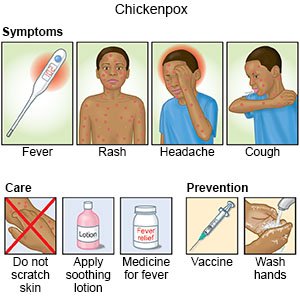
Chickenpox is a disease caused by the varicella virus. Chickenpox is spread when an infected person coughs or sneezes. It is also spread when someone touches the fluid that comes out of chickenpox blisters.
 |
DISCHARGE INSTRUCTIONS:
Call your local emergency number (911 in the US) if:
- Your child has trouble breathing or is breathing faster than usual.
- Your child has a seizure.
Seek care immediately if:
- Your child is confused or more clumsy than usual.
- The rash spreads to one or both of your child's eyes.
Call your child's doctor if:
- The blisters get red, warm, tender, or drain yellow or white fluid.
- You have questions or concerns about your child's condition or care.
Related medications
Treatment options
The following list of medications are related to or used in the treatment of this condition.
Medicines:
Your child may need any of the following:
- Acetaminophen decreases pain and fever. It is available without a doctor's order. Ask how much to give your child and how often to give it. Follow directions. Read the labels of all other medicines your child uses to see if they also contain acetaminophen, or ask your child's doctor or pharmacist. Acetaminophen can cause liver damage if not taken correctly.
- Antihistamines help decrease itching. They are available without a doctor's order. Follow directions. These medicines can make your child sleepy.
- Do not give aspirin to children younger than 18 years. Your child could develop Reye syndrome if he or she has the flu or a fever and takes aspirin. Reye syndrome can cause life-threatening brain and liver damage. Check your child's medicine labels for aspirin or salicylates.
- Give your child's medicine as directed. Contact your child's healthcare provider if you think the medicine is not working as expected. Tell the provider if your child is allergic to any medicine. Keep a current list of the medicines, vitamins, and herbs your child takes. Include the amounts, and when, how, and why they are taken. Bring the list or the medicines in their containers to follow-up visits. Carry your child's medicine list with you in case of an emergency.
Manage your child's symptoms:
- Help relieve your child's itching. A bacterial skin infection or scars may develop if your child scratches or picks at his or her rash. The following may help relieve your child's itching:
- Apply calamine lotion on your child's rash. Follow the directions on the label. Do not use this lotion on sores inside your child's mouth.
- Give your child baths in lukewarm water. Add ½ cup of baking soda or uncooked oatmeal to the water. Let your child bathe for about 30 minutes. Do this several times a day.
- Trim your child's fingernails. Put gloves or socks on his or her hands, especially at night. Wash his or her hands with germ-killing soap to prevent a bacterial infection.
- Keep your child cool. The itching can get worse if your child sweats.
- Help relieve painful mouth sores. You may be given medicine to put on your child's mouth sores. These may include numbing gels or an antacid solution. Use these medicines before he or she eats or drinks. Avoid spicy, salty, hot, or sour foods.
- Give your child liquids as directed. Liquids help prevent dehydration. Ask how much liquid your child should drink each day and which liquids are best. Good liquids include water, juice, or broth. Your child may need an oral rehydration solution (ORS). An ORS has the right amounts of water, salts, and sugar needed to replace body fluids.
- Help your child rest. He or she should rest as much as possible and get plenty of sleep.
Prevent the spread of chickenpox:
 |
- Keep your child away from others. He or she will need to stay home from school or daycare until the blisters are crusted over. This usually takes about 1 week.
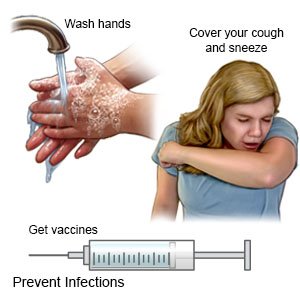
- Ask your child's healthcare provider about the chickenpox vaccine. Your child will need 2 doses of the vaccine. If your child misses a dose, ask his or her provider when to come in for a catch-up dose.
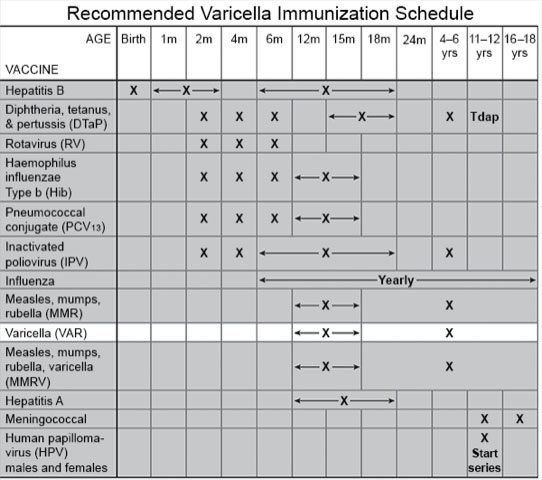
- Have your child wash his or her hands often. He or she should wash after using the bathroom and before preparing or eating food. Have your child use soap and water. Show him or her how to rub soapy hands together, lacing the fingers. Wash the front and back of the hands, and in between the fingers. The fingers of one hand can scrub under the fingernails of the other hand. Teach your child to wash for at least 20 seconds. Use a timer, or sing a song that is at least 20 seconds. An example is the happy birthday song 2 times. Have your child rinse with warm, running water for several seconds. Then dry with a clean towel or paper towel. Your older child can use hand sanitizer that contains alcohol if soap and water are not available.
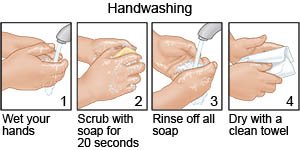
- Remind your child to cover a sneeze or cough. Show your child how to use a tissue to cover his or her mouth and nose. Have your child throw the tissue away in a trash can right away. Then your child should wash his or her hands well or use a hand sanitizer. Show your child how to use the bend of his or her arm if a tissue is not available.
- Clean surfaces often. Clean doorknobs, countertops, cell phones, and other surfaces that are touched often. Use a disinfecting wipe, a single-use sponge, or a cloth you can wash and reuse. Use disinfecting cleaners if you do not have wipes. You can create a disinfecting cleaner by mixing 1 part bleach with 10 parts water.
Follow up with your child's doctor as directed:
Write down your questions so you remember to ask them during your visits.
© Copyright Merative 2025 Information is for End User's use only and may not be sold, redistributed or otherwise used for commercial purposes.
The above information is an educational aid only. It is not intended as medical advice for individual conditions or treatments. Talk to your doctor, nurse or pharmacist before following any medical regimen to see if it is safe and effective for you.
Learn more about Chickenpox
Treatment options
- Medications for Herpes Zoster Myelitis
- Medications for Varicella Pneumonitis
- Medications for Varicella-Zoster
Care guides
Symptoms and treatments
Further information
Always consult your healthcare provider to ensure the information displayed on this page applies to your personal circumstances.