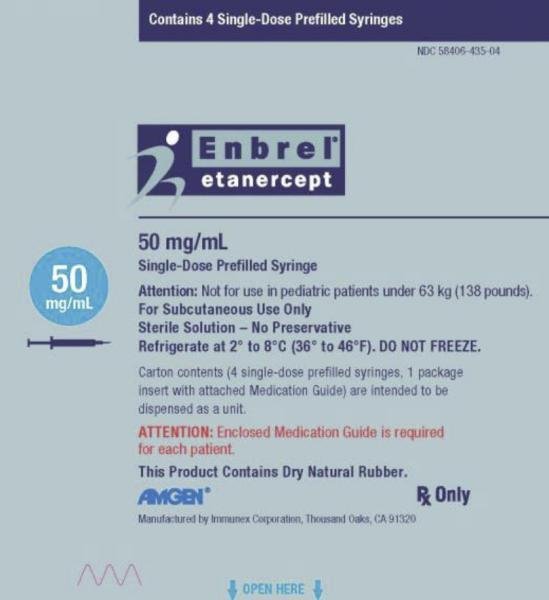
Enbrel Side Effects

Generic Name: etanercept

Please note - some side effects for Enbrel may not be reported. Always consult your doctor or healthcare specialist for medical advice. You may also report side effects to the FDA.

Side Effects of Enbrel - for the Consumer

Enbrel Multiple-Use Vials

All medicines may cause side effects, but many people have no, or minor, side effects. Check with your doctor if any of these most COMMON side effects persist or become bothersome when using Enbrel Multiple-Use Vials:

Dizziness; headache; mild pain, redness, itching, bruising, or swelling around the injection site.

Seek medical attention right away if any of these SEVERE side effects occur when using Enbrel Multiple-Use Vials:

Severe allergic reactions (rash; hives; itching; difficulty breathing; tightness in the chest; swelling of the mouth, face, lips, or tongue; unusual hoarseness); blood in the urine or stools; burning, numbness, or tingling; butterfly rash (rash on your nose and cheeks); change in the appearance of a mole; chest pain or discomfort; decreased mental alertness; fast heartbeat; fever, chills, or sore throat; general feeling of being unwell; increased or painful urination; mental or mood changes; new or worsening cough; open sore that does not heal; rapid breathing; rash on your face and arms that gets worse in the sun; red, swollen, blistered, or peeling skin; seizures; shortness of breath; sudden, unexplained weight gain; swelling of the arms or legs; swelling of the lymph nodes; symptoms of liver problems (eg, yellowing of the skin or eyes, dark urine, pale stools); unusual bruising or bleeding; unusual lumps; unusual nausea, vomiting, stomach pain, or diarrhea; unusual skin growth or other skin changes; unusual tiredness or weakness; unusually pale skin; vision problems; weakness in the arms or legs.

This is not a complete list of all side effects that may occur. If you have questions about side effects, contact your health care provider. Call your doctor for medical advice about side effects. To report side effects to the appropriate agency, please read the Guide to Reporting Problems to FDA.

Enbrel Prefilled Syringes

All medicines may cause side effects, but many people have no, or minor, side effects. Check with your doctor if any of these most COMMON side effects persist or become bothersome when using Enbrel Prefilled Syringes:

Dizziness; headache; mild pain, redness, itching, bruising, or swelling around the injection site.

Seek medical attention right away if any of these SEVERE side effects occur when using Enbrel Prefilled Syringes:

Severe allergic reactions (rash; hives; itching; difficulty breathing; tightness in the chest; swelling of the mouth, face, lips, or tongue; unusual hoarseness); blood in the urine or stools; burning, numbness, or tingling; butterfly rash (rash on your nose and cheeks); change in the appearance of a mole; chest pain or discomfort; decreased mental alertness; fast heartbeat; fever, chills, or sore throat; general feeling of being unwell; increased or painful urination; mental or mood changes; new or worsening cough; open sore that does not heal; rapid breathing; rash on your face and arms that gets worse in the sun; red, swollen, blistered, or peeling skin; seizures; shortness of breath; sudden, unexplained weight gain; swelling of the arms or legs; swelling of the lymph nodes; symptoms of liver problems (eg, yellowing of the skin or eyes, dark urine, pale stools); unusual bruising or bleeding; unusual lumps; unusual nausea, vomiting, stomach pain, or diarrhea; unusual skin growth or other skin changes; unusual tiredness or weakness; unusually pale skin; vision problems; weakness in the arms or legs.

This is not a complete list of all side effects that may occur. If you have questions about side effects, contact your health care provider. Call your doctor for medical advice about side effects. To report side effects to the appropriate agency, please read the Guide to Reporting Problems to FDA.

Top

Enbrel Side Effects - for the Professional

Enbrel

Across clinical studies and postmarketing experience, the most serious adverse reactions with Enbrel were infections, neurologic events, CHF, and hematologic events [see Warnings and Precautions (5)]. The most common adverse reactions with Enbrel were infections and injection site reactions.

Clinical Studies Experience

Adverse Reactions in Adult Patients With Rheumatoid Arthritis, Psoriatic Arthritis, Ankylosing Spondylitis, or Plaque Psoriasis

The data described below reflect exposure to Enbrel in 2219 adult patients with RA followed for up to 80 months, in 182 patients with PsA for up to 24 months, in 138 patients with AS for up to 6 months, and in 1204 adult patients with PsO for up to 18 months.

In controlled trials, the proportion of Enbrel‑treated patients who discontinued treatment due to adverse events was approximately 4% in the indications studied. 

Because clinical trials are conducted under widely varying conditions, adverse reactions rates observed in the clinical trials of a drug cannot be directly compared to rates in the clinical trials of another drug and may not predict the rates observed in clinical practice.

Infections

Infections, including viral, bacterial, and fungal infections, have been observed in adult and pediatric patients.  Infections have been noted in all body systems and have been reported in patients receiving Enbrel alone or in combination with other immunosuppressive agents.

In controlled portions of trials, the types and severity of infection were similar between Enbrel and the respective control group (placebo or MTX for RA and PsA patients) in RA, PsA, AS, and PsO patients.  Rates of infections in RA and PsO patients are provided in Table 3 and Table 4, respectively.  Infections consisted primarily of upper respiratory tract infection, sinusitis, and influenza.

In controlled portions of trials in RA, PsA, AS, and PsO, the rates of serious infection were similar (0.8% in placebo, 3.6% in MTX, and 1.4% in Enbrel/Enbrel + MTX‑treated groups).  In clinical trials in rheumatologic indications, serious infections experienced by patients have included, but are not limited to, pneumonia, cellulitis, septic arthritis, bronchitis, gastroenteritis, pyelonephritis, sepsis, abscess, and osteomyelitis.  In clinical trials in PsO, serious infections experienced by patients have included, but are not limited to, pneumonia, cellulitis, gastroenteritis, abscess, and osteomyelitis.  The rate of serious infections was not increased in open‑label extension trials and was similar to that observed in Enbrel‑ and placebo‑treated patients from controlled trials.  

In 66 global clinical trials of 17,505 patients (21,015 patient-years of therapy), tuberculosis was observed in approximately 0.02% of patients.  In 17,696 patients (27,169 patient-years of therapy) from 38 clinical trials and 4 cohort studies in the US and Canada, tuberculosis was observed in approximately 0.006% of patients.  These studies include reports of pulmonary and extrapulmonary tuberculosis [see Warnings and Precautions (5.1)].

Injection Site Reactions

In placebo-controlled trials in rheumatologic indications, approximately 37% of patients treated with Enbrel developed injection site reactions.  In controlled trials in patients with PsO, 15% of patients treated with Enbrel developed injection site reactions during the first 3 months of treatment.  All injection site reactions were described as mild to moderate (erythema, itching, pain, swelling, bleeding, bruising) and generally did not necessitate drug discontinuation.  Injection site reactions generally occurred in the first month and subsequently decreased in frequency.  The mean duration of injection site reactions was 3 to 5 days.  Seven percent of patients experienced redness at a previous injection site when subsequent injections were given.  

Immunogenicity

Patients with RA, PsA, AS, or PsO were tested at multiple time points for antibodies to etanercept.  Antibodies to the TNF receptor portion or other protein components of the Enbrel drug product were detected at least once in sera of approximately 6% of adult patients with RA, PsA, AS, or PsO.  These antibodies were all non-neutralizing. Results from JIA patients were similar to those seen in adult RA patients treated with Enbrel. 

In PsO studies that evaluated the exposure of etanercept for up to 120 weeks, the percentage of patients testing positive at the assessed time points of 24, 48, 72, and 96 weeks ranged from 3.6% - 8.7% and were all non-neutralizing.  The percentage of patients testing positive increased with an increase in the duration of study; however, the clinical significance of this finding is unknown.  No apparent correlation of antibody development to clinical response or adverse events was observed. The immunogenicity data of Enbrel beyond 120 weeks of exposure are unknown.

The data reflect the percentage of patients whose test results were considered positive for antibodies to etanercept in an ELISA assay, and are highly dependent on the sensitivity and specificity of the assay.  Additionally, the observed incidence of any antibody positivity in an assay is highly dependent on several factors, including assay sensitivity and specificity, assay methodology, sample handling, timing of sample collection, concomitant medications, and underlying disease.  For these reasons, comparison of the incidence of antibodies to etanercept with the incidence of antibodies to other products may be misleading.

Autoantibodies

Patients with RA had serum samples tested for autoantibodies at multiple time points.  In RA Studies I and II, the percentage of patients evaluated for antinuclear antibodies (ANA) who developed new positive ANA (titer ≥ 1:40) was higher in patients treated with Enbrel (11%) than in placebo‑treated patients (5%).  The percentage of patients who developed new positive anti‑double‑stranded DNA antibodies was also higher by radioimmunoassay (15% of patients treated with Enbrel compared to 4% of placebo‑treated patients) and by Crithidia luciliae assay (3% of patients treated with Enbrel compared to none of placebo‑treated patients).  The proportion of patients treated with Enbrel who developed anticardiolipin antibodies was similarly increased compared to placebo‑treated patients.  In RA Study III, no pattern of increased autoantibody development was seen in Enbrel patients compared to MTX patients [see Warnings and Precautions (5.9)].

Other Adverse Reactions

Table 3 summarizes adverse reactions reported in adult RA patients.  The types of adverse reactions seen in patients with PsA or AS were similar to the types of adverse reactions seen in patients with RA.

Table 3. Percent of Adult RA Patients Experiencing Adverse Reactions in Controlled Clinical Trials
     

Placebo Controlled*

(Studies I, II, and a Phase 2 Study)
  

Active Controlled

(Study III)
     

Placebo

(N = 152)
  

Enbrel

(N = 349)
  

MTX

(N = 217)
  

Enbrel

(N = 415)
  Reaction   Percent of Patients   Percent of Patients
*
Includes data from the 6-month study in which patients received concurrent MTX therapy in both arms.
Study duration of 2 years.
Any dose.
§
Includes bacterial, viral, and fungal infections.
Most frequent Upper Respiratory Infections were upper respiratory tract infection, sinusitis, and influenza.
  Infection§(total)   39   50   86   81
  Upper Respiratory Infections   30   38   70   65
  Non-upper Respiratory Infections   15   21   59   54
  Injection Site Reactions   11   37   18   43
  Diarrhea   9   8   16   16
  Rash   2   3   19   13
  Pruritus   1   2   5   5
  Pyrexia   -   3   4   2
  Urticaria   1   -   4   2
  Hypersensitivity   -   -   1   1

In placebo-controlled PsO trials, the percentages of patients reporting adverse reactions in the 50 mg twice a week dose group were similar to those observed in the 25 mg twice a week dose group or placebo group.

Table 4 summarizes adverse reactions reported in adult PsO patients from Studies I and II.

Table 4. Percent of Adult PsO Patients Experiencing Adverse Reactions in Placebo-Controlled Portions of Clinical Trials (Studies I & II)
     

Placebo

(N = 359)
  

Enbrel*

(N = 876)
  Reaction   Percent of Patients
*
Includes 25 mg SC QW, 25 mg SC BIW, 50 mg SC QW, and 50 mg SC BIW doses.
Includes bacterial, viral, and fungal infections.
Most frequent Upper Respiratory Infections were upper respiratory tract infection, nasopharyngitis, and sinusitis.
  Infection(total)   28   27
  Non-upper Respiratory Infections   14   12
  Upper Respiratory Infections   17   17
  Injection Site Reactions   6   15
  Diarrhea   2   3
  Rash   1   1
  Pruritus   2   1
  Urticaria   -   1
  Hypersensitivity   -   1
  Pyrexia   1   -

Adverse Reactions in Pediatric Patients

In general, the adverse reactions in pediatric patients were similar in frequency and type as those seen in adult patients [see Warnings and Precautions (5), Adverse Reactions (6), and Clinical Studies (14.2)].  The types of infections reported in pediatric patients were generally mild and consistent with those commonly seen in the general pediatric population.  Two JIA patients developed varicella infection and signs and symptoms of aseptic meningitis, which resolved without sequelae.  

In open-label clinical studies of children with JIA, adverse reactions reported in those ages 2 to 4 years were similar to adverse reactions reported in older children.

Postmarketing Experience

Adverse reactions have been reported during post approval use of Enbrel in adults and pediatric patients. Because these reactions are reported voluntarily from a population of uncertain size, it is not always possible to reliably estimate their frequency or establish a causal relationship to Enbrel exposure.

Adverse reactions are listed by body system below:


Blood and lymphatic system disorders:


pancytopenia, anemia, leukopenia, neutropenia, thrombocytopenia, lymphadenopathy, aplastic anemia [see Warnings and Precautions (5.5)]


Cardiac disorders:


congestive heart failure [see Warnings and Precautions (5.4)]


Gastrointestinal disorders:

General disorders:


inflammatory bowel disease (IBD)

angioedema, chest pain


Hepatobiliary disorders:


autoimmune hepatitis, elevated transaminases


Immune disorders:


macrophage activation syndrome, systemic vasculitis


Musculoskeletal and connective tissue disorders:


lupus‑like syndrome


Neoplasms benign, malignant, and unspecified:


melanoma and non-melanoma skin cancers, merkel cell carcinoma [see Warnings and Precautions (5.3)]


Nervous system disorders:


convulsions, multiple sclerosis, demyelination, optic neuritis, transverse myelitis, paresthesias [see Warnings and Precautions (5.2)]


Ocular disorders:


uveitis


Respiratory, thoracic, and mediastinal disorders:


interstitial lung disease


Skin and subcutaneous tissue disorders:


cutaneous lupus erythematosus, cutaneous vasculitis (including leukocytoclastic vasculitis), erythema multiforme, Stevens-Johnson syndrome, toxic epidermal necrolysis, subcutaneous nodule, new or worsening psoriasis (all sub-types including pustular and palmoplantar)

Opportunistic infections, including atypical mycobacterial infection, herpes zoster, aspergillosis, and Pneumocystis jiroveci pneumonia, and protozoal infections have also been reported in postmarketing use.

Top

Side Effects by Body System - for Healthcare Professionals

Respiratory

A 38-year-old man with rheumatoid arthritis developed disseminated histoplasmosis after 11 months of treatment with etanercept. He recovered following itraconazole therapy.

A 50-year-old male with rheumatoid arthritis experienced pulmonary nodulosis coincident with etanercept therapy. On presentation, he was taking leflunomide (20 mg/day for 3 years) and etanercept (25 mg twice weekly for 2 years). Clinical examination showed multiple densities in the apical part of the left lung. Chest radiography and high resolution computed tomography showed disseminated bilateral, partly confluating nodules, some pleural thickening, and pleural effusion. Both etanercept and leflunomide were stopped and therapy with prednisolone and azathioprine was initiated. Three months later, the pulmonary nodules had largely disappeared.

A 40-year-old male with a history of severe psoriatic arthritis experienced pulmonary sarcoidosis coincident with etanercept therapy. He was admitted to the hospital with dyspnea and subfebrile illness several months after initiating treatment with etanercept 25 mg subcutaneously twice weekly. His diagnosis was consistent exclusively with sarcoidosis. The patient's symptoms improved when etanercept therapy was discontinued, but they did not resolve completely. Therapy with prednisone 40 mg led to complete improvement of his pulmonary disease.

A 37-year-old male with a greater than 10-year history of psoriatic arthritis experienced lung granulomas coincident with etanercept therapy. He started therapy with etanercept 25 mg subcutaneously twice weekly for psoriatic arthritis. Approximately a year and one-half later, he developed respiratory symptoms with fever, productive cough, and dyspnea. Chest radiograph indicated a bilateral reticulonodular interstitial pattern which was worse in the upper lobes, but with no hilar lymphadenopathy. Etanercept therapy was discontinued and he was initially treated with amoxicillin and then, when he did not improve, with clarithromycin. His symptoms improved and his chest radiograph showed improvement.

Respiratory side effects have included the development of respiratory infections (29% to 38%), upper respiratory tract infection (20.89%), rhinitis (12% to 18.42%), pharyngitis (2% to 7%), cough (3% to 6%), unexplained respiratory disorder (5%,) sinusitis (3%), dyspnea, worsening of prior lung disorder, coccidioidomycosis, pneumocystis, increased cough, bronchitis, pneumonia, lung abscess, pleural infection, and tonsillitis. Histoplasmosis and tuberculosis have been reported rarely. Cases of pulmonary cavitation and vasculitis, interstitial lung disease, viral pneumonia, and pulmonary disease have been reported. At least one case of pulmonary nodulosis has been reported, in addition to a case of pulmonary sarcoidosis. At least three cases of lung granulomas have also been reported.

Immunologic

Immunologic side effects have included serious infections and sepsis, including fatalities. Cases of systemic lupus erythematosus have also been reported.

Infections have been reported with various pathogens including viral, bacterial, fungal, and protozoal organisms.

Many of the serious events have been reported in patients with underlying diseases in addition to their rheumatoid arthritis which could have predisposed them to infections.

Four cases of systemic lupus erythematosus (SLE) have been reported to occur between 6 weeks and 14 months after initiation of therapy. All SLE related symptoms resolved between 2 to 6 weeks after discontinuation of therapy.

Nervous system

Nervous system side effects have included headache (17% to 20%) and dizziness (7% to 10%). Stroke, paresthesias, seizures, and central nervous system events suggestive of multiple sclerosis or isolated demyelinating conditions such as transverse myelitis or optic neuritis have been reported. Neurologic events suggestive of demyelination (n=17) including paresthesias, visual disturbances secondary to optic neuritis, confusion, gait disturbance, apraxia, facial palsy, and Guillain-Barré syndrome have been reported during postmarketing experience. At least one case of herpes zoster has also been reported, in addition to a case of demyelinating disease and a case of peripheral mononeuropathy.

Although neurological events suggestive of demyelination reported during postmarketing experience did not show causal relationship between adverse events and etanercept, the neurologic side effects resolved, partially or completely, on discontinuation of therapy.

A patient with a history of Takayasu arteritis experienced herpes zoster coincident with etanercept therapy. Etanercept was temporarily discontinued in this patient, and treatment with valcyclovir led to full clinical recovery.

An 18-year-old female with severe psoriasis of 14 years duration experienced demyelinating disease coincident with etanercept therapy. Her history was significant for previous flares of psoriatic erythroderma and pustular psoriasis. She had been recently treated with 25 mg etanercept of subcutaneously twice per week for 1 year, with excellent control of her psoriasis. At presentation, she reported the gradual resolution during the week just past of left-sided tingling and numbness in the upper and lower extremities and scalp, as well as blurry vision in the left eye, lasting about 4 weeks. She was still taking etanercept. A neurological examination revealed hyperreflexia throughout. Magnetic resonance imaging results of the brain were consistent with demyelinating disease. Etanercept was discontinued at presentation and alternative therapy was initiated. She has had no recurrence of neurologic symptoms during 7 months of follow-up and has had stable findings on neurological examination.

A 43-year-old male with a history of psoriatic arthritis experienced peripheral neuropathy coincident with etanercept therapy. Eight weeks after reinitiating therapy with etanercept and leflunomide for the fourth time, the patient presented with acute-onset numbness in the ulnar aspect of his left hand, fourth and fifth digits. His neurological examination showed mildly decreased left hand intrinsic motor strength (4/5) and diminished pinprick sensation on his fifth digit. Given his distribution of findings, he was diagnosed with ulnar neuropathy. However, based on symptom improvement after the drug was discontinued and a lack of other possible causes, drug-induced peripheral neuropathy seemed like the most plausible diagnosis. The patient's neuropathy improved 6 weeks after etanercept was discontinued, although he continued taking leflunomide, which had been started 6 months before the neuropathy.

Gastrointestinal

Gastrointestinal (GI) side effects have included diarrhea (18.4%), nausea (10% to 20.86%), vomiting (5%), mouth ulcers (3%), abdominal pain, dyspepsia, altered sense of taste, oral mycosis, GI infection, and bacterial peritonitis. Uncommon cases of dry mouth have been reported, in addition to rare cases of anorexia. Pancreatitis, esophagitis, and gastroenteritis have been reported. Cases of intestinal perforation have been reported. At least one case of cacogeusia has also been reported, in addition to a case of Crohn's disease.

A 21-year-old male with a 10 year history of psoriatic arthritis was in clinical remission after beginning etanercept 25 mg twice weekly 3 years prior. He presented with right upper quadrant and bilateral lower quadrant pain of 3 weeks duration. Although histological features were nonspecific, the diagnosis suggested CD due to the involvement of the terminal ileum, colon, and rectum. He continued taking etanercept for his arthritis and started mesalamine therapy for his CD, with good control.

Cardiovascular

Cardiovascular side effects have included hypertension (7%), heart failure, chest pain, vasodilation (flushing), and angioedema. During postmarketing experience, new-onset heart failure, with or without documented risk factors, was the most frequently reported event followed by heart failure exacerbation. Arteriosclerosis and leukocytoclastic vasculitis have been reported. At least one case of giant cell arteritis has been reported.

Cases of heart failure (n=29) reported during postmarketing experience developed on average 6 months after initiation of etanercept therapy.

A 22-year-old female with juvenile rheumatoid arthritis (JRA) experienced leukocytoclastic vasculitis coincident with etanercept therapy. The patient presented with purpuric rash and lower extremity edema. Four years prior to the current admission, she was started on etanercept for JRA and responded immediately. Skin biopsy showed leukocytoclastic vasculitis. Rapid resolution of the clinical features and accompanying improvements were observed following discontinuation of etanercept.

A 79-year-old female with rheumatoid arthritis experienced giant cell arteritis (GCA) coincident with etanercept therapy. She presented with left jaw pain, so severe that she would not open her mouth to eat. The patient had associated ear pain and a sore throat. She had been prescribed etanercept 25 mg twice weekly and methotrexate 7.5 mg weekly for two years. A biopsy of the left temporal artery showed GCA.

Dermatologic

A 49-year-old male with alopecia areata and rheumatoid arthritis experienced recurrence of alopecia areata coincident with etanercept therapy. Three years prior, he had begun a twice weekly subcutaneous course of 25 mg etanercept injections. After more than 2 years of etanercept treatment, the alopecia areata recurred, with extensive, confluent 4- to 6-cm patches on the occipital and parietal regions of the scalp. He is currently being treated with clobetasol foam twice daily on weekends and topical 5% minoxidil twice daily, along with intralesional triamcinolone injections to a few affected areas. Only slight improvement has been observed.

A 38-year-old female with rheumatoid arthritis experienced lichen planus coincident with etanercept therapy. She received etanercept 25 mg twice weekly and methotrexate 15 mg weekly. Four months starting etanercept therapy, a pruriginous cutaneous eruption appeared on the right lower limb, consisting of numerous erythematous to violaceous polygonal flat-topped papules in a zosteriform distribution. Etanercept was suspected, and the therapy was withdrawn. After discontinuation, progressive healing was observed, with further complete remission over a period of 4 months, secondarily helped by topical betamethasone propionate once daily for 8 weeks. Continuation of the patients other medications without relapse of the skin eruption excluded the drugs as causal.

A patient presented with an abscess of the right gluteal area within 6 weeks after discontinuing etanercept; it was treated by surgical incision and oral administration of amoxicillin-clavulanate 1 g every 6 hours for 10 days, and resolved.

A 56-year-old female with psoriatic arthritis experienced lichen planopilaris (LPP) coincident with etanercept therapy. She was prescribed etanercept 50 mg weekly initially and after 12 weeks, the patient showed improvement of both skin lesions and joint tenderness. At week 32 of therapy, the patient attended the routine follow-up evaluation complaining about remarkable hair loss, and severe pain and itch affecting the whole scalp. Two areas of cicatricial alopecia with erythema and follicular hyperkeratosis with peripheral distribution were noted. The histology of a biopsy specimen revealed atrophy of the follicular epithelium and perifollicular fibrosis, with moderate inflammatory infiltrate and evolution to cicatricial alopecia. The picture was suggestive of LPP. Because of the onset of alopecia and pain, the patient wanted to stop etanercept therapy. After 3 months, the patient's erythema and follicular hyperkeratosis disappeared, with local pain and itch remarkably reduced.

Dermatologic side effects have included rash (5%), urticaria, and pruritus. Cutaneous vasculitis and subcutaneous nodules have rarely been reported. A necrotic lesion on the lower extremity, not at the injection site, has been reported to occur after the first injection. Psoriasis, interstitial granulomatous dermatitis, fungal skin infection, bacterial skin infection, paronychia, furuncle/folliculitis, erysipelas, and cellulitis have been reported. At least one case of recurrence of alopecia areata has also been reported, in addition to a case of lichen planus, a case of lichen planopilaris, and a case of gluteal abscess.

Musculoskeletal

Musculoskeletal side effects have included bone fracture (3.2%). Joint pain and accelerated nodulosis have been reported uncommonly. Back pain and infective arthritis have also been reported. At least one case of septic arthritis due to Listeria monocytogenes has been reported.

A 65-year-old male with polyarticular rheumatoid arthritis experienced septic arthritis due to Listeria monocytogenes after being treated with etanercept and low-dose prednisolone. He presented with an inflamed knee joint, and aspiration yielded yellow-green turbid synovial fluid showing granulocytic effusion with 50,000 cells/mL, but Gram stain did not show any organisms. After 48 hours of culture, gram positive bacteria were observed, and Listeria monocytogenes was isolated after 72 hours. Antibiotic therapy started at presentation was continued, and later joint irrigation was done, which eliminated the infection, but joint destruction resulted eventually.

Local

Local side effects have included reports of mild to moderate injection site reactions (erythema, itching, pain, and/or swelling) in 24.67% to 37% of patients. Redness was experienced in 7% of patients at a previous injection site after subsequent injections were given. Injection site ecchymosis has also been reported. At least one case of eosinophilic cellulitis-like reaction has also been reported.

Injection site reactions occurred in the first month of administration with etanercept and decreased in frequency. The average duration of these reactions was 3 to 5 days.

A 57-year-old female with an 8-month history of rheumatoid arthritis (RA) experienced eosinophilic cellulitis-like reaction coincident with etanercept therapy. The patient was given etanercept 25 mg subcutaneously twice weekly for RA. Within 24 hours of her first dose, she developed an evanescent, pruritic, slightly indurated, erythematous plaque surrounding the injection site. Within 12 to 24 hours after her second injection, a much larger injection site reaction (ISR) was observed. On presentation, 3 days after second injection, the patient reported that the reaction had continued to increase in size. A skin biopsy was conducted, and the patient was treated with oral antihistamines and prednisone, with complete resolution of the ISR over the next 2 days.

Hematologic

Hematologic side effects have included anemia, leukopenia, and thrombocytopenia. Rare reports of pancytopenia, including aplastic anemia, some with a fatal outcome have been reported. At least one case of leukocytoclastic vasculitis has also been reported, in addition to a case of macrophage activation syndrome.

Cases of pancytopenia have occurred as early as 2 weeks after initiation of therapy.

A 42-year-old female with a history of rheumatoid arthritis (RA) experienced macrophage activation syndrome (MAS) coincident with etanercept therapy. She presented to the hospital with a two month history of fever, chills, night sweats, rigors, and a dry cough. Two months prior to presentation, she had discontinued etanercept therapy due to her presenting complaint of a fever of unknown origin. She was diagnosed with MAS and was given cyclosporine, intravenous immunoglobulin, and dexamethasone. She then developed a gram-negative bacilli septicemia and acute renal failure. She was transferred to the intensive care unit, where all immunosuppressant treatment was discontinued. She developed anasarca and 2 weeks later died of acute respiratory distress syndrome and multiorgan failure considered secondary to sepsis and uncontrolled MAS 6 weeks after being admitted.

Ocular

Ocular side effects have rarely included ocular inflammation and dry eyes. Uveitis has also been reported during postmarketing experience.

Hypersensitivity

Hypersensitivity side effects including allergic reactions (less than 2%) and leukocytoclastic vasculitis have been reported.

Oncologic

Oncologic side effects have included malignant lymphomas, solid malignancies, and rare cancers including lymphomas and Hepatosplenic T-Cell Lymphoma occurring mostly in adolescents and young adults.
Lymphoproliferative disorders have been reported during postmarketing experience. The majority of cases (81%) were non-Hodgkin's lymphomas. At least six cases of solid cancers including two cases of mucinous adenocarcinoma of the colon, one metastatic cholangiocarcinoma, one renal-cell carcinoma, one breast carcinoma, and one liposarcoma have been reported. Prostate carcinoma has been reported. At least one case of multiple cutaneous squamous cell carcinomas and keratoacanthomas has also been reported.

Postmarketing adverse events including lymphoproliferative disorders developed, on average, 8 weeks after initiation of therapy with etanercept.

A 64-year-old male with a history of psoriasis experienced multiple cutaneous squamous cell carcinomas (SCC) and keratoacanthomas (KAs) coincident with etanercept therapy. The patient was given a 3-month course of therapy with etanercept 50 mg weekly in divided doses. Approximately 10 weeks later, he noticed lumps appearing on his legs. There were at least 50 nodules on his legs but the rest of his body did not have any lesions that looked like skin cancer. Two large lesions were excised and histological examination showed them to be SCC. Seven of the smaller lesions were removed and showed KAs on histological examination. The KAs regressed after therapy with etanercept was discontinued.

Hepatic

Hepatic side effects have included autoimmune hepatitis. At least 2 cases of hepatotoxicity have also been reported.

Genitourinary

Genitourinary side effects including urinary tract infection have been reported. Herpes simplex and vaginal mycosis/candidiasis have been reported.

Renal

A 32-year-old female with typical rheumatoid arthritis experienced necrotizing crescentic glomerulonephritis, associated with a positive antineutrophil cytoplasmic antibody, causing acute renal failure coincident with etanercept therapy. A renal biopsy demonstrated segmental necrosis within one glomerulus and partial fibrosis of the glomerular tuft with fibrocellular crescents within a number of other glomeruli. Extensive irreversible tubular damage was also evident. The patient was treated with steroids and cyclophosphamide following withdrawal of etanercept, with a good clinical outcome.

A 22-year-old female with juvenile rheumatoid arthritis (JRA) experienced proliferative lupus nephritis coincident with etanercept therapy. The patient presented with purpuric rash and lower extremity edema. Four years prior to the current admission, she was started on etanercept for JRA and responded immediately. A renal biopsy showed lupus nephritis. Rapid resolution of the clinical features and accompanying improvements were observed following discontinuation of etanercept.

Renal side effects including pyelonephritis have been reported. At least one case of necrotizing crescentic glomerulonephritis has been reported, in addition to a case of proliferative lupus nephritis.

Other

The development of a new positive antinuclear antibody occurred in 11% of patients. New positive anti-double-stranded DNA antibodies occurred in 15% of patients. The number of patients who developed anticardiolipin antibodies was similarly increased compared to patients treated with placebo. No patients have developed a lupus-like syndrome or other autoimmune diseases. The impact of long-term treatment with etanercept, however, in the development of autoimmune diseases is unknown.

Other side effects have included asthenia (5% to 8%), autoantibodies development (11% to 15%), adenopathy, fever, flu syndrome, weight gain, accidental injury, abscess, otitis media, and sepsis/urosepsis. Fatigue and generalized pain have been reported infrequently. Listeria monocytogenes infections have also been reported during postmarketing experience, with some cases resulting in death.

Top

Disclaimer: Every effort has been made to ensure that the information provided is accurate, up-to-date, and complete, but no guarantee is made to that effect. In addition, the drug information contained herein may be time sensitive and should not be utilized as a reference resource beyond the date hereof. This information does not endorse drugs, diagnose patients, or recommend therapy. This drug information is a reference resource designed as supplement to, and not a substitute for, the expertise, skill , knowledge, and judgement of healthcare practitioners in patient care. The absence of a warning for a given drug or drug combination in no way should be construed to indicate that the drug of drug combination is safe, effective, or appropriate for any given patient. Drugs.com does not assume any responsibility for any aspect of healthcare administered with the aid of information provided. The information contained herein is not intended to cover all possible uses, directions, precautions, warnings, drug interactions, allergic reactions, or adverse effects. If you have questions about the drugs you are taking, check with your doctor, nurse, or pharmacist.

Did you find this page helpful? Yes No

(web6)