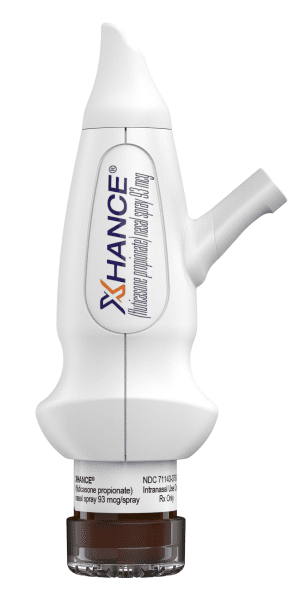
Fluticasone (EENT) (Monograph)
Brand name: Flonase
Drug class: Corticosteroids
Introduction
Synthetic trifluorinated corticosteroid.
Uses for Fluticasone (EENT)
Seasonal and Perennial Rhinitis
Symptomatic treatment of seasonal or perennial rhinitis when conventional therapy with antihistamines or decongestants is ineffective or is not tolerated.
Generally provides symptomatic relief of watery rhinorrhea, nasal congestion, sneezing, postnasal drip, and nasal itching; generally does not relieve signs and symptoms of conjunctivitis, although improvement in ophthalmic manifestations may occur.
Relieves symptoms in both allergic and nonallergic rhinitis, although experience is more extensive with allergic rhinitis.
Has been used successfully prior to the onset of the pollen season for the prophylaxis of symptoms of seasonal allergic rhinitis† [off-label].
Related/similar drugs
Nucala, prednisone, hydroxyzine, fluticasone nasal, loratadine, cetirizine, promethazine
Fluticasone (EENT) Dosage and Administration
Administration
Intranasal Administration
Administer by nasal inhalation using a metered-dose nasal spray pump.
Avoid contact with the eyes.
If used once daily, administer preferably in the morning. Generally, initiate therapy with once-daily dosing; some patients may obtain greater relief with twice-daily divided dosing.
Although regular dosing generally provides optimal benefit, as needed (prn) dosing may be adequate in some patients with seasonal allergic rhinitis.
Clear nasal passages prior to administration. If nasal passages are blocked, a topical nasal decongestant can be administered 5–15 minutes before intranasal administration.
Prime pump prior to initial use or after a period of nonuse (i.e., ≥1 week).
Tilt the head slightly forward, insert the nasal adapter into one nostril, and point the tip of the adapter toward the inflamed nasal turbinates and away from the nasal septum.
Pump the drug into one nostril while holding the other nostril closed and concurrently inspire through the nose. Repeat procedure for the other nostril.
After removing the nasal adapter and dust cap, these pieces should be rinsed in warm water and dried thoroughly; do not clean by inserting a sharp object into the piece.
Dosage
Nasal inhaler delivers about 50 mcg of fluticasone propionate per metered spray and about 120 metered sprays per 16-g container.
Adjust dosage according to individual requirements and response.
Therapeutic effects of intranasal corticosteroids, unlike those of decongestants, are not immediate. This should be explained to the patient in advance to ensure compliance and continuation of the prescribed treatment regimen.
Generally assess response to the initial dosage 4–7 days after starting therapy; a reduction in maintenance dosage may be possible at that time.
Pediatric Patients
Seasonal Rhinitis
Intranasal Inhalation
Adolescents and children ≥4 years of age: 1 spray (50 mcg) in each nostril once daily (total dose: 100 mcg/day). Increase dosage to 2 sprays (100 mcg) in each nostril daily (total dose: 200 mcg/day) if response is inadequate.
Reduce dosage to 1 spray in each nostril (total dose: 100 mcg/day) once adequate symptom control is achieved.
Some patients ≥12 years of age with seasonal allergic rhinitis may find as needed (prn) use of 200 mcg (100 mcg in each nostril) doses (no more frequently than once daily) to be effective in controlling symptoms. Greater symptom control may be achieved with regular dosing.
Perennial Rhinitis
Intranasal Inhalation
Adolescents and children ≥4 years of age: 1 spray (50 mcg) in each nostril daily (total dose: 100 mcg/day). Increase dosage to 2 sprays (100 mcg) in each nostril daily (total dose: 200 mcg/day) if response is inadequate.
Maintenance dose is 1 spray in each nostril (total dose: 100 mcg/day) once adequate symptom control is achieved.
Adults
Seasonal Rhinitis
Treatment
Intranasal InhalationUsual initial dose is 2 sprays (100 mcg) in each nostril once daily (total 200 mcg/day). Alternatively, 1 spray (50 mcg) in each nostril twice daily (total 200 mcg/day).
Maintenance dose is 1 spray in each nostril (total dose: 100 mcg/day) once adequate symptom control is achieved.
Some patients with seasonal allergic rhinitis may find as needed (prn) use of 200-mcg (100 mcg in each nostril) doses (no more frequently than once daily) to be effective in controlling symptoms. Greater symptom control may be achieved with regular dosing.
Prophylaxis† [off-label]
Intranasal InhalationMaintenance dose is 2 sprays (100 mcg) in each nostril daily (200 mcg total).
Perennial Rhinitis
Intranasal InhalationUsual initial dose is 2 sprays (100 mcg) in each nostril once daily (total dose: 200 mcg/day). Alternatively, 1 spray (50 mcg) in each nostril twice daily (total 200 mcg/day).
Maintenance dose is 1 spray in each nostril (total dose: 100 mcg/day) once adequate symptom control is achieved.
Prescribing Limits
No evidence that higher than recommended dosages or increased frequency of administration is beneficial.
Exceeding the maximum recommended daily dosage may only increase the risk of adverse systemic effects (e.g., HPA-axis suppression, Cushing’s syndrome).
Pediatric Patients
Seasonal Rhinitis
Intranasal Inhalation
Adolescents and children ≥4 years of age: Maximum 100 mcg (2 sprays) in each nostril (200 mcg total) daily.
Perennial Rhinitis
Intranasal Inhalation
Adolescents and children ≥4 years of age: Maximum 100 mcg (2 sprays) in each nostril (200 mcg total) daily.
Adults
Seasonal Rhinitis
Intranasal Inhalation
Maximum 100 mcg (2 sprays) in each nostril (200 mcg total) daily.
Perennial Rhinitis
Intranasal Inhalation
Maximum 100 mcg (2 sprays) in each nostril (200 mcg total) daily.
Special Populations
Hepatic Impairment
No specific dosage recommendations for hepatic impairment.
Renal Impairment
No specific dosage recommendations for renal impairment.
Geriatric Patients
No specific geriatric dosage recommendations.
Cautions for Fluticasone (EENT)
Contraindications
-
Known hypersensitivity to fluticasone or any ingredient in the formulation.
Warnings/Precautions
Warnings
Withdrawal of Systemic Corticosteroid Therapy
Patients being switched from prolonged systemic corticosteroids to intranasal therapy should be monitored carefully since corticosteroid withdrawal symptoms (e.g., joint pain, muscular pain, lassitude, depression), acute adrenal insufficiency, and/or severe symptomatic exacerbation of asthma or other clinical conditions may occur.
Systemic corticosteroid dosage should be tapered, and patients should be carefully monitored during dosage reduction.
Infection, Trauma, or Surgery
Use cautiously, if at all, in patients with clinical tuberculosis or asymptomatic Mycobacterium tuberculosis infections; untreated local or systemic fungal or bacterial infections; systemic viral or parasitic infections; ocular herpes simplex infections; or septal ulcers, trauma, or surgery in the nasal region.
Hypothalamic-Pituitary-Adrenal (HPA) Axis Suppression
Avoid higher than recommended dosages since suppression of HPA function may occur.
Immunosuppression
Although risk with intranasal use is unknown, consider the possibility that corticosteroid-induced immunosuppression could occur. Avoid exposure to varicella and measles in previously unexposed patients.
Sensitivity Reactions
Possible immediate hypersensitivity reactions (e.g., wheezing, contact dermatitis, rash, dyspnea, anaphylaxis/anaphylactoid reactions, pruritus, urticaria, angioedema, edema of the face and tongue, and bronchospasm).
General Precautions
Systemic Corticosteroid Effects
Excessive intranasal dosages or use in patients who are particularly sensitive to corticosteroid effects may cause systemic corticosteroid effects (e.g., Cushing’s syndrome, adrenal suppression).
Nasopharyngeal Effects
Temporary or permanent loss of smell may occur.
Rarely, localized candidal infections of the nose and/or pharynx. Treat suspected local infection appropriately; may require discontinuance of fluticasone therapy.
Rarely, nasal septal perforations.
Avoid use until healing occurs in patients with recurrent epistaxis, recent nasal septal ulcers, nasal surgery, or nasal trauma.
Ophthalmic Effects
Possible increased IOP.
Cataracts, ocular dryness and irritation, conjunctivitis, blurred vision, and glaucoma have been reported.
Oral Effects
Temporary or permanent loss of taste may occur.
Specific Populations
Pregnancy
Category C.
Lactation
Other corticosteroids known to be distributed into milk. Caution if used in nursing women.
May cause adverse effects (e.g., growth suppression) in nursing infants if distributed into milk.
Pediatric Use
May be a useful therapeutic alternative to oral corticosteroids in children ≥4 years of age with seasonal or perennial allergic rhinitis since intranasal administration is associated with a decreased risk of adverse systemic effects.
Intranasal corticosteroids may reduce growth velocity in pediatric patients. Children 3–9 years of age receiving 200 mcg of fluticasone propionate daily for 1 year did not show evidence of reduction in normal growth velocity. No clinically relevant changes in HPA axis or bone mineral density (as assessed by dual X-ray absorptiometry) observed.
Safety and efficacy not established in children <4 years of age.
Geriatric Use
Adverse effect profile similar to profile in younger adults.
Common Adverse Effects
Mild, transient nasal burning and stinging, aftertaste , epistaxis, headache, nausea and vomiting, abdominal bloating, pharyngitis, cough and asthma symptoms are most common.
Drug Interactions
Metabolized by CYP3A4.
Drugs Affecting Hepatic Microsomal Enzymes
Drugs that affect CYP3A4 activity: Potential pharmacokinetic interaction (altered metabolism of fluticasone). Exercise caution when potent CYP3A4 inhibitors are used concomitantly.
Specific Drugs
|
Drug |
Interaction |
Comments |
|---|---|---|
|
Corticosteroids |
Potential pharmacodynamic interaction (increased the risk of hypercorticism, suppression of the HPA axis, decreased growth rate in children) with concomitant use of other inhaled and/or systemically absorbed corticosteroids |
Concomitant use not recommended |
|
Erythromycin |
Does not affect the pharmacokinetics of fluticasone |
|
|
Ketoconazole |
Possible increase in mean plasma fluticasone concentrations and toxicity |
Exercise caution |
|
Ritonavir |
Increases plasma fluticasone concentrations, resulting in decreased plasma cortisol AUC Cushing’s syndrome and adrenal suppression reported |
Concomitant use not recommended unless potential benefit outweighs the risk of adverse effects |
Fluticasone (EENT) Pharmacokinetics
Absorption
Bioavailability
Poorly absorbed from the respiratory and GI tracts following nasal inhalation.
Systemic bioavailability of less than 2% based on indirect calculations.
Onset
Symptomatic relief usually is evident within 12–48 hours of initiation of therapy in adults and within 36 hours in children.
Optimum effectiveness generally requires 2–4 days in most patients.
Duration
Following discontinuance, symptoms of rhinitis do not recur for 1–2 weeks.
Distribution
Extent
Placental distribution in humans is unknown, but fluticasone crosses the placenta in animals.
Distribution into milk unknown, but other corticosteroids are distributed.
Plasma Protein Binding
Approximately 91%.
Elimination
Metabolism
Rapidly metabolized in the liver by the CYP3A4.
Elimination Route
Following oral administration, about 87–100% is excreted in the feces, and less than 5% of the dose is excreted in the urine.
Half-life
Plasma half-life: about 3 hours after IV administration.
Stability
Storage
Nasal Suspension
4–30°C.
Discard the nasal pump spray after 120 sprays.
Actions
-
Potent glucocorticoid and weak mineralocorticoid effects.
-
Local anti-inflammatory and vasoconstrictor effects result from local actions of the deposited inhaled dose on the nasal mucosa.
-
Reduces the number of mediator cells (basophils, eosinophils, helper-inducer [CD4+, T4+] T-cells, mast cells, and neutrophils) in the nasal mucosa. Also reduces nasal reactivity to allergens and release of inflammatory mediators and proteolytic enzymes.
-
May inhibit nasal postcapillary venule dilation and permeability.
-
May facilitate nasomucociliary clearance of nasal secretions.
-
May decrease nasal turbinate swelling, mucosal inflammation, and nasal hyperreactivity.
Advice to Patients
-
Proper techniques for assembly and priming of nasal spray pump and for administration and storage of the nasal solution.
-
Importance of not administering the entire dose (i.e., 2–4 sprays) into a single nostril.
-
Give patients a copy of the manufacturer’s patient instructions.
-
Advise patients to cleanse the nasal spray adapter and/or pump at least once weekly.
-
Importance of shaking containers of nasal spray gently prior to each use.
-
Importance of discarding the container after 120 actuations or once the expiration date on the label is reached.
-
Caution against spraying into eyes or directly on nasal septum.
-
Advise patients that effects are not immediate; full benefit requires regular use and usually can be achieved in several days.
-
Importance of taking as directed and not exceeding prescribed dosage.
-
Importance of informing clinician if symptoms fail to improve or if symptoms worsen.
-
Importance of not increasing dosage unless directed by a clinician.
-
Importance of advising clinician if sneezing or nasal irritation occurs.
-
Advise that concomitant nasal decongestants and/or oral antihistamines may be needed until effects of fluticasone are optimal.
-
If receiving immunosuppressive doses of corticosteroids, importance of avoiding exposure to chickenpox or measles, and if exposed, to notify a clinician.
-
Importance of informing clinicians of existing or contemplated concomitant therapy, including prescription and OTC drugs.
-
Importance of women informing clinicians if they are or plan to become pregnant or plan to breast-feed.
-
Importance of informing patients of other important precautionary information. (See Cautions.)
Additional Information
The American Society of Health-System Pharmacists, Inc. represents that the information provided in the accompanying monograph was formulated with a reasonable standard of care, and in conformity with professional standards in the field. Readers are advised that decisions regarding use of drugs are complex medical decisions requiring the independent, informed decision of an appropriate health care professional, and that the information contained in the monograph is provided for informational purposes only. The manufacturer’s labeling should be consulted for more detailed information. The American Society of Health-System Pharmacists, Inc. does not endorse or recommend the use of any drug. The information contained in the monograph is not a substitute for medical care.
Preparations
Excipients in commercially available drug preparations may have clinically important effects in some individuals; consult specific product labeling for details.
Please refer to the ASHP Drug Shortages Resource Center for information on shortages of one or more of these preparations.
|
Routes |
Dosage Forms |
Strengths |
Brand Names |
Manufacturer |
|---|---|---|---|---|
|
Nasal |
Suspension, for intranasal use only |
50 mcg/metered spray |
Flonase Nasal Spray (with benzalkonium chloride and phenylethyl alcohol) |
GlaxoSmithKline |
AHFS DI Essentials™. © Copyright 2024, Selected Revisions August 1, 2005. American Society of Health-System Pharmacists, Inc., 4500 East-West Highway, Suite 900, Bethesda, Maryland 20814.
† Off-label: Use is not currently included in the labeling approved by the US Food and Drug Administration.
Reload page with references included
More about fluticasone nasal
- Check interactions
- Compare alternatives
- Pricing & coupons
- Reviews (339)
- Side effects
- Dosage information
- Patient tips
- During pregnancy
- Drug class: nasal steroids
Patient resources
Professional resources
Other brands
Flonase, Xhance, Veramyst, Ticanase