Degarelix (Monograph)
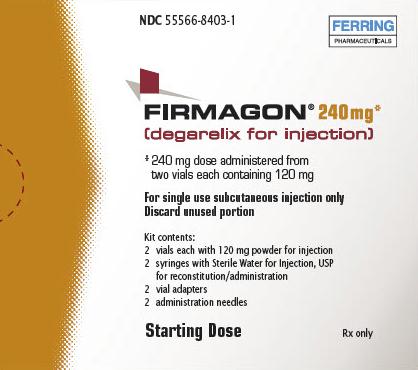
Brand name: Firmagon
Drug class: Antigonadotropins
Chemical name: N-Acetyl-3-(2-naphthalenyl)-d-alanyl-4-chloro-d-phenylalanyl-3-(3-pyridinyl)-d-alanyl-l-seryl-4-[[[(4S)-hexahydro-2,6-dioxo-4-pyrimidinyl]carbonyl]amino]-l-phenylalanyl-4-[(aminocarbonyl)amino]-d-phenylalanyl-l-leucyl-N6-(1-methylethyl)-l-lysyl-l-prolyl-d-alaninamide acetate hydrate
Molecular formula: C82H103ClN18O16•xC2H4O2•nH2O
CAS number: 934246-14-7
Introduction
Antineoplastic agent; gonadotropin-releasing hormone (GnRH, luteinizing hormone-releasing hormone [LHRH], gonadorelin) antagonist.
Uses for Degarelix
Prostate Cancer
Treatment of advanced prostate cancer.
Medical castration (defined as serum total testosterone concentration ≤50 ng/dL) achieved sooner with degarelix compared with leuprolide.
Degarelix Dosage and Administration
General
-
Consult specialized references for procedures for proper handling and disposal of antineoplastics.
Administration
Sub-Q Administration
Administer by sub-Q injection in abdominal region; rotate injection sites. Do not administer IV.
Administer initial dose as 2 sub-Q injections at 2 different injection sites; administer maintenance dosages as one sub-Q injection every 28 days.
Administer injections in areas of abdomen not exposed to pressure (e.g., not close to the waistband, belt, or ribs). Grasp tissue around injection site, elevate sub-Q tissue, and insert needle deeply into sub-Q tissue at an angle of ≥45°. Gently pull back plunger to ensure that blood is not aspirated. If blood appears in syringe, do not use reconstituted solution; discontinue procedure, discard syringe and needle, and reconstitute new dose for patient.
Wear gloves at all times during preparation and administration of the drug to minimize risk of dermal exposure. If drug comes in contact with skin or mucosa, immediately and thoroughly wash affected areas of skin with soap and water and flush affected mucosa with water.
Reconstitution
Carefully reconstitute powder prior to administration using proper aseptic technique.
Reconstitute vial containing 80 or 120 mg of degarelix by slowly adding 4.2 or 3 mL of sterile water for injection, respectively, (using a 5-mL syringe with a 21-gauge, 2-inch needle) to provide a solution containing approximately 20 or 40 mg/mL, respectively. Administration of other concentrations not recommended. Do not use bacteriostatic water for injection to reconstitute the drug. Based on indicated dosage of drug, reconstitute appropriate number of vials (i.e., two 120-mg vials for initial dose [reconstituted separately using 2 syringes] and one 80-mg vial for maintenance doses).
Keep vial vertical at all times; do not shake (to avoid foam formation). To keep solution and syringe sterile, do not remove syringe and needle from vial following addition of sterile water for injection. Very gently swirl vial (in upright position) until liquid is clear and all powder or particles dissolve. If powder adheres to vial over surface of solution, slightly tilt vial to dissolve powder. A ring of small air bubbles on surface of solution is acceptable. Reconstitution procedure may take up to 15 minutes.
While needle is maintained in lowest part of vial and vial is slightly tilted, withdraw appropriate dose of degarelix (i.e., 4 or 3 mL from vial containing 80 or 120 mg of degarelix, respectively); do not turn vial upside down. Prior to administration, replace 21-gauge, 2-inch reconstitution needle with 27-gauge, 1.25-inch administration needle for deep sub-Q administration; remove any remaining air bubbles.
Immediately administer reconstituted solution; must administer within one hour following addition of sterile water for injection to lyophilized powder.
Dosage
Available as degarelix acetate; dosage expressed in terms of degarelix.
Adults
Prostate Cancer
Sub-Q
Initially, 240 mg (given as 2 sub-Q injections of 120 mg at a concentration of 40 mg/mL, administered at 2 different injection sites), followed by maintenance dosage of 80 mg (given as one sub-Q injection of 80 mg at a concentration of 20 mg/mL) every 28 days; administer first maintenance dose 28 days after initial dose.
Special Populations
Hepatic Impairment
No dosage adjustment required in patients with mild (Child-Pugh class A) or moderate (Child-Pugh class B) hepatic impairment. Degarelix not studied in patients with severe hepatic impairment; use with caution. (See Hepatic Impairment under Cautions.)
Renal Impairment
No dosage adjustment required in patients with mild (Clcr of 50–80 mL/minute) or moderate (Clcr of 30 to <50 mL/minute ) renal impairment. However, insufficient data in patients with moderate renal impairment, and not studied in patients with severe renal impairment; use with caution in patients with Clcr <50 mL/minute. (See Renal Impairment under Cautions.)
Geriatric Patients
No dosage adjustment required. (See Geriatric Use under Cautions.)
Cautions for Degarelix
Contraindications
-
Known hypersensitivity to degarelix or any ingredient in the formulation.
-
Women who are or may become pregnant; not indicated for use in women. (See Fetal/Neonatal Morbidity and Mortality and also see Pregnancy under Cautions.)
Warnings/Precautions
Fetal/Neonatal Morbidity and Mortality
May cause fetal harm; teratogenicity and embryolethality demonstrated in animals. (See Contraindications under Cautions.)
Prolongation of QT Interval
Prolongation of QTcF interval reported.
Long-term androgen deprivation therapy prolongs QT interval.
Consider whether benefits of androgen deprivation therapy outweigh potential risks in patients with congenital long QT syndrome, electrolyte abnormalities, or CHF and in patients receiving class IA (e.g., procainamide, quinidine) or class III (e.g., amiodarone, sotalol) antiarrhythmic agents.
Laboratory Monitoring
Periodically measure PSA concentrations to monitor response to the drug. If serum PSA concentrations increase, measure serum testosterone concentrations.
Laboratory Test Interferences
Degarelix therapy suppresses pituitary gonadal system; may affect results of diagnostic tests of pituitary gonadotropic and gonadal functions performed during and after therapy.
Decrease in Bone Mineral Density
Possible decrease in bone mineral density (BMD) with long-term androgen deprivation therapy.
Antibody Formation
Development of antibodies to degarelix reported; safety and efficacy of the drug not affected by antibody formation.
Specific Populations
Pregnancy
Category X. (See Fetal/Neonatal Morbidity and Mortality and also see Contraindications under Cautions.)
Lactation
Not known whether distributed into milk. Not indicated for use in women. (See Contraindications under Cautions.)
Pediatric Use
Safety and efficacy not established in pediatric patients.
Geriatric Use
No substantial differences in safety and efficacy relative to younger adults, but increased sensitivity cannot be ruled out. (See Geriatric Patients under Dosage and Administration.)
Hepatic Impairment
Patients with hepatic impairment were excluded from clinical study in prostate cancer.
No dosage adjustment required in patients with mild (Child-Pugh class A) or moderate (Child-Pugh class B) hepatic impairment. Not studied in patients with severe hepatic impairment; use with caution in such patients.
Reduced degarelix exposure in patients with mild or moderate hepatic impairment. (See Special Populations under Pharmacokinetics.)
Monitor testosterone concentrations monthly in patients with hepatic impairment until medical castration achieved; thereafter, consider monitoring testosterone concentrations every other month.
Renal Impairment
Insufficient data in patients with moderate renal impairment, and not studied in patients with severe renal impairment; use with caution in patients with Clcr <50 mL/minute because 20–30% of a given dose is excreted unchanged in urine. (See Renal Impairment under Dosage and Administration.)
Pharmacokinetics not studied in patients with renal impairment. (See Special Populations under Pharmacokinetics.)
Common Adverse Effects
Injection site reactions (e.g., pain, erythema, swelling, induration, nodule), hot flashes, weight gain, increased transaminase and γ-glutamyltransferase (γ-glutamyltranspeptidase, GGT, GGTP) concentrations, hypertension, back pain, fatigue, chills, arthralgia, constipation, urinary tract infection.
Drug Interactions
No formal drug interaction studies to date.
Not a substrate, inducer, or inhibitor of CYP isoenzyme or P-glycoprotein transport systems.
Drugs Affecting or Metabolized by Hepatic Microsomal Enzymes
Clinically important pharmacokinetic interactions with drugs affecting or metabolized by CYP isoenzymes unlikely.
Drugs Affecting or Affected by the P-glycoprotein Transport System
Clinically important pharmacokinetic interactions with drugs affecting or affected by the P-glycoprotein transport system unlikely.
Degarelix Pharmacokinetics
Absorption
Bioavailability
Forms a depot at injection site following sub-Q administration from which drug is slowly released into circulation.
Peak plasma concentrations generally occur within 2 days following sub-Q administration of a single 240-mg dose at a concentration of 40 mg/mL.
Pharmacokinetic behavior strongly influenced by concentration of drug in injection solution.
Onset
Medical castration achieved within 7 days.
Special Populations
Pharmacokinetics not affected by age, weight, or race.
Exposure to degarelix reduced by 10 or 18% in patients with mild (Child-Pugh class A) or moderate (Child-Pugh class B) hepatic impairment, respectively, compared with individuals with normal hepatic function. (See Hepatic Impairment under Cautions.)
Pharmacokinetics not studied in patients with renal impairment; however, a population pharmacokinetic analysis suggests that mild renal impairment (Clcr of 50–80 mL/minute) has no clinically important effect on concentrations of degarelix or testosterone. (See Renal Impairment under Cautions.)
Distribution
Extent
Distributed throughout total body water.
Not known whether distributed into milk. (See Contraindications under Cautions.)
Plasma Protein Binding
Approximately 90%.
Elimination
Metabolism
Subjected to peptide hydrolysis during passage through the hepatobiliary system; mainly excreted as peptide fragments in feces.
No substantial metabolites detected in plasma following sub-Q administration.
Not a substrate, inducer, or inhibitor of CYP isoenzyme or P-glycoprotein transport systems.
Elimination Route
Excreted in urine (20–30%) as unchanged drug; 70–80% of administered dose presumably excreted via hepatobiliary system.
Half-life
Eliminated in a biphasic manner; median terminal half-life of about 53 days following sub-Q administration of a 240-mg dose at a concentration of 40 mg/mL.
Stability
Storage
Parenteral
Powder for Injection
25°C (may be exposed to 15–30°C).
Reconstituted solution: Use within one hour following addition of sterile water for injection to lyophilized powder.
Actions
-
Synthetic GnRH antagonist.
-
Immediately, competitively, and reversibly binds to and blocks GnRH receptors in the pituitary, thereby reducing release of gonadotropins (i.e., LH, FSH) and, consequently, testosterone without initial stimulation of hypothalamic-pituitary-gonadal axis and associated testosterone surge.
-
Exhibits low histamine-releasing potential compared with other GnRH antagonists; no signs of immediate- or late-onset systemic allergic reactions reported.
Advice to Patients
-
Importance of instructing patients to carefully read the manufacturer’s patient information before initiating therapy and each time the prescription is refilled.
-
Importance of understanding frequency and duration of treatment and required monitoring procedures.
-
Risk of hot flashes, flushing of the skin, increased weight, decreased sex drive, and difficulties with erectile function.
-
Risk of redness, swelling, and itching at the injection site; usually mild, self-limiting, and decrease within 3 days.
-
Importance of informing clinicians of existing or contemplated concomitant therapy, including prescription (e.g., antiarrhythmic agents) and OTC drugs and herbal supplements, as well as any concomitant illnesses (e.g., CHF, electrolyte abnormalities, hepatic or renal impairment).
-
Importance of informing patients of other important precautionary information. (See Cautions.)
Preparations
Excipients in commercially available drug preparations may have clinically important effects in some individuals; consult specific product labeling for details.
Please refer to the ASHP Drug Shortages Resource Center for information on shortages of one or more of these preparations.
|
Routes |
Dosage Forms |
Strengths |
Brand Names |
Manufacturer |
|---|---|---|---|---|
|
Parenteral |
For injection, for subcutaneous use only |
80 mg (of degarelix) |
Firmagon |
Ferring |
|
120 mg (of degarelix) |
Firmagon |
Ferring |
AHFS DI Essentials™. © Copyright 2025, Selected Revisions October 16, 2017. American Society of Health-System Pharmacists, Inc., 4500 East-West Highway, Suite 900, Bethesda, Maryland 20814.
Reload page with references included
Related/similar drugs
Frequently asked questions
More about degarelix
- Check interactions
- Compare alternatives
- Reviews (15)
- Side effects
- Dosage information
- During pregnancy
- Drug class: gonadotropin-releasing hormone antagonists
- En español