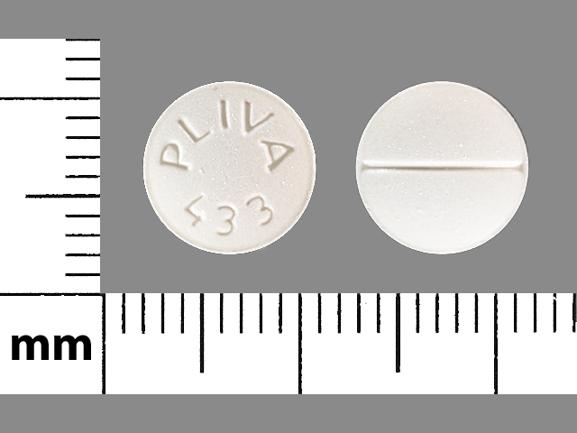
Trazodone Dosage
This dosage information may not include all the information needed to use Trazodone safely and effectively. See additional information for Trazodone.
The information at Drugs.com is not a substitute for medical advice. ALWAYS consult your doctor or pharmacist.
Usual Adult Dose for:
Usual Geriatric Dose for:
Usual Pediatric Dose for:
Additional dosage information:
Usual Adult Dose for Depression
Immediate-release tablets:
Initial dose: 150 mg per day in divided doses.
Maintenance dose: May be increased by 50 mg per day every 3 to 4 days. The maximum dose for outpatients usually should not exceed 400 mg per day in divided doses. Inpatients may be given up to but not in excess of 600 mg per day in divided doses.
Trazodone should be taken shortly after a meal or light snack.
Extended-release tablets:
Recommended starting dose: 150 mg once daily
Maintenance dose: The dose may be increased by 75 mg/day every three days (for example, start 225 mg on day 4 of therapy).
Maximum daily dose: 375 mg
Trazodone extended-release tablets should be taken orally at the same time every day, in the late evening preferably at bedtime, on an empty stomach. Once an adequate response has been achieved, dosage may be gradually reduced, with subsequent adjustment depending on therapeutic response.
Patients should be monitored for withdrawal symptoms when discontinuing treatment with trazodone hydrochloride. The dose should be gradually reduced whenever possible.
The efficacy of trazodone extended-release tablets for the maintenance treatment of MDD has not been evaluated. While there is no body of evidence available to answer the question of how long a patient treated with trazodone extended-release tablets should continue the drug, it is generally recommended that treatment be continued for several months after an initial response. Patients should be maintained on the lowest effective dose and be periodically reassessed to determine the continued need for maintenance treatment.
Usual Geriatric Dose for Depression
Immediate-release tablets:
Initial dose: 150 mg per day in divided doses.
Maintenance dose: May be increased by 50 mg per day every 3 to 4 days. The maximum dose for outpatients usually should not exceed 400 mg per day in divided doses. Inpatients may be given up to but not in excess of 600 mg per day in divided doses.
Trazodone should be taken shortly after a meal or light snack.
Extended-release tablets:
Recommended starting dose: 150 mg once daily
Maintenance dose: The dose may be increased by 75 mg/day every three days (for example, start 225 mg on day 4 of therapy).
Maximum daily dose: 375 mg
Trazodone extended-release tablets should be taken orally at the same time every day, in the late evening preferably at bedtime, on an empty stomach. Once an adequate response has been achieved, dosage may be gradually reduced, with subsequent adjustment depending on therapeutic response.
Patients should be monitored for withdrawal symptoms when discontinuing treatment with trazodone hydrochloride. The dose should be gradually reduced whenever possible.
The efficacy of trazodone extended-release tablets for the maintenance treatment of MDD has not been evaluated. While there is no body of evidence available to answer the question of how long a patient treated with trazodone extended-release tablets should continue the drug, it is generally recommended that treatment be continued for several months after an initial response. Patients should be maintained on the lowest effective dose and be periodically reassessed to determine the continued need for maintenance treatment.
In the clinical trial, there were nine patients older than 65. No overall differences in safety or effectiveness were observed between these subjects and younger subjects, and other reported clinical literature and experience with trazodone have not identified differences in responses between elderly and younger patients. However, as experience in the elderly with trazodone extended-release tablets is limited, it should be used with caution in geriatric patients.
Antidepressants have been associated with cases of clinically significant hyponatremia in elderly patients who may be at greater risk for this adverse reaction.
Usual Pediatric Dose for Depression
(Not approved by FDA)
Immediate-release tablets:
6 to 12 years:
Initial dose: 1.5 to 2 mg/kg/day in divided doses.
Maintenance dose: May increase up to 6 mg/kg/day in 3 divided doses.
Greater than 12 years to 18 years:
Initial dose: 25 to 50 mg per day.
Maintenance dose: May increase up to 100 to 150 mg per day in divided doses.
Trazodone should be taken shortly after a meal or light snack.
Renal Dose Adjustments
Because the metabolites of trazodone are eliminated by the kidneys, and at least one such metabolite may be active, use of trazodone is not recommended for use in patients with renal dysfunction.
Liver Dose Adjustments
The disposition and safety of trazodone in patients with liver dysfunction has not been described. Therefore, if trazodone must be used, it should be used very cautiously. Consideration should be given to the use of alternative therapies in patients with liver dysfunction.
Dose Adjustments
Occurrence of drowsiness may require the administration of a major portion of the daily dose at bedtime or a reduction of dosage. Once an adequate response has been achieved, dosage may be gradually reduced, with subsequent adjustment depending on therapeutic response.
Precautions
Children, adolescents, and young adults (18 to 24 years of age) with major depressive disorder and other psychiatric disorders may be at an increased risk of suicidal thinking and suicidality with antidepressant use, particularly during the first few months of treatment. Medical evidence has not shown this increased risk to exist in adults older than 24 years of age, but adults 65 years of age and older taking antidepressants appear to have a decreased risk of suicidality. The results of a meta-analysis indicate an overall favorable risk-to-benefit profile for the use of antidepressants (i.e., selective serotonin and/or norepinephrine reuptake inhibitors) in the treatment of pediatric patients (less than 19- years- old) with major depressive disorders (MDD), obsessive-compulsive disorder (OCD), or non- OCD anxiety disorders. Although this study also reports an overall increased risk of suicidal ideation/suicide attempt associated with the use of antidepressants in pediatric patients, the risk may be less than originally estimated. Additional prospective studies are warranted in order to confirm these findings.
Worsening of depression and/or increased suicidal thinking or behavior may always be a possibility in patients treated with antidepressant medications, particularly those being treated for depression. Anxiety, agitation, panic attacks, insomnia, irritability, hostility, impulsivity, akathisia (severe restlessness), hypomania, and mania have been reported in patients being treated with antidepressants for major depressive disorder as well as for other indications, both psychiatric and nonpsychiatric. It is unknown if these symptoms are a precursor to either worsening of depression or the emergence of suicidal impulses; however, there is concern that patients who experience one or more of these symptoms may be at increased risk for worsening depression or suicidality. Although the FDA has not concluded that antidepressant drugs cause worsening depression or suicidality, health care providers should be aware that worsening of symptoms could be due to the underlying disease or might be a result of drug therapy.
Health care providers should carefully monitor patients receiving antidepressants for possible and/or persistent worsening of depression or emergent suicidality, especially at the beginning of therapy or when the dose either increases or decreases. If symptoms are severe, abrupt in onset, or were not part of the patient's presenting symptoms, the health care provider will need to determine what intervention, including discontinuing or modifying the current drug therapy, is indicated. Prescriptions should be written for small quantities of drug to reduce the risk of an attempt to overdose. Health care providers should instruct patients, their families and their caregivers to be alert for the emergence of agitation, irritability, and the other symptoms described above, as well as the emergence of suicidality and worsening depression, and to report such symptoms immediately to their health care provider.
Because antidepressants are believed to have the potential for inducing manic episodes in patients with bipolar disorder, there is a concern about using antidepressants alone in this population. Therefore, patients should be adequately screened to determine if they are at risk for bipolar disorder before initiating antidepressant treatment so that they can be appropriately monitored during treatment. Such screening should include a detailed psychiatric history, including a family history of suicide, bipolar disorder, and depression.
Safety and effectiveness have not been established in pediatric patients (less than 18 years of age).
Dialysis
Because the metabolites of trazodone are eliminated by the kidneys, and at least one such metabolite may be active, use of trazodone is not recommended for use in patients with renal dysfunction.
Other Comments
Symptomatic relief may be seen during the first week, with optimal antidepressant effects typically evident within 2 weeks.
Trazodone extended-release tablets are scored to provide flexibility in dosing. Trazodone extended-release tablets can be swallowed whole or administered as a half tablet by breaking the tablet along the score line. Breaking the tablet in half does not affect the controlled-release properties of the tablet.
In order to maintain its controlled-release properties, trazodone extended-release tablets should not be chewed or crushed.