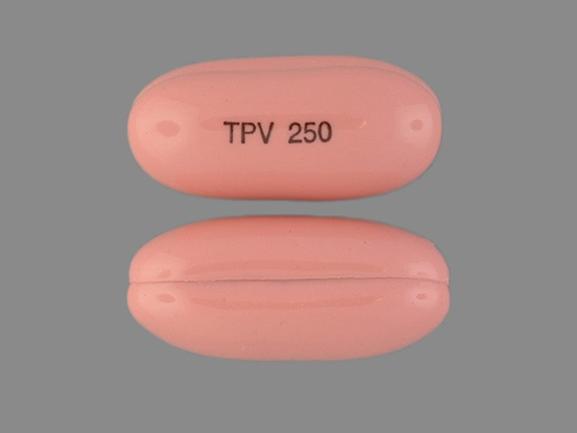
Tipranavir Dosage
Medically reviewed by Drugs.com. Last updated on Aug 14, 2023.
Applies to the following strengths: 100 mg/mL; 250 mg
Usual Adult Dose for:
Usual Pediatric Dose for:
Additional dosage information:
Usual Adult Dose for HIV Infection
Tipranavir 500 mg plus ritonavir 200 mg orally twice a day
Use: In combination with ritonavir and other antiretrovirals, for the treatment of HIV-1 infection in therapy-experienced patients infected with HIV-1 strains resistant to more than 1 protease inhibitor
Usual Pediatric Dose for HIV Infection
2 to 18 years:
- Based on weight: Tipranavir 14 mg/kg plus ritonavir 6 mg/kg orally twice a day
- Based on BSA: Tipranavir 375 mg/m2 plus ritonavir 150 mg/m2 orally twice a day
Comments:
- Special vigilance recommended during dose calculation, medication order transcription, dispensing information, and dosing instructions to reduce risk for medication errors, overdose, and underdose.
- Pediatric dose should not exceed the usual adult dose.
Use: In combination with ritonavir and other antiretrovirals, for the treatment of HIV-1 infection in therapy-experienced patients infected with HIV-1 strains resistant to more than 1 protease inhibitor
Renal Dose Adjustments
Data not available
Liver Dose Adjustments
Mild liver dysfunction (Child-Pugh A): Caution recommended.
Moderate or severe liver dysfunction (Child-Pugh B or C): Contraindicated
Comments:
- Levels of this drug may be increased in patients with mild liver dysfunction.
- This drug (plus ritonavir) should be used with caution in patients with elevated transaminases or coinfected with HBV or HCV.
Dose Adjustments
2 to 18 years:
- Based on weight: Tipranavir 12 mg/kg plus ritonavir 5 mg/kg orally twice a day
- Based on BSA: Tipranavir 290 mg/m2 plus ritonavir 115 mg/m2 orally twice a day
Comments:
- Dose reduction may be considered if intolerance or toxicity develops and patients cannot continue the usual dose, as long as their virus is not resistant to multiple protease inhibitors.
Precautions
US BOXED WARNINGS:
- HEPATOTOXICITY: Clinical hepatitis and hepatic decompensation (including some fatalities) reported. Extra caution is needed in patients coinfected with chronic HBV or HCV as they have greater risk of hepatotoxicity.
- INTRACRANIAL HEMORRHAGE: Fatal and nonfatal intracranial hemorrhage reported.
Safety and efficacy have not been established in patients younger than 2 years.
Consult WARNINGS section for additional precautions.
Dialysis
Data not available
Comments:
- Significant removal via dialysis is not likely (highly protein bound).
Other Comments
Administration advice:
- Must use in combination with ritonavir (to exert therapeutic effect); use with other active agents (to increase likelihood of treatment response).
- When coadministered with ritonavir capsules or solution: May administer without regard to meals
- When coadministered with ritonavir tablets: Must only administer with meals
- Swallow capsules whole and do not chew.
- If a patient is unable to reliably swallow a capsule, use the oral solution; administer the oral solution using a calibrated dosing syringe.
Storage requirements:
- Capsules: Store unopened bottle in a refrigerator at 2C to 8C (36F to 46F); after opening bottle, may store at 25C (77F), with excursions permitted to 15C to 30C (59F to 86F); once bottle opened, must use within 60 days.
- Oral solution: Store at 25C (77F), with excursions permitted to 15C to 30C (59F to 86F); do not refrigerate or freeze; once bottle opened, must use within 60 days.
General:
- Use of this drug (plus ritonavir) should be guided by genotypic/phenotypic testing and/or treatment history; virologic response to this drug (plus ritonavir) affected by the number of baseline primary protease inhibitor mutations.
- If this drug is not coadministered with ritonavir correctly, plasma tipranavir levels will not be adequate to achieve desired antiviral effect; some drug interactions will be altered.
- This drug (plus ritonavir) is not recommended for use in therapy-naive patients.
- The manufacturer product information for ritonavir should be consulted.
Monitoring:
- Hepatic: Signs/symptoms of hepatitis; clinical and laboratory monitoring in all patients, especially those coinfected with chronic HBV or HCV; liver function tests (before starting and frequently during therapy)
- Metabolic: Cholesterol and triglyceride levels (prior to therapy and periodically thereafter)
Patient advice:
- Read the US FDA-approved patient labeling (Patient Information).
- If signs/symptoms of clinical hepatitis develop, stop therapy and seek medical attention.
- Report any unusual/unexplained bleeding to physician.
- If symptoms of rash develop, stop therapy and contact physician.
- If using the oral solution, do not take supplemental vitamin E greater than a standard multivitamin.
More about tipranavir
- Check interactions
- Compare alternatives
- Side effects
- During pregnancy
- Drug class: protease inhibitors
- Breastfeeding
- En español
Patient resources
Other brands
Professional resources
Other brands
Related treatment guides
Further information
Always consult your healthcare provider to ensure the information displayed on this page applies to your personal circumstances.