
Sciatica
Medically reviewed by Drugs.com. Last updated on Sep 1, 2024.
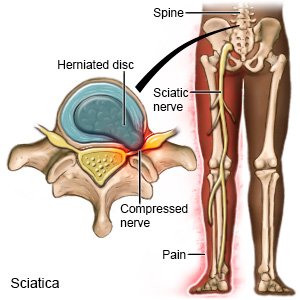
Sciatica is a condition that causes pain along your sciatic nerve. The sciatic nerve runs from your spine through both sides of your buttocks. It then runs down the back of your thigh, into your lower leg and foot. Any place along your sciatic nerve may be compressed, inflamed, irritated, or stretched.
 |
DISCHARGE INSTRUCTIONS:
Seek immediate care if:
- You have trouble controlling your urine or bowel movements.
- You have weakness in both legs.
- You have numbness in your groin or buttocks.
Call your doctor if:
- You have pain in your lower back at night or when resting.
- You have pain in your lower back with numbness below the knee.
- You have weakness in one leg only.
- You have questions or concerns about your condition or care.
Medicines:
You may need any of the following:
- NSAIDs , such as ibuprofen, help decrease swelling, pain, and fever. This medicine is available with or without a doctor's order. NSAIDs can cause stomach bleeding or kidney problems in certain people. If you take blood thinner medicine, always ask your healthcare provider if NSAIDs are safe for you. Always read the medicine label and follow directions.
- Acetaminophen decreases pain and fever. It is available without a doctor's order. Ask how much to take and how often to take it. Follow directions. Read the labels of all other medicines you are using to see if they also contain acetaminophen, or ask your doctor or pharmacist. Acetaminophen can cause liver damage if not taken correctly.
- Muscle relaxers help decrease pain and muscle spasms.
- Take your medicine as directed. Contact your healthcare provider if you think your medicine is not helping or if you have side effects. Tell your provider if you are allergic to any medicine. Keep a list of the medicines, vitamins, and herbs you take. Include the amounts, and when and why you take them. Bring the list or the pill bottles to follow-up visits. Carry your medicine list with you in case of an emergency.
Manage your symptoms:
- Decrease your activity as directed. Do not lift heavy objects or twist your back for at least 6 weeks. Slowly return to your usual activity.
- Apply ice to help decrease swelling and pain. Use an ice pack, or put crushed ice in a plastic bag. Cover it with a towel before you place it on your back or leg. Apply ice for 15 to 20 minutes every hour, or as directed.
- Apply heat to help decrease pain and muscle spasms. Use a heat pack or a heating pad set on low heat. Apply heat on your back or leg for 20 to 30 minutes every 2 hours for as many days as directed.
- Go to physical or occupational therapy as directed. A physical therapist teaches you exercises to help improve movement and strength, and to decrease pain. An occupational therapist teaches you skills to help with your daily activities.
- Use assistive devices, if directed. You may need to wear back support, such as a back brace. You may need crutches, a cane, or a walker to decrease stress on your lower back and leg muscles. Ask your healthcare provider for more information about assistive devices and how to use them correctly.
Treatment options
The following list of medications are related to or used in the treatment of this condition.
Prevent sciatica:
- Avoid pressure on your back and legs. Do not lift heavy objects, or stand or sit for long periods of time.
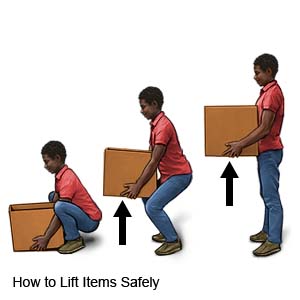
- Lift objects safely. Keep your back straight and bend your knees when you pick up an object. Do not bend or twist your back when you lift.
- Maintain a healthy weight. Ask your healthcare provider what a healthy weight is for you. Your provider can help you create a weight loss plan, if needed.
- Exercise as directed. Ask your healthcare provider about the best stretching, warmup, and exercise plan for you.
Follow up with your doctor as directed:
Write down your questions so you remember to ask them during your visits.
© Copyright Merative 2024 Information is for End User's use only and may not be sold, redistributed or otherwise used for commercial purposes.
The above information is an educational aid only. It is not intended as medical advice for individual conditions or treatments. Talk to your doctor, nurse or pharmacist before following any medical regimen to see if it is safe and effective for you.
Learn more about Sciatica
Treatment options
Care guides
Symptoms and treatments
Medicine.com guides (external)
Further information
Always consult your healthcare provider to ensure the information displayed on this page applies to your personal circumstances.