
Sciatica
Medically reviewed by Drugs.com. Last updated on Sep 1, 2024.
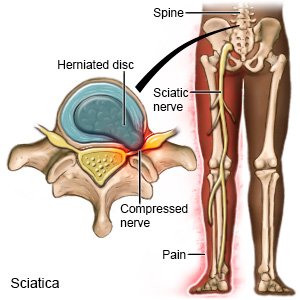
Sciatica is a condition that causes pain along your sciatic nerve. The sciatic nerve runs from your spine through both sides of your buttocks. It then runs down the back of your thigh, into your lower leg and foot. Any place along your sciatic nerve may be compressed, inflamed, irritated, or stretched.
 |
WHILE YOU ARE HERE:
Informed consent
is a legal document that explains the tests, treatments, or procedures that you may need. Informed consent means you understand what will be done and can make decisions about what you want. You give your permission when you sign the consent form. You can have someone sign this form for you if you are not able to sign it. You have the right to understand your medical care in words you know. Before you sign the consent form, understand the risks and benefits of what will be done. Make sure all your questions are answered.
Activity:
You may need to rest in bed at first. Do not stay in bed longer than 2 days. Your healthcare provider will tell you when it is okay to get out of bed. Call your healthcare provider before you get up for the first time. As the pain decreases, you may need to start moving or walking to recover faster.
Medicines:
- Pain medicine may be given. Do not wait until the pain is severe before you ask for more medicine.
- Muscle relaxers help decrease pain and muscle spasms.
- Epidural steroid medicine may include both an anesthetic (numbing medicine) and a steroid. A steroid may decrease swelling and relieve pain. It is given as a shot close to the spine in the area where you have pain.
Tests:
- X-rays of your back, hip, thigh, or leg may show other problems, such as fractures (broken bones).
- A CT scan or MRI may show your sciatic nerve, muscles, and blood vessels. You may be given contrast liquid to help the area show up better in pictures. Tell the healthcare provider if you have ever had an allergic reaction to contrast liquid. Do not enter the MRI room with anything metal. Metal can cause serious injury. Tell the healthcare provider if you have any metal in or on your body.
- An electromyography (EMG) test measures the electrical activity of your muscles at rest and with movement.
- Nerve conduction tests check how surface nerves and related muscles respond to stimulation. Electrodes with wires or tiny needles are placed on certain areas, such as the buttocks and legs.
Treatment:
- Ultrasound therapy is a machine that uses sound waves to decrease pain. Topical medicines may be added to help decrease pain and inflammation.
- Chemonucleolysis is an injection given into the damaged disc to soften or shrink the disc.
- Surgery may be done to correct problems such as a damaged disc or a tumor in your spine. Surgery may be done to decrease the pressure on the sciatic nerve. Healthcare providers may also release the muscle that may be pressing into your sciatic nerve.
- Physical or occupational therapy may be recommended. A physical therapist teaches you exercises to help improve movement and strength, and to decrease pain. An occupational therapist teaches you skills to help with your daily activities.
- Assistive devices may make you more comfortable or relieve pressure in the area. You may need back support, such as a back brace. You may need crutches, a cane, or a walker to decrease stress on your lower back and leg muscles. Ask your healthcare provider for more information about assistive devices and how to use them correctly.
Treatment options
The following list of medications are related to or used in the treatment of this condition.
RISKS:
If sciatica is not treated, your muscles and nerves may become damaged permanently. You may have decreased strength. You may not be able to move your leg or control when you urinate or have bowel movements.
CARE AGREEMENT:
You have the right to help plan your care. Learn about your health condition and how it may be treated. Discuss treatment options with your healthcare providers to decide what care you want to receive. You always have the right to refuse treatment.© Copyright Merative 2024 Information is for End User's use only and may not be sold, redistributed or otherwise used for commercial purposes.
The above information is an educational aid only. It is not intended as medical advice for individual conditions or treatments. Talk to your doctor, nurse or pharmacist before following any medical regimen to see if it is safe and effective for you.
Learn more about Sciatica
Treatment options
Care guides
Symptoms and treatments
Medicine.com guides (external)
Further information
Always consult your healthcare provider to ensure the information displayed on this page applies to your personal circumstances.