Thomson Reuters Micromedex

Rotator Cuff Injury

What is a rotator cuff injury?

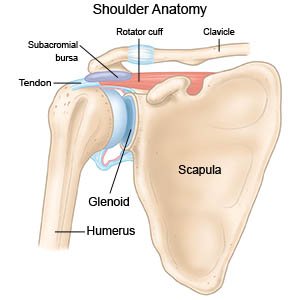
The rotator cuff is made up of a group of muscles and tendons that hold the shoulder joint (the place where the bones of your shoulder meet) in place. Tendons are tough tissues that join muscle to bone. The rotator cuff is used when you lift your arm and reach overhead. A small sack of fluid around the joint, called a bursa, also helps your shoulder move. Injuries to the rotator cuff may include stretching of the muscles, and small or large tears of the tendons. There may also be inflammation (swelling) of the tendons or the bursa.

Shoulder- Front View

What increases my risk, or causes a rotator cuff injury?

Smoking increases the risk of injuring your rotator cuff. Rotator cuff injury may be caused by any of the following:

  • Wear and tear of the tendons: As you get older, your tendons get weaker.

  • Impingement: This happens when the bone of your upper arm presses on the tendon of your shoulder when you lift your arm. This problem causes pain and inflammation (swelling) that weakens the rotator cuff.

  • Using the rotator cuff too much, a fall, or another injury: Heavy lifting, throwing, or overuse, may damage the rotator cuff. Athletes, such as baseball pitchers and tennis players can have problems caused by using the rotator cuff too much. Falling during sports such as skiing may also damage your rotator cuff.

What are the signs and symptoms of a rotator cuff injury?

Rotator cuff symptoms may be acute (happen suddenly) such as if you have fallen down, or they may be chronic (long-lasting). A chronic injury may cause your shoulder muscles to get smaller over time. You may have one or more of the following symptoms:

  • Pain or stiffness: You may feel pain in your shoulder that also may travel down your arm. The pain may be constant or you feel it some of the time. The pain may be stronger at night. It may be painful lying on the side of your injured shoulder.

  • Decreased range of motion: You may have trouble lifting your arm. You may find it hard to do movements such as placing your arm behind your back. It may also be hard to use your shoulder for activities such as sports and work. If you have a bad injury, your cuff may not be able to hold the bones of the shoulder in place. If this happens, you may not be able to move your shoulder at all.

  • Tenderness or swelling: Your shoulder area may swell up and be painful to touch. Your shoulders may look uneven when you look in the mirror.

  • Numbness: You may lose feeling in part or all of your arm. This is more common in athletes that throw as part of their sport, such as baseball pitchers.

  • A popping noise: This may be felt or heard along with pain while lifting your arm.

How is a rotator cuff injury diagnosed?

Your caregiver will ask you if you have had an injury or surgery on your shoulder. Your caregiver will check your arm for signs of rotator cuff injury. You may need an injection of pain medicine before your caregiver checks your arm. Your caregiver will test the strength of your arm, and how well you can move it. You may need other tests to show what is causing your symptoms such as pain and swelling. These tests can also show how bad the injury is. You may need one or more of the following:

  • Ultrasound: This test uses sound waves to look at your shoulder. Pictures show up on a TV-like screen. An ultrasound may show fluid or swelling around the rotator cuff.

  • X-ray: This is a picture of the bones and tissues in your shoulder.

  • Computed tomography scan: This test is also called a CT scan. A special x-ray machine uses a computer to take a picture of your shoulder. Before taking the pictures you may be given dye through a tube that is placed in your vein (IV). This dye helps injuries of your shoulder show up better in the pictures. People who are allergic to shellfish (lobster, shrimp or crab) may be allergic to this dye. Tell your caregiver if you are allergic to any of these.

  • Magnetic resonance imaging: This test is also called MRI. During the MRI, pictures are taken of your shoulder. Never enter the MRI room with an oxygen tank, watch, or any other metal objects. This can cause serious injury. Tell your caregiver if you have any metal implants in your body.

How is a rotator cuff injury treated?

Your treatment depends on the cause and type of injury you have, and how bad the injury is. See your caregiver as soon as you can if you have been injured. By doing this you can start treatment sooner, and increase your chances of returning to your usual activities faster. Some people may have pain in their shoulder for a long time without seeing a caregiver. Even if you have had pain or other symptoms for a long time, treatment may also help you. Caregivers may suggest waiting until time has passed to see if the symptoms go away without treatment. If you need treatment, it may include any of the following:

  • Medicines:

    • NSAIDs: Nonsteroidal anti-inflammatory (NSAID) medicine may decrease swelling and pain or fever. This medicine can be bought with or without a doctor's order. This medicine can cause stomach bleeding or kidney problems in certain people. Always read the medicine label and follow the directions on it before using this medicine.

    • Steroids: An injection (shot) of steroids into your shoulder may be given by your caregiver. This may help reduce pain and inflammation (swelling). This treatment may help decrease pain in your shoulder, so that you can lift and move your arm.

    • Anesthesia: Your caregiver may give you an injection (shot) into your shoulder to numb the area and decrease pain. This is usually given with the shot of steroids.

  • Physical therapy methods: Your caregiver may use sound waves, water exercises, and electrical impulse through the skin as part of your therapy. Ask your caregiver which physical therapy methods are right for you.

  • Range of motion exercises:

    • A physical therapist will show you exercises to help your arm and shoulder muscles get stronger. Exercising your arm may help you go back to your usual activities, such as lifting your arm overhead. Ask your caregiver for more information about range of motion exercises. You may have only a few exercises to start with, and they may increase over time.

    • At first, the goal of treatment will be decreasing your shoulder pain. You may need to take pain medicine before doing the exercises. Later, caregivers will work with you to increase your ability to move your arm, and to strengthen your shoulder and arm. With therapy, caregivers will help you return to your usual activities. Therapy can help athletes return to their sport, such as throwing balls. Ask caregivers about stretching exercises that you can do before playing sports and doing activities.

  • Surgery: Ask your caregiver for more information if you need to have surgery. You may need surgery if you have a bad injury, if your symptoms do not improve over time. You may also need surgery if other treatments have not worked to decrease your signs and symptoms. Surgery options may include:

    • Debridement and repair: This surgery is done for partial or full tears of your rotator cuff. Your caregiver will clean away damaged tissue and fix your tear.

    • Tendon transfer and graft: This surgery is done for badly torn rotator cuffs that cannot be easily repaired. Your caregiver will use a piece of another tissue or muscle to fix the torn tendon.

    • Arthrodesis: This surgery is to reshape the bone of your shoulder joint so it stays in place. This is done if the muscles of your rotator cuff are not working.

    • Arthroplasty: During this surgery, a man-made joint using metal and plastic is put into your shoulder. This surgery may be done if the rotator cuff cannot be fixed, or if your pain and swelling do not go away.

How can I help my rotator cuff injury heal?

  • Rest: If you have an acute injury, rest may let your shoulder heal. Overuse of your shoulder can make your injury worse. You may need to wear a sling to keep your shoulder in place. If you need to wear a sling, ask caregivers when, and for how long you will need to wear it. If you have a chronic injury, rest as well as exercise may make up your treatment plan.

  • Put ice or heat on your shoulder: This may help decrease pain and swelling. Ask your caregiver when and how often you need to ice or put heat on your shoulder.

  • Stop smoking: Smoking may slow down healing of your rotator cuff injury.

When should I call my caregiver?

Call your caregiver if:

  • The pain in your shoulder or arm is not improving, or is worse than before you started treatment.

  • You have new pain in your neck.

  • You suddenly cannot move your arm.

  • You have stomach or back pain, are vomiting blood, or have black bowel movements.

  • You have pain, redness, or swelling in the area of your steroid shot.

  • You get a fever (high body temperature).

Care Agreement

You have the right to help plan your care. Learn about your health condition and how it may be treated. Discuss treatment options with your caregivers to decide what care you want to receive. You always have the right to refuse treatment.

Copyright © 2012. Thomson Reuters. All rights reserved. Information is for End User's use only and may not be sold, redistributed or otherwise used for commercial purposes.

The above information is an educational aid only. It is not intended as medical advice for individual conditions or treatments. Talk to your doctor, nurse or pharmacist before following any medical regimen to see if it is safe and effective for you.

Learn more about Rotator Cuff Injury

Advertisement
Close

Recommended

(web2)