
Cubital Tunnel Syndrome
Medically reviewed by Drugs.com. Last updated on Aug 4, 2025.
What is cubital tunnel syndrome?
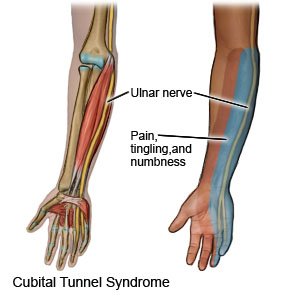
Cubital tunnel syndrome is a condition that causes pressure to build on the ulnar nerve in your elbow. The ulnar nerve controls muscles and feeling in the hand.
 |
What increases my risk for cubital tunnel syndrome?
- A past injury to your elbow or ulnar nerve, or a tumor or cyst
- Leaning on or bending your elbow for long periods of time, including during sleep
- Repetitive motion of your elbow, such as painting, playing a musical instrument, or using power tools
- Sports that stretch or put pressure on the elbow, such as tennis, riding a bicycle, or lifting weights
- Health conditions such as hypothyroidism, diabetes, obesity, or arthritis
What are the signs and symptoms of cubital tunnel syndrome?
- Numbness and tingling in your arm or hand, usually in the ring and little fingers
- Pain in your elbow that extends into your forearm and hand
- Weakness in your hand and fingers
- Not being able to straighten your fingers, usually the ring and little fingers
How is cubital tunnel syndrome diagnosed?
Your healthcare provider will ask about your signs and symptoms and examine your hand and arm. He or she may check the movement of your shoulder, elbow, wrist, and fingers. You may be asked to cross your middle and ring fingers. You may need any of the following:
- Nerve tests may be used to test how well your nerves are working. The tests may also be used to check for numbness, tingling, and pain. Your healthcare provider will tap or press on your elbow. He or she may also ask you to keep your elbow bent for a short time.
- X-ray, ultrasound, or MRI pictures of your elbow may be used to find the cause of your symptoms. You may be given contrast liquid to help any problems show up better in the pictures. Tell healthcare providers if you have ever had an allergic reaction to contrast liquid. Do not enter the MRI room with anything metal. Metal can cause serious injury. Tell healthcare providers if you have any metal in or on your body.
Related medications
How is cubital tunnel syndrome treated?
Cubital tunnel syndrome may go away without treatment. If it does not go away, you may need any of the following:
- NSAIDs help decrease swelling and pain or fever. This medicine is available with or without a doctor's order. NSAIDs can cause stomach bleeding or kidney problems in certain people. If you take blood thinner medicine, always ask your healthcare provider if NSAIDs are safe for you. Always read the medicine label and follow directions.
- A steroid injection helps decrease pain and swelling.
- Surgery may be needed if your symptoms do not get better within 3 months. Surgery will take pressure off your ulnar nerve. Your surgeon may move your nerve to a different area to stop it from being stretched or pinched. He or she may remove part of your bone if it is pressing on your nerve.
Treatment options
The following list of medications are related to or used in the treatment of this condition.
How can I manage my symptoms?
- Do not put pressure on your elbow. Certain positions put pressure on the ulnar nerve in your elbow. Do not lean on your elbow. Do not sleep with your arm overhead and elbow bent. Go to sleep with your arm straight and by your side.
- Apply ice. Ice helps decrease swelling and pain and prevents tissue damage. Use an ice pack or put crushed ice in a plastic bag. Cover the bag with a towel before you place it on your skin. Apply ice for 15 to 20 minutes every hour, or as directed.
- Rest your arm. Avoid activities that cause your symptoms to allow your nerve to heal.
- Go to physical therapy as directed. A physical therapist can show you exercises to help improve movement and strength. Physical therapy can also help decrease pain and loss of function.
- Use an elbow splint or brace. The brace or splint helps decrease arm movement and keep pressure off your ulnar nerve. Your healthcare provider will tell you when and how long to wear it each day. You may need to wear it at night. You may also need elbow pads to protect your elbow.
When should I seek immediate care?
- You suddenly lose feeling in your hand or fingers.
- You cannot move your ring or little finger.
When should I call my doctor?
- Your symptoms get worse.
- Your hand and fingers are so weak that you cannot grab, squeeze, or lift items.
- You have questions or concerns about your condition or care.
Care Agreement
You have the right to help plan your care. Learn about your health condition and how it may be treated. Discuss treatment options with your healthcare providers to decide what care you want to receive. You always have the right to refuse treatment. The above information is an educational aid only. It is not intended as medical advice for individual conditions or treatments. Talk to your doctor, nurse or pharmacist before following any medical regimen to see if it is safe and effective for you.© Copyright Merative 2025 Information is for End User's use only and may not be sold, redistributed or otherwise used for commercial purposes.
Further information
Always consult your healthcare provider to ensure the information displayed on this page applies to your personal circumstances.