
Bicycle Helmet Use
Medically reviewed by Drugs.com. Last updated on Jun 30, 2025.
Why should my child wear a bicycle helmet?
Bicycle accidents can cause injuries to the face, brain, and skull. The best way to protect your child from an injury is for him to wear a bicycle helmet. If he does get injured, a helmet may decrease his risk for permanent or life-threatening injury. Many states have laws that require bicycle helmet use. Do not allow your child to use a different kind of helmet, such as a sports helmet. He should only wear a bicycle helmet when he rides his bicycle.
When should my child wear a bicycle helmet?
Make sure your child always wears a helmet, even when he goes on short bicycle rides. Your child should start to wear a helmet when he learns how to ride a bicycle. He should also wear a helmet if he rides in a passenger seat on an adult bicycle.
How do I choose a safe bicycle helmet for my child?
- Check inside the helmet for a sticker or label stating that the helmet meets safety standards. The helmet should be approved by the United States Consumer Products Safety Commission (CPSC). It may also be approved by the Snell Memorial Foundation.
- Do not let your child wear a helmet that was used by another child. The helmet may be worn or missing parts needed for safety. Always replace a helmet after an accident. Even if you cannot see dents or cracks, it might not be safe. The helmet may not fit your child's head as well as it fit the other child's head.
- Choose a helmet that has a bright color or that will be easy for drivers to see.
Related medications
Risperidone
Risperidone is used to treat schizophrenia and symptoms of bipolar disorder. Learn about side ...
Amantadine
Easy-to-read patient leaflet for amantadine. Includes indications, proper use, special ...
How can I make sure my child's bicycle helmet fits properly?
- Always buy a helmet that fits your child currently. Do not buy a bigger helmet because you want him to grow into it. Replace the helmet as your child grows. Some helmets are made with thick foam that can be replaced with thinner foam as your child's head grows. Do not remove foam or padding unless the helmet is designed for this.
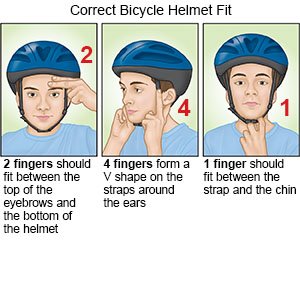
- Place the bicycle helmet on your child's head. It should be centered on top of his head and cover the top of his forehead. The helmet should be at the same level at the front and back of his head. The space between the front of the helmet and your child's eyebrows should equal the width of 1 to 2 fingers. Your child should be able to see the rim of his helmet when he looks up.
- Fix the straps so they form a V around his ears. One strap should be in front of your child's ear and the other strap should be behind his ear.
- Fasten the helmet strap under his chin. Ask your child to open his mouth as wide as he can. He should feel the helmet pull down on his head when he does this. Pull the strap until it fits tightly but stays comfortable against your child's chin.
- Once the helmet is firmly strapped, ask your child to shake his head around. The bicycle helmet should not move. Tighten the strap if the helmet moves with head movement. You may also adjust the pads to make the helmet fit better.
 |
How can I get my child to wear a bicycle helmet?
- Be a role model for your child. Always wear a helmet when you ride a bicycle. Your child is more likely to wear a bicycle helmet when he sees you doing the same.
- Learn more about bicycle helmet use. Ask about programs in your neighborhood or your child's school that promote bicycle helmet use. Take part in these programs to learn more about proper bicycle helmet use.
- Let your child choose his helmet. Your child may be more likely to wear a helmet if he chooses one that he likes.
- Set a family rule about helmet use. Set a clear and simple rule about the need to wear a helmet when he rides a bicycle. Do not allow him ride without a helmet.
Further information
- National Highway Traffic Safety Administration
1200 New Jersey Avenue, SE
Washington , DC 20590
Phone: 1- 888 - 327-4236
Web Address: http://www.nhtsa.dot.gov
Care Agreement
You have the right to help plan your child's care. To help with this plan, you must learn about bicycle helmets. You can then discuss choices with your child's healthcare provider. Work with him to decide what choices are best for your child.The above information is an educational aid only. It is not intended as medical advice for individual conditions or treatments. Talk to your doctor, nurse or pharmacist before following any medical regimen to see if it is safe and effective for you.© Copyright Merative 2025 Information is for End User's use only and may not be sold, redistributed or otherwise used for commercial purposes.
Always consult your healthcare provider to ensure the information displayed on this page applies to your personal circumstances.