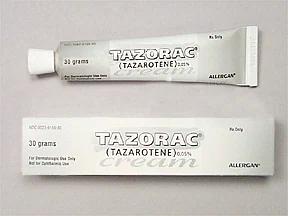
Tazorac Side Effects
Generic name: tazarotene topical
Note: This document contains side effect information about tazarotene topical. Some dosage forms listed on this page may not apply to the brand name Tazorac.
Applies to tazarotene topical: topical cream, topical foam, topical gel/jelly, topical lotion.
Serious side effects of Tazorac
Along with its needed effects, tazarotene topical (the active ingredient contained in Tazorac) may cause some unwanted effects. Although not all of these side effects may occur, if they do occur they may need medical attention.
Check with your doctor immediately if any of the following side effects occur while taking tazarotene topical:
More common
- Burning or stinging of the skin (severe)
- changes in color of the treated skin
- deep grooves or lines in the skin
- dryness, itching, peeling, or redness of the skin (severe)
- pain or swelling of the treated skin
- skin rash (in patients with psoriasis only)
Incidence not known
- Blistering, crusting, or irritation of the skin
- cracked, dry, scaly skin
- flaking and falling off of the skin
- swelling at or near the application site
Other side effects of Tazorac
Some side effects of tazarotene topical may occur that usually do not need medical attention. These side effects may go away during treatment as your body adjusts to the medicine. Also, your health care professional may be able to tell you about ways to prevent or reduce some of these side effects.
Check with your health care professional if any of the following side effects continue or are bothersome or if you have any questions about them:
More common
- Burning or stinging after application
- dryness, itching, peeling, or redness of the skin (mild)
For Healthcare Professionals
Applies to tazarotene topical: topical cream, topical foam, topical gel, topical lotion.
Dermatologic
Very common (10% or more): Desquamation (29%), dry skin (27%), erythema (21%), burning sensation (14%)
Common (1% to 10%): Pruritus, irritation, nonspecific rash, irritant contact dermatitis, skin pain, worsening of psoriasis, stinging sensation, inflammation
Uncommon (0.1% to 1%): Cheilitis, excoriated skin, eczema, erythema sun-induced, papules, skin tightness, worsened acne
Postmarketing reports: Blister, dermatitis, urticaria, skin exfoliation, swelling at or near application sites, skin discoloration (including skin hyperpigmentation or skin hypopigmentation)[Ref]
Metabolic
Common (1% to 10%): Hypertriglyceridemia[Ref]
Other
Common (1% to 10%): Facial pain[Ref]
Ocular
Common (1% to 10%): Eyelid edema, eyelid irritation, eyelid inflammation[Ref]
Immunologic
Uncommon (0.1% to 1%): Infection[Ref]
Respiratory
Uncommon (0.1% to 1%): Pharyngitis[Ref]
Nervous system
Uncommon (0.1% to 1%): Headache, hypesthesia[Ref]
Frequently asked questions
- What are the most common skin conditions? (with photos)
- Is Tazorac better than Retin-A?
- Is Tazorac the same as Retin-A?
- Does it help with acne scars?
- How long does it take to work?
- Tazorac Cream vs Gel: What's the difference?
- Does it cause purging?
- What are the different brands of tazarotene?
- Can Tazorac and Differin be used together?
More about Tazorac (tazarotene topical)
- Check interactions
- Compare alternatives
- Pricing & coupons
- Reviews (38)
- Drug images
- Dosage information
- Patient tips
- During pregnancy
- Generic availability
- Drug class: topical acne agents
- Breastfeeding
- En español
Patient resources
Other brands
Professional resources
Other brands
Related treatment guides
References
1. Product Information. Tazorac (tazarotene topical). Allergan Inc. 2001;PROD.
2. Cerner Multum, Inc. UK Summary of Product Characteristics.
3. Cerner Multum, Inc. Australian Product Information.
Further information
Always consult your healthcare provider to ensure the information displayed on this page applies to your personal circumstances.
Some side effects may not be reported. You may report them to the FDA.