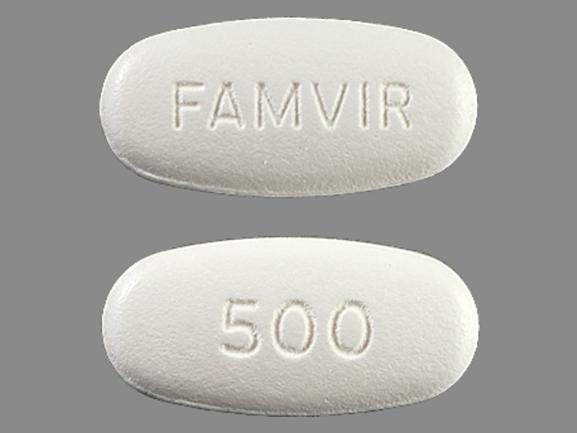
Famvir Side Effects
Generic name: famciclovir
Medically reviewed by Drugs.com. Last updated on Aug 22, 2023.
Note: This document contains side effect information about famciclovir. Some dosage forms listed on this page may not apply to the brand name Famvir.
Applies to famciclovir: oral tablet.
Serious side effects of Famvir
Along with its needed effects, famciclovir (the active ingredient contained in Famvir) may cause some unwanted effects. Although not all of these side effects may occur, if they do occur they may need medical attention.
Check with your doctor immediately if any of the following side effects occur while taking famciclovir:
Incidence not known
- Black, tarry stools
- bleeding gums
- blistering, peeling, or loosening of the skin
- blood in urine or stools
- chills
- clay-colored stools
- cough
- dark urine
- dizziness
- fever
- joint or muscle pain
- loss of appetite
- pinpoint red spots on the skin
- red, irritated eyes
- sore throat
- sores, ulcers, or white spots in the mouth or on the lips
- unpleasant breath odor
- unusual bleeding or bruising
- vomiting of blood
- yellow eyes or skin
Other side effects of Famvir
Some side effects of famciclovir may occur that usually do not need medical attention. These side effects may go away during treatment as your body adjusts to the medicine. Also, your health care professional may be able to tell you about ways to prevent or reduce some of these side effects.
Check with your health care professional if any of the following side effects continue or are bothersome or if you have any questions about them:
More common
- Cramps
- diarrhea
- headache
- heavy bleeding
- nausea
- stomach pain
Less common
- Bloated, full feeling
- burning, crawling, itching, numbness, prickling, "pins and needles", or tingling feeling
- confusion as to time, place, or person
- excess air or gas in the stomach or intestines
- hives or welts
- holding false beliefs that cannot be changed by fact
- itching skin
- mood or mental changes
- passing gas
- rash
- redness of skin
- seeing, hearing, or feeling things that are not there
- unusual excitement, nervousness, or restlessness
- unusual tiredness or weakness
- vomiting
Incidence not known
- Sleepiness or unusual drowsiness
For Healthcare Professionals
Applies to famciclovir: oral tablet.
General
Famciclovir (the active ingredient contained in Famvir) is generally well tolerated. The most common side effects reported in at least 1 indication by greater than 10% of patients are headache and nausea.[Ref]
Nervous system
Confusion and bradykinesia developed in an 80-year-old woman who received famciclovir (the active ingredient contained in Famvir) for acute herpes zoster. The dosage administered was clinically appropriate and adjusted to her estimated creatinine clearance. Although herpes zoster may sometimes elicit neurological complications and cannot be ruled out as a contributing factor, the patient's mobility problems and mental deterioration corresponded temporally with drug administration (onset within 48 and 72 hours, respectively, of initiation and reinstitution of therapy).[Ref]
Very common (10% or more): Headache (up to 39.3%)
Common (1% to 10%): Migraine (up to 3.1%), paresthesia (up to 2.6%)
Frequency not reported: Insomnia
Postmarketing reports: Dizziness, somnolence[Ref]
Gastrointestinal
An isolated case of acute necrotic-hemorrhagic pancreatitis occurred in a kidney graft recipient who was treated with famciclovir (the active ingredient contained in Famvir) for severe hepatitis B infection. The author could not identify any other etiologic factor for the pancreatitis, although some possible predisposing factors were noted, including the patient's liver insufficiency and renal dysfunction.[Ref]
Very common (10% or more): Nausea (up to 13%)
Common (1% to 10%): Diarrhea (up to 9%), abdominal pain (up to 7.9%), vomiting (up to 5%), elevated lipase (greater than 1.5 times normal range high [NRH]; 4.9%), flatulence (up to 4.8%), elevated amylase (greater than 1.5 times NRH; 1.5%)
Rare (less than 0.1%): Pancreatitis
Frequency not reported: Dyspepsia, anorexia[Ref]
Genitourinary
Common (1% to 10%): Dysmenorrhea (up to 7.6%)[Ref]
Other
Common (1% to 10%): Fatigue (up to 4.8%)
Frequency not reported: Injury, back pain, viral infection (including influenza, influenza-like symptoms, and symptoms of a cold), asthenia, fever[Ref]
Dermatologic
Common (1% to 10%): Pruritus (up to 3.7%), rash (up to 3.3%)
Postmarketing reports: Urticaria, erythema multiforme, Stevens-Johnson syndrome, toxic epidermal necrolysis, angioedema (e.g., face, eyelid, periorbital, and pharyngeal edema), leukocytoclastic vasculitis[Ref]
Hematologic
Common (1% to 10%): Neutropenia (less than 0.8 times normal range low [NRL]; 3.2%), leukopenia (less than 0.75 times NRL; 1.3%)
Uncommon (0.1% to 1%): Anemia (less than 0.8 times NRL; 0.1%)
Postmarketing reports: Thrombocytopenia[Ref]
Hepatic
Common (1% to 10%): Elevated ALT (greater than 2 times NRH; 3.2%), elevated AST (greater than 2 times NRH; 2.3%), elevated total bilirubin (greater than 1.5 times NRH; 1.9%)
Postmarketing reports: Cholestatic jaundice, abnormal liver function tests[Ref]
Renal
Uncommon (0.1% to 1%): Elevated serum creatinine (greater than 1.5 times NRH; 0.2%)
Frequency not reported: Acute renal failure[Ref]
Cardiovascular
Postmarketing reports: Palpitations
Psychiatric
Postmarketing reports: Confusion (including delirium, disorientation, and confusional state occurring predominantly in the elderly), hallucinations
Respiratory
Frequency not reported: Upper respiratory tract infection, pharyngitis[Ref]
More about Famvir (famciclovir)
- Check interactions
- Compare alternatives
- Reviews (16)
- Drug images
- Dosage information
- During pregnancy
- Generic availability
- Drug class: purine nucleosides
- Breastfeeding
Patient resources
Professional resources
Related treatment guides
References
1. Product Information. Famvir (famciclovir). SmithKline Beecham. 2001;PROD.
2. Luber AD, Flaherty JF. Famciclovir for treatment of herpesvirus infections. Ann Pharmacother. 1996;30:978-85.
3. DiazMitoma F, Sibbald RG, Shafran SD, Boon R, Saltzman RL. Oral famciclovir for the suppression of recurrent genital herpes: A randomized controlled trial. JAMA. 1998;280:887-92.
4. Wald A. New therapies and prevention strategies for genital herpes. Clin Infect Dis. 1999;28:s4-13.
5. Romanowski B, Aoki FY, Martel AY, Lavender EA, Parsons JE, Saltzman RL. Efficacy and safety of famciclovir for treating mucocutaneous herpes simplex infection in HIV-infected individuals. Aids. 2000;14:1211-7.
6. Sacks SL, Aoki FY, Martel AY, Shafran SD, Lassonde M. Clinic-initiated, twice-daily oral famciclovir for treatment of recurrent genital herpes: a randomized, double-blind, controlled trial. Clin Infect Dis. 2005;41:1097-104.
7. Aoki FY, Tyring S, Diaz-Mitoma F, Gross G, Gao J, Hamed K. Single-day, patient-initiated famciclovir therapy for recurrent genital herpes: a randomized, double-blind, placebo-controlled trial. Clin Infect Dis. 2006;42:8-13.
8. Saltzman R, Jurewicz R, Boon R. Safety of famciclovir in patients with herpes zoster and genital herpes. Antimicrob Agents Chemother. 1994;38:2454-7.
9. Gales BJ, Gales MA. Confusion and bradykinesia associated with famciclovir therapy for herpes zoster. Am J Health Syst Pharm. 1996;53:1454,1456.
10. Tyring S, Belanger R, Bezwoda W, Ljungman P, Boon R, Saltzman RL. A randomized, double-blind trial of famciclovir versus acyclovir for the treatment of localized dermatomal herpes zoster in immunocompromised patients. Cancer Invest. 2001;19:13-22.
11. Spruance SL, Bodsworth N, Resnick H, et al. Single-dose, patient-initiated famciclovir: A randomized, double-blind, placebo-controlled trial for episodic treatment of herpes labialis. J Am Acad Dermatol. 2006;55:47-53.
12. Dworkin RH, Johnson RW, Breuer J, et al. Recommendations for the management of herpes zoster. Clin Infect Dis. 2007;44 Suppl 1:S1-S26.
13. Simpson D, Lyseng-Williamson KA. Famciclovir: a review of its use in herpes zoster and genital and orolabial herpes. Drugs. 2006;66:2397-416.
14. Abudalu M, Tyring S, Koltun W, Bodsworth N, Hamed K. Single-day, patient-initiated famciclovir therapy versus three-day valacyclovir regimen for recurrent genital herpes: a randomized, double-blind, comparative trial. Clin Infect Dis. 2008;47:651-8.
Further information
Always consult your healthcare provider to ensure the information displayed on this page applies to your personal circumstances.
Some side effects may not be reported. You may report them to the FDA.