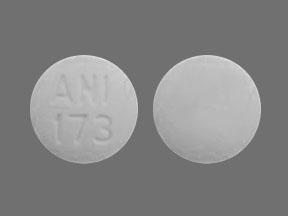
Nilutamide (Monograph)
Brand name: Nilandron
Drug class: Antineoplastic Agents
Warning
- Interstitial Pneumonitis
-
Interstitial pneumonitis reported in 2% of patients in controlled clinical trials. In postmarketing experience, interstitial pneumonitis resulting in hospitalization and death reported rarely. Manifestations generally occurred within the first 3 months of therapy and resolved following discontinuance of the drug.
-
Symptoms include exertional dyspnea, cough, chest pain, fever, interstital or alveolo-interstitial changes on X-ray, and restrictive pattern with decreased carbon monoxide diffusing capacity (DLco) on pulmonary function tests.
-
Peform routine chest X-ray prior to initiating treatment and consider baseline pulmonary function tests.
-
Immediately discontinue therapy if symptoms occur until it can be determined if symptoms are drug related.
Introduction
Antineoplastic agent; a nonsteroidal antiandrogen
Uses for Nilutamide
Prostate Cancer
Used in combination with orchiectomy in the treatment of metastatic prostate cancer (stage D2).
For maximum benefit, begin nilutamide therapy on the same day as or on the day after surgical castration.
Use of nilutamide in combination with androgen deprivation therapy (including orchiectomy) for metastatic prostate cancer is not supported by current guidelines in light of the strong evidence available for alternative therapies.
Nilutamide Dosage and Administration
General
Pretreatment Screening
-
Perform a routine chest radiograph prior to initiation of treatment with nilutamide. Consider obtaining baseline pulmonary function tests.
-
Measure serum transaminase levels prior to treatment with nilutamide.
Patient Monitoring
-
Monitor for any new or worsening shortness of breath. If symptoms occur, immediately discontinue nilutamide until it is determined if symptoms are drug related.
-
Monitor serum transaminase levels at regular intervals for the first 4 months of treatment, and then periodically thereafter. Obtain liver function tests if symptoms of nausea, vomiting, abdominal pain, jaundice, dark urine, "flu-like" symptoms, or right upper quadrant tenderness occurs. If at any time jaundice is present, or ALT >2 times ULN, immediately discontinue nilutamide and closely monitor liver function tests until resolution.
-
Monitor prostate specific antigen (PSA) concentrations periodically and consider conventional imaging during treatment to monitor therapeutic response.
Administration
Oral Administration
Administer orally once daily without regard to meals.
Dosage
Adults
Prostate Cancer
Oral
300 mg once daily for 30 days, followed by 150 mg once daily thereafter. For maximum benefit, initiate nilutamide on the day of or the day after surgical castration.
Special Populations
Hepatic Impairment
No specific dosage recommendations at this time.
Renal Impairment
Contraindicated in severe hepatic impairment.
Geriatric Patients
No specific dosage recommendations at this time.
Cautions for Nilutamide
Contraindications
-
Severe hepatic impairment.
-
Severe respiratory insufficiency.
-
Known hypersensitivity to nilutamide or any ingredient in the formulation.
Warnings/Precautions
Warnings
Interstitial Pneumonitis
Interstitial pneumonitis reported; symptoms include progressive exertional dyspnea, cough, chest pain, fever, interstitial or alveolo-interstitial changes on chest radiographs, and pulmonary function tests showing a restrictive pattern with decreased carbon monoxide diffusing capacity. (See Boxed Warning.) Manifestations generally occurred within the first 3 months of therapy and resolved following discontinuance of the drug.
Obtain a chest radiograph prior to initiation of therapy. Consider baseline pulmonary function tests.
Immediately discontinue therapy if symptoms occur until it can be determined if symptoms are drug related.
Other Warnings and Precautions
Hepatitis
Severe hepatic injury (i.e., hepatitis, increased serum transaminase concentrations) reported, sometimes resulting in hospitalization and/or rarely death; generally occurred within first 3–4 months of therapy.
Measure serum transaminase concentrations prior to initiation of therapy, at regular intervals during first 4 months of treatment, and periodically thereafter. Immediately measure serum transaminase concentrations if clinical signs or symptoms suggestive of liver dysfunction (e.g., nausea, vomiting, abdominal pain, fatigue, anorexia, "flu-like" symptoms, dark urine, jaundice, right upper quadrant tenderness) occur.
Discontinue immediately and closely monitor liver function if jaundice develops or serum ALT concentration >2 times ULN.
Use in Women
Safety and efficacy not established in women.
Not intended for use in women, particularly for nonserious or non-life-threatening conditions.
Hematologic Effects
Isolated cases of aplastic anemia reported, but a causal relationship to nilutamide not established.
Antiandrogen Withdrawal Syndrome
Patients whose disease progresses while being treated with an antiandrogen, such as nilutamide, may experience clinical improvement with discontinuation of the antiandrogen.
Specific Populations
Pregnancy
No available data to evaluate the drug-associated risk in pregnancy. Unknown whether nilutamide can cause fetal harm.
Administer nilutamide to a pregnant patient only if clearly needed.
Not intended for use in women.
Lactation
No available data on use during lactation.
Pediatric Use
Safety and efficacy not established.
Geriatric Use
Safety and efficacy not established.
Hepatic Impairment
Contraindicated in severe hepatic impairment.
Obtain serum transaminase levels prior to starting nilutamide, at regular intervals for first 4 months of treatment, and periodically thereafter.
Obtain liver function tests if symptoms of nausea, vomiting, abdominal pain, fatigue, anorexia, jaundice, dark urine, “flu-like” symptoms, or right upper quadrant tenderness occur. If at any time jaundice is present, or ALT >2 times ULN, immediately discontinue nilutamide and closely monitor liver function tests until resolution.
Renal Impairment
Only a small quantity of nonmetabolized drug found in urine. Renal impairment likely to have little effect on pharmacokinetics.
Common Adverse Effects
Adverse effects (≥5%) in patients receiving nilutamide with surgical castration: hypertension, nausea, constipation, hot flushes, increased ALT, increased aspartate aminotransferase (AST), dizziness, dyspnea, impaired adaptation to dark, abnormal vision, urinary tract infection.
Adverse effects (≥10%) in patients receiving nilutamide with leuprolide: pain, headache, asthenia, back pain, abdominal pain, nausea, constipation, anorexia, hot flushes, impotence, decreased libido, increased AST, peripheral edema, insomnia, dizziness, dyspnea, impaired adaptation to dark, testicular atrophy, gynecomastia.
Drug Interactions
Inhibits the activity of CYP isoenzymes; may reduce metabolism of drugs metabolized by these systems.
Specific Drugs
|
Drug |
Interaction |
Comment |
|---|---|---|
|
Alcohol |
Possible alcohol intolerance (e.g., facial flushing, malaise, hypotension) |
Avoid concomitant use |
|
Phenytoin |
Potential for increased plasma phenytoin concentrations |
Monitor for phenytoin toxicity and adjust dosages as needed |
|
Theophylline |
Potential for increased plasma theophylline concentrations |
Monitor for theophylline toxicity and adjust dosages as needed |
|
Vitamin K antagonists (e.g., warfarin) |
Potential for increased warfarin concentrations |
Monitor PT and adjust dosage of warfarin as needed |
Nilutamide Pharmacokinetics
Absorption
Bioavailability
Rapidly and completely absorbed to yield high and persistent plasma concentrations.
Distribution
Plasma Protein Binding
Moderately bound to plasma proteins; minimally bound to erythrocytes.
Elimination
Metabolism
Extensively metabolized in the liver and lungs by CYP isoenzymes.
Elimination Route
Eliminated almost exclusively by hepatic metabolism. Excreted principally in urine as metabolites; <2% is excreted unchanged in urine.
Half-life
Mean elimination half-life following a single 100–300-mg dose approximately 38-59.1 hours (most values ranging from 41-49 hours).
Stability
Storage
Oral
Tablets
25°C (excursions permitted between 15–30°C). Protect from light.
Actions
-
Pure antiandrogen, possesses no intrinsic estrogenic, antiestrogenic, progestational, antiprogestational, or adrenocortical activity.
-
Competitively blocks nuclear androgen receptors in target tissues (e.g., prostate, seminal vesicles, adrenal cortex).
-
Blockade of androgen receptors in the hormone-sensitive tumor cells may result in growth arrest or transient tumor regression through inhibition of androgen-dependent DNA and protein synthesis.
-
The relative binding affinity of nilutamide at androgen receptors is less than that of bicalutamide, but similar to that of hydroxyflutamide, the active metabolite of flutamide.
Advice to Patients
-
Importance of reading the manufacturer's patient information prior to starting nilutamide.
-
Risk of interstitial pneumonitis. Inform patients to notify their clinicians of dyspnea or worsening of preexisting dyspnea.
-
Risk of hepatic toxicity. Inform patients to notify their clinicians if symptoms of nausea, vomiting, abdominal pain, fatigue, anorexia, "flu-like" symptoms, dark urine, jaundice, or right upper quadrant pain occur.
-
Risk of delay in visually adapting to changes from light to dark. Inform patients who experience this effect to wear tinted glasses during exposure to bright light and to exercise caution when driving at night or through tunnels.
-
Risk of alcohol intolerance (e.g., facial flushing, malaise, hypotension). Advise patients to avoid alcohol consumption if such intolerance occurs.
-
Inform patients that nilutamide should be started the day of or on the day after surgical castration, and that dosing should not be interrupted or stopped without prescriber consultation. .
-
Advise patients to inform their clinicians of existing or contemplated concomitant therapy, including prescription and OTC drugs, as well as any concomitant illnesses (e.g., hepatic impairment).
-
Inform patients of other important precautionary information.
Additional Information
The American Society of Health-System Pharmacists, Inc. represents that the information provided in the accompanying monograph was formulated with a reasonable standard of care, and in conformity with professional standards in the field. Readers are advised that decisions regarding use of drugs are complex medical decisions requiring the independent, informed decision of an appropriate health care professional, and that the information contained in the monograph is provided for informational purposes only. The manufacturer’s labeling should be consulted for more detailed information. The American Society of Health-System Pharmacists, Inc. does not endorse or recommend the use of any drug. The information contained in the monograph is not a substitute for medical care.
Preparations
Excipients in commercially available drug preparations may have clinically important effects in some individuals; consult specific product labeling for details.
Please refer to the ASHP Drug Shortages Resource Center for information on shortages of one or more of these preparations.
|
Routes |
Dosage Forms |
Strengths |
Brand Names |
Manufacturer |
|---|---|---|---|---|
|
Oral |
Tablets |
150 mg |
Nilandron (with povidone) |
Sanofi-Aventis |
AHFS DI Essentials™. © Copyright 2024, Selected Revisions June 19, 2023. American Society of Health-System Pharmacists, Inc., 4500 East-West Highway, Suite 900, Bethesda, Maryland 20814.
Reload page with references included
More about nilutamide
- Check interactions
- Compare alternatives
- Drug images
- Side effects
- Dosage information
- During pregnancy
- Drug class: antiandrogens
- En español