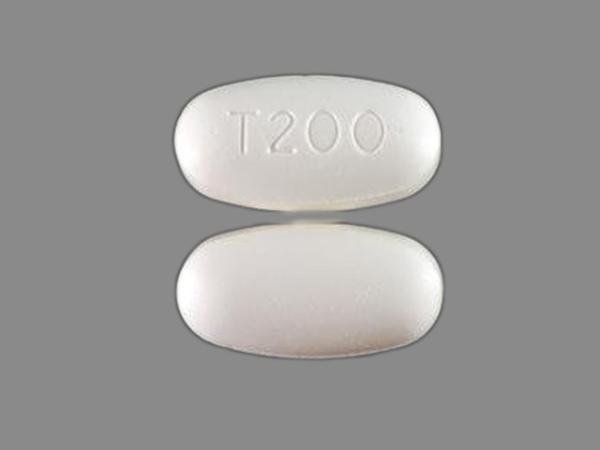
Etravirine (Monograph)
Brand name: Intelence
Drug class: HIV Nonnucleoside Reverse Transcriptase Inhibitors
Introduction
Antiretroviral; HIV nonnucleoside reverse transcriptase inhibitor (NNRTI).
Uses for Etravirine
Treatment of HIV Infection
Treatment of HIV-1 infection in adults and pediatric patients ≥2 years of age who are treatment-experienced; used in conjunction with other antiretrovirals.
Used as part of a fully suppressive antiretroviral regimen in treatment-experienced patients.
Safety and efficacy not systematically evaluated in treatment-naïve patients.
Postexposure Prophylaxis following Occupational Exposure to HIV
Postexposure prophylaxis of HIV infection following occupational exposure† [off-label] (PEP) in health-care personnel and other individuals.
USPHS recommends 3-drug regimen of raltegravir in conjunction with emtricitabine and tenofovir disoproxil fumarate (tenofovir DF) as the preferred regimen for PEP following occupational exposures to HIV. Etravirine and 2 NRTIs is one of several alternative regimens.
Management of occupational exposures to HIV is complex and evolving; consult infectious disease specialist, clinician with expertise in administration of antiretroviral agents, and/or National Clinicians’ Postexposure Prophylaxis Hotline (PEPline at 888-448-4911) whenever possible. Do not delay initiation of PEP while waiting for expert consultation.
Etravirine Dosage and Administration
General
Patient Monitoring
-
Monitor for signs or symptoms of severe skin reactions or hypersensitivity reactions (e.g., severe rash or rash accompanied by fever, general malaise, fatigue, muscle or joint aches, blisters, oral lesions, conjunctivitis, facial edema, hepatitis, eosinophilia, angioedema).
Dispensing and Administration Precautions
-
The Institute for Safe Medication Practices (ISMP) list of error-prone abbreviations, symbols, and dose designations states that the use of abbreviations for antiretroviral medications (e.g., DOR, TAF, TDF) during the medication use process should be avoided as their use has been associated with serious medication errors.
Administration
Oral Administration
Administer orally twice daily after a meal.
Swallow tablets whole with a liquid (e.g., water); do not chew.
For patients unable to swallow tablets whole, place dose of etravirine tablets in 5 mL of water (enough to cover tablets) and stir until a uniform, milky dispersion occurs. Add 15 mL (1 tablespoon) of liquid; water may be used, but orange juice or milk may improve taste. Do not use carbonated beverages or warm (>40°C) water. Consume dispersion immediately; rinse glass several times with water, orange juice, or milk and swallow.
Dosage
Pediatric Patients
Treatment of HIV Infection
Antiretroviral-experienced
OralChildren 2 years to <18 years of age weighing ≥10 kg: Dosage is based on weight and should not exceed recommended adult dosage. (See Table 1.)
|
Body Weight |
Dosage |
|---|---|
|
10 to <20 kg |
100 mg twice daily |
|
20 to <25 kg |
125 mg twice daily |
|
25 to <30 kg |
150 mg twice daily |
|
≥30 kg |
200 mg twice daily |
Adults
Treatment of HIV Infection
Antiretroviral-experienced
Oral200 mg twice daily. Give dose as a single 200-mg tablet or two 100-mg tablets.
Postexposure Prophylaxis following Occupational Exposure to HIV† [off-label]
Oral
200 mg twice daily. Use in conjunction with 2 NRTIs.
Initiate PEP as soon as possible following occupational exposure to HIV (preferably within hours); continue for 4 weeks, if tolerated.
Special Populations
Hepatic Impairment
Dosage adjustments not necessary in patients with mild or moderate hepatic impairment (Child-Pugh class A or B). Pharmacokinetics not studied in patients with severe hepatic impairment (Child-Pugh class C).
Dosage adjustments not necessary in HIV-infected adults coinfected with HBV and/or HCV.
Renal Impairment
Dosage adjustments not necessary.
Geriatric Patients
No specific dosage recommendations. Select dosage with caution because of age-related decreases in hepatic, renal, and/or cardiac function and concomitant disease and drug therapy.
Cautions for Etravirine
Contraindications
-
None.
Warnings/Precautions
Severe Skin and Hypersensitivity Reactions
Severe, potentially life-threatening and fatal skin reactions, including Stevens-Johnson syndrome, toxic epidermal necrolysis, and erythema multiforme, reported. Hypersensitivity reactions, including drug rash with eosinophilia and systemic symptoms (DRESS) characterized by rash and systemic symptoms (sometimes involving organ dysfunction such as hepatic failure), also reported.
If severe hypersensitivity reactions (e.g., severe rash or rash with fever, malaise, fatigue, muscle or joint pain, blisters, oral lesions, conjunctivitis, facial edema, hepatitis, eosinophilia, angioedema) occur, immediately discontinue etravirine and initiate appropriate therapy. Monitor clinical status and liver transaminase concentrations.
Rash of mild to moderate intensity also reported; generally occurs within first few weeks of therapy and resolves with continued therapy (median duration 12–16 days).
Manufacturer states that history of rash while receiving other NNRTIs does not appear to increase the risk for etravirine-related rash.
Drug Interactions
Risk of potentially significant drug interactions; may lead to loss of therapeutic effect or clinically significant adverse reactions.
Consider potential for drug interactions prior to and during etravirine therapy and review concomitant medications during therapy.
Fat Redistribution
Possible redistribution or accumulation of body fat, including central obesity, dorsocervical fat enlargement (“buffalo hump”), peripheral wasting, facial wasting, breast enlargement, and general cushingoid appearance. Mechanisms and long-term consequences of fat redistribution unknown; causal relationship not established.
Immune Reconstitution Syndrome
During initial treatment, patients who respond to antiretroviral therapy may develop an inflammatory response to indolent or residual opportunistic infections (e.g., Mycobacterium avium, M. tuberculosis, cytomegalovirus [CMV], Pneumocystis jirovecii [formerly P. carinii]); may necessitate further evaluation and treatment.
Autoimmune disorders (e.g., Graves' disease, polymyositis, Guillain-Barré syndrome, autoimmune hepatitis) reported to occur in the setting of immune reconstitution; time to onset is more variable and can occur many months after initiation of antiretroviral therapy.
Specific Populations
Pregnancy
Antiretroviral Pregnancy Registry (APR) at 800-258-4263 or [Web].
Limited human data indicate 1 birth defect in 66 first trimester exposures to etravirine-containing regimens. In animal studies, etravirine was not associated with adverse developmental effects.
Lactation
Based on limited data, etravirine shown to be present in human breast milk. No data on effects on the breastfed infant or the effects on milk production.
The HHS perinatal HIV transmission guideline provides updated recommendations on infant feeding. The guideline states that patients with HIV should receive evidence-based, patient-centered counseling to support shared decision making about infant feeding. During counseling, patients should be informed that feeding with appropriate formula or pasteurized donor human milk from a milk bank eliminates the risk of postnatal HIV transmission to the infant. Additionally, achieving and maintaining viral suppression with antiretroviral therapy during pregnancy and postpartum reduces the risk of breastfeeding HIV transmission to <1%, but does not completely eliminate the risk. Replacement feeding with formula or banked pasteurized donor milk is recommended when patients with HIV are not on antiretroviral therapy and/or do not have a suppressed viral load during pregnancy (at a minimum throughout the third trimester), as well as at delivery.
Pediatric Use
Safety and efficacy not established in pediatric patients <2 years of age.
Safety, efficacy, and pharmacokinetics evaluated in antiretroviral-experienced pediatric patients 2 years to <18 years of age weighing ≥10 kg; adverse effects similar to those reported in adults, although rash reported more frequently in pediatric patients. Postmarketing cases of Stevens-Johnson syndrome reported.
Geriatric Use
Insufficient experience in patients ≥65 years of age to determine whether they respond differently than younger adults. Etravirine pharmacokinetics not considerably different within the age range (18–77 years) evaluated.
Hepatic Impairment
Pharmacokinetics not altered in patients with mild or moderate hepatic impairment (Child-Pugh class A or B). Pharmacokinetics not studied in patients with severe hepatic impairment (Child-Pugh class C).
Renal Impairment
Minimal renal clearance; decrease in clearance not expected in patients with renal impairment.
Common Adverse Effects
Most common adverse effects (≥2%) of moderate to severe intensity in adults: rash and peripheral neuropathy.
Most common adverse effects (≥2%) in pediatric patients: rash and diarrhea.
Drug Interactions
Metabolized by CYP isoenzymes 3A, 2C9, and 2C19. Induces CYP3A; inhibits 2C9 and 2C19. Inhibits P-glycoprotein (P-gp).
Drugs Affecting or Affected by Hepatic Microsomal Enzymes
Potential pharmacokinetic interactions with drugs that induce or inhibit CYP3A, 2C9, or 2C19 with possible altered metabolism of etravirine.
Potential pharmacokinetic interaction with drugs that are substrates for CYP3A, 2C9, or 2C19 with possible altered metabolism of such drugs.
Drugs Affected by P-gp Transport
Potential pharmacokinetic interaction with drugs that are substrates for P-gp.
Specific Drugs
|
Drug |
Interaction |
Comments |
|---|---|---|
|
Abacavir |
No in vitro evidence of antagonistic antiretroviral effects |
|
|
Antiarrhythmics (amiodarone, disopyramide, flecainide, systemic lidocaine, mexiletine, propafenone, quinidine) |
Possible decreased antiarrhythmic agent concentrations |
Use concomitantly with caution; monitor antiarrhythmic agent concentrations |
|
Anticoagulants, oral |
Possible increased warfarin concentrations |
Monitor INR; adjust warfarin dosage if needed |
|
Anticonvulsants (carbamazepine, phenobarbital, phenytoin) |
Possible decreased etravirine concentrations and decreased antiretroviral efficacy; decreased anticonvulsant concentrations |
Concomitant use not recommended |
|
Antifungals, azoles |
Fluconazole: Substantially increased etravirine concentrations and AUC; no clinically important change in fluconazole concentrations or AUC Itraconazole: Possible increased etravirine concentrations and decreased itraconazole concentrations Ketoconazole: Possible increased etravirine concentrations and decreased ketoconazole concentrations Posaconazole: Possible increased etravirine concentrations; no change in posaconazole concentrations Voriconazole: Substantially increased etravirine concentrations and AUC; increased voriconazole concentration and AUC |
Fluconazole: Dosage adjustments not needed for either drug; use caution because of limited safety data regarding increased etravirine concentrations Itraconazole: Adjustment of itraconazole dosage may be needed depending on other concomitantly administered drugs Ketoconazole: Adjustment of ketoconazole dosage may be needed depending on other concomitantly administered drugs Posaconazole: Manufacturer of etravirine states adjustment of posaconazole dosage may be needed depending on other concomitantly administered drugs Voriconazole: Use caution because of limited safety data regarding increased etravirine concentrations dosage adjustments not needed |
|
Antimalarials |
Fixed combination of artemether and lumefantrine (artemether/lumefantrine): Decreased concentrations and AUC of artemether, active metabolite of artemether (dihydroartemisinin), and lumefantrine; no clinically important effect on etravirine concentrations or AUC |
Artemether/lumefantrine: Dosage adjustments not needed; use concomitantly with caution since effect on antimalarial efficacy not known |
|
Antimycobacterials (rifabutin, rifampin, rifapentine) |
Rifabutin: Decreased concentrations of etravirine and rifabutin Rifampin: Substantially decreased etravirine concentrations possible Rifapentine: Substantially decreased etravirine concentrations possible |
Rifabutin: Recommended rifabutin dosage is 300 mg daily in patients receiving etravirine without a ritonavir-boosted PI; rifabutin not recommended in patients receiving etravirine with a ritonavir-boosted PI Rifampin: Concomitant use not recommended Rifapentine: Concomitant use not recommended |
|
Benzodiazepines (diazepam) |
Diazepam: Possible increased diazepam concentrations |
Diazepam: Decreased diazepam dosage may be needed |
|
Clarithromycin |
Increased etravirine concentrations; decreased clarithromycin concentrations and increased concentrations of the major metabolite (14-hydroxyclarithromycin) |
Consider an alternative to clarithromycin (e.g., azithromycin) for treatment or prophylaxis of MAC |
|
Clopidogrel |
Possible decreased concentrations of the active metabolite of clopidogrel |
Avoid concomitant use if possible; consider alternatives to clopidogrel |
|
Corticosteroids (dexamethasone) |
Dexamethasone: Possible decreased etravirine concentrations and decreased antiretroviral efficacy |
Use concomitantly with caution; consider alternatives to dexamethasone, especially when long-term corticosteroid use anticipated |
|
Digoxin |
Possible increased digoxin concentrations; no change in etravirine concentrations |
If digoxin and etravirine are initiated at the same time, initiate digoxin at the lowest dosage If etravirine is initiated in a patient already receiving digoxin, dosage adjustments not needed for either drug Monitor serum digoxin concentrations and adjust digoxin dosage to achieve desired clinical effect |
|
Emtricitabine |
No in vitro evidence of antagonistic antiretroviral effects |
|
|
Estrogens/progestins |
Hormonal contraceptives: Slight increase in ethinyl estradiol concentrations; no change in norethindrone concentrations |
Dosage adjustments not needed with oral contraceptives containing ethinyl estradiol and norethindrone |
|
Hepatitis C Antivirals (dacalastavir, elbasvir/grazoprevir |
Daclatasvir: Coadministration of etravirine with daclatasvir may decrease daclatasvir concentrations Elbasvir/grazoprevir: Coadministration of etravirine with elbasvir/grazoprevir may decrease concentrations of elbasvir and grazoprevir, leading to reduced therapeutic effect of elbasvir/grazoprevir |
Daclatasvir: Increase the dosage of daclatasvir to 90 mg once daily Elbasvir/grazoprevir: Avoid coadministration |
|
HMG-CoA reductase inhibitors (statins) |
Atorvastatin: Decreased atorvastatin concentrations; no change in etravirine concentrations Fluvastatin: Possible increased fluvastatin concentrations; no change in etravirine concentrations Lovastatin: Possible decreased lovastatin concentrations Pitavastatin: Possible increased pitavastatin concentrations Simvastatin: Possible decreased simvastatin concentrations |
Atorvastatin: Usual etravirine and atorvastatin dosages can be used; however, may need to adjust atorvastatin dosage based on clinical response Fluvastatin: May need to adjust fluvastatin dosage Lovastatin: May need to adjust lovastatin dosage based on clinical response Pitavastatin: May need to adjust pitavastatin dosage Simvastatin: May need to adjust simvastatin dosage based on clinical response |
|
HIV Entry and Fusion Inhibitors (enfuvirtide, maraviroc) |
Enfuvirtide: No in vitro evidence of antagonistic antiretroviral effects Maraviroc: Decreased maraviroc concentrations and AUC; no clinically important effect on etravirine concentrations or AUC No in vitro evidence of antagonistic antiretroviral effects |
Enfuvirtide: Dosage adjustments not needed Maraviroc: Recommended maraviroc dosage is 600 mg twice daily with usual etravirine dosage, provided regimen does not include a potent CYP3A inhibitor Recommended maraviroc dosage is 150 mg twice daily with the usual etravirine dosage if etravirine used in regimen that contains maraviroc and a ritonavir-boostedPI |
|
HIV Integrase Inhibitors (INSTIs; dolutegravir, raltegravir) |
Dolutegravir: Substantially decreased dolutegravir concentrations and AUC; no apparent effect on etravirine Effect on dolutegravir pharmacokinetics is mitigated if etravirine and dolutegravir used concomitantly with lopinavir/ritonavir or ritonavir-boosted darunavir; effect expected to be mitigated if etravirine and dolutegravir used concomitantly with ritonavir-boosted atazanavir Raltegravir: Decreased raltegravir concentrations and AUC; no clinically important effect on etravirine pharmacokinetics No in vitro evidence of antagonistic antiretroviral effects |
Dolutegravir: Do not use etravirine and dolutegravir concomitantly unless ritonavir-boosted atazanavir, ritonavir-boosted darunavir, or lopinavir/ritonavir also included in the regimen Raltegravir: Dosage adjustments not needed |
|
HIV Nonnucleoside Reverse Transcriptase Inhibitors (NNRTIs; delavirdine, efavirenz, nevirapine, rilpivirine) |
Delavirdine: Possible increased etravirine concentrations Efavirenz: Possible decreased etravirine concentrations Nevirapine: Decreased etravirine concentrations and loss of antiretroviral efficacy Rilpivirine: Possible decreased rilpivirine concentrations; no change in etravirine concentrations |
Delavirdine: Do not use concomitantly Efavirenz: Do not use concomitantly Nevirapine: Do not use concomitantly Rilpivirine: Do not use concomitantly |
|
HIV Nucleoside and Nucleotide Reverse Transcriptase Inhibitors (NRTIs; didanosine, tenofovir) |
Didanosine: No effect on didanosine or etravirine concentrations Tenofovir: Decreased etravirine concentrations; no change in tenofovir concentrations |
Didanosine: Dosage adjustments not needed Tenofovir: Dosage adjustments not needed |
|
HIV Protease Inhibitors (atazanavir, darunavir, fosamprenavir, indinavir, lopinavir, nelfinavir, ritonavir, saquinavir, tipranavir) |
Atazanavir: Atazanavir or ritonavir-boosted atazanavir: Increased etravirine concentrations; decreased atazanavir concentrations and possible decreased antiretroviral efficacy No in vitro evidence of antagonistic antiretroviral effects Atazanavir/cobicistat: Potential loss of therapeutic effect and development of resistance to atazanavir Darunavir: Ritonavir-boosted darunavir: Decreased etravirine AUC; no change in darunavir concentrations; safety and efficacy of concomitant use established in phase 3 clinical studies No in vitro evidence of antagonistic antiretroviral effects Darunavir/cobicistat: Potential loss of therapeutic effect and development of resistance to darunavir Fosamprenavir: Fosamprenavir or ritonavir-boosted fosamprenavir: Substantially increased concentrations of amprenavir (active metabolite of fosamprenavir) No in vitro evidence of antagonistic antiretroviral effects Indinavir: Indinavir (without low-dose ritonavir): Possible decreased indinavir concentrations No in vitro evidence of antagonistic antiretroviral effects Lopinavir/ritonavir: Decreased etravirine concentrations and AUC; decreased lopinavir concentrations and AUC No in vitro evidence of antagonistic antiretroviral effects Nelfinavir: Nelfinavir (without low-dose ritonavir): Possible increased nelfinavir concentrations No in vitro evidence of antagonistic antiretroviral effects Ritonavir: Full-dose ritonavir (600 mg twice daily): Substantial decrease in etravirine concentrations and possible loss of antiretroviral efficacy Saquinavir: Ritonavir-boosted saquinavir: Decreased etravirine AUC; no change in saquinavir concentrations Decrease in systemic exposure to etravirine is similar to that in patients receiving etravirine in conjunction with ritonavir-boosted darunavir (a combination found to be safe and effective) No in vitro evidence of antagonistic antiretroviral effects Tipranavir: Ritonavir-boosted tipranavir: Decreased etravirine concentrations and possible decreased antiretroviral efficacy; increased tipranavir concentrations No in vitro evidence of antagonistic antiretroviral effects |
Atazanavir:Do not use concomitantly without low-dose ritonavir. Atazanavir/cobicistat: Do not use concomitantly with etravirine Darunavir: Ritonavir-boosted darunavir: Dosage adjustments not needed Darunavir/cobicistat: Do not use concomitantly with etravirine Fosamprenavir: Fosamprenavir (with or without low-dose ritonavir): Do not use concomitantly Indinavir: Do not use concomitantly without low-dose ritonavir Lopinavir/ritonavir: Because decrease in etravirine systemic exposure in patients receiving concomitant lopinavir/ritonavir is similar to that in patients receiving etravirine and concomitant ritonavir-boosted darunavir (a combination found to be safe and effective), manufacturer states that dosage adjustments not needed for either drug Nelfinavir: Do not use concomitantly with etravirine without low-dose ritonavir Ritonavir: Full-dose ritonavir (600 mg twice daily): Do not use concomitantly with etravirine Low-dose ritonavir (usually 100 mg once or twice daily): Etravirine may be used concomitantly with certain ritonavir-boosted PI regimens (i.e., ritonavir-boosted darunavir, lopinavir/ritonavir, ritonavir-boostedsaquinavir); concomitant use withritonavir-boosted fosamprenavir or ritonavir-boosted tipranavir not recommended Saquinavir: Ritonavir-boosted saquinavir: Dosage adjustments not needed Tipranavir: Ritonavir-boosted tipranavir: Do not use concomitantly |
|
Immunosuppressive agents (cyclosporine, sirolimus, tacrolimus) |
Potential for decreased immunosuppressive agent concentrations |
Use concomitantly with caution |
|
Lamivudine |
No in vitro evidence of antagonistic antiretroviral effects |
|
|
Opiates and Opiate Partial Agonists (buprenorphine, buprenorphine/naloxone, methadone) |
Buprenorphine: Decreased buprenorphine concentrations and AUC; no effect on norbuprenorphine or etravirine concentrations Methadone: No clinically important change in methadone or etravirine concentrations |
Buprenorphine: Routine buprenorphine or buprenorphine/naloxone dosage adjustments not needed; monitor for withdrawal symptoms since buprenorphine or buprenorphine/naloxone maintenance dosage adjustment may be needed in some patients Methadone: Dosage adjustments not needed; monitoring for withdrawal symptoms is recommended as methadone maintenance therapy may need to be adjusted in some patients |
|
Paroxetine |
No change in etravirine or paroxetine concentrations |
Dosage adjustments not needed |
|
Proton pump inhibitors |
Omeprazole: Increased etravirine concentrations |
Omeprazole: Dosage adjustments not needed |
|
Sildenafil |
Decreased sildenafil concentrations |
Usual etravirine and sildenafil dosages can be used; sildenafil dosage may need to be increased based on clinical effect |
|
St. John’s wort (Hypericum perforatum) |
Possible substantially decreased etravirine concentrations and loss of antiretroviral efficacy |
Concomitant use not recommended |
|
Tadalafil |
Possible pharmacokinetic interaction with tadalafil |
No recommendations at this time |
|
Vardenafil |
Possible pharmacokinetic interaction with vardenafil |
No recommendations at this time |
|
Zidovudine |
No in vitro evidence of antagonistic antiretroviral effects |
Etravirine Pharmacokinetics
Absorption
Bioavailability
Absolute oral bioavailability is unknown.
Following oral administration in adults, peak plasma concentrations attained within approximately 2.5–4 hours.
Food
Systemic exposure is decreased by about 50% if etravirine is administered under fasting conditions compared with administration after a meal.
Effect of food on etravirine bioavailability was studied using various meals (standard, light, enhanced-fiber, high-fat); magnitude of the food effect is similar with all meal types.
Distribution
Extent
Distribution into compartments other than plasma (e.g., CSF, genital tract secretions) not evaluated.
Crosses the placenta and has been detected in cord blood.
Distributed into human milk.
Plasma Protein Binding
99.9%, principally albumin and alpha 1-acid glycoprotein.
Elimination
Metabolism
Metabolized principally in the liver by CYP isoenzymes 3A, 2C9, and 2C19.
In cell culture, the major metabolites are at least 90% less active than etravirine against wild-type HIV-1.
Elimination Route
Following oral administration of a single dose in adults, the majority (93.7%) is eliminated in feces as unchanged etravirine (81.2–86.4%). Up to 1.2% of the dose is eliminated in urine as metabolites.
Unlikely to be removed by hemodialysis or peritoneal dialysis.
Half-life
Mean terminal elimination half-life in adults is about 41 hours.
Special Populations
Renal impairment: Pharmacokinetics not studied; alterations not expected because renal clearance is minimal.
Hepatic impairment: Pharmacokinetics not altered in patients with mild or moderate hepatic impairment (Child-Pugh class A or B); not studied in patients with severe hepatic impairment (Child-Pugh class C).
HIV-infected individuals coinfected with HBV and/or HCV: Reduced clearance reported.
Geriatric individuals: Studies in those up to 77 years of age indicate no substantial differences in pharmacokinetics relative to younger adults.
Pediatric patients 2 years to <18 years of age weighing ≥10 kg: Weight-based dosage results in systemic etravirine exposures similar to those reported in adults receiving 200 mg twice daily.
Pregnant patients: Pharmacokinetics not studied.
Stability
Storage
Oral
Tablets
25°C (excursions permitted between 15–30°C). Store in tight, closed container; protect from moisture. Dispense and store in original container; do not remove desiccant from bottle.
Actions and Spectrum
-
Inhibits replication of HIV-1 by interfering with viral RNA- and DNA-directed polymerase activities of reverse transcriptase.
-
Highly active against wild-type HIV-1; active against some clinical HIV-1 isolates resistant to some other NNRTIs (delavirdine, efavirenz, nevirapine).
-
Different resistance profile than other NNRTIs; certain single mutations that result in class resistance to other NNRTIs may not necessarily result in etravirine resistance.
-
Cross-resistance may occur between etravirine and other commercially available NNRTIs (delavirdine, etravirine, nevirapine, rilpivirine), and is expected in patients who have virologic failure while receiving a regimen that contains etravirine.
Advice to Patients
-
Advise patients of the critical nature of compliance with human immunodeficiency virus (HIV) therapy and importance of remaining under the care of a clinician. Inform patients of the importance of taking as prescribed; do not alter or discontinue antiretroviral regimen without consulting a clinician.
-
Advise patients of the importance of using etravirine in conjunction with other antiretrovirals and to not use for monotherapy.
-
Advise patients of the importance of taking etravirine twice daily after a meal on a regular dosing schedule. Food enhances absorption of the drug; magnitude of the food effect is similar with all meal types (standard, light, enhanced-fiber, high-fat).
-
Advise patients to swallow the tablets whole with liquid (e.g., water) without chewing. Patients unable to swallow tablets whole may disperse the tablets in 5 mL (1 teaspoon) of water (enough to cover the tablets); after dispersion in water, orange juice, milk, or water (approximately 15 mL, 1 tablespoon) may be added to the mixture. Ingest the liquid containing the dispersed etravirine tablets immediately, then rinse the glass several times with water, orange juice, or milk and drink the rinse each time to ensure that the entire dose is ingested. Warm water (greater than 40°C) or carbonated beverages should not be used.
-
Inform patients that if a missed dose is remembered within 6 hours of the usually scheduled time, it should be taken after a meal as soon as possible and the next dose taken at the regularly scheduled time. If the missed dose is remembered more than 6 hours after the scheduled time, the dose should be omitted and the next dose taken at the regularly scheduled time.
-
Advise patients that a severe and potentially life-threatening rash has occurred (usually within the first few weeks of etravirine therapy). Advise patients on the importance of immediately contacting clinician if rash occurs. Advise patients on the importance of immediately discontinuing etravirine and seeking medical care if rash associated with systemic symptoms (e.g., fever, generally ill feeling, extreme tiredness, muscle or joint aches, blisters, oral lesions, eye inflammation, swelling of the face, eyes, lips, or mouth, breathing difficulties, yellowing of the eyes or skin, dark or tea colored urine, pale colored stools, nausea, vomiting, loss of appetite, or right upper quadrant tenderness/pain) occurs.
-
Inform patients that redistribution/accumulation of body fat may occur, with as yet unknown long-term health effects.
-
Advise patients to inform their healthcare provider immediately of any symptoms of infection, since in some patients with advanced HIV infection, signs and symptoms of inflammation from previous infections may occur soon after anti-HIV treatment is started.
-
Advise patients to inform their clinician of existing or contemplated concomitant therapy, including prescription and OTC drugs and herbal supplements (e.g., St. John’s wort), as well as any concomitant illnesses.
-
Advise women to inform their clinician if they are or plan to become pregnant or plan to breast-feed.
-
Advise patients of other important precautionary information.
Additional Information
The American Society of Health-System Pharmacists, Inc. represents that the information provided in the accompanying monograph was formulated with a reasonable standard of care, and in conformity with professional standards in the field. Readers are advised that decisions regarding use of drugs are complex medical decisions requiring the independent, informed decision of an appropriate health care professional, and that the information contained in the monograph is provided for informational purposes only. The manufacturer’s labeling should be consulted for more detailed information. The American Society of Health-System Pharmacists, Inc. does not endorse or recommend the use of any drug. The information contained in the monograph is not a substitute for medical care.
Preparations
Excipients in commercially available drug preparations may have clinically important effects in some individuals; consult specific product labeling for details.
Please refer to the ASHP Drug Shortages Resource Center for information on shortages of one or more of these preparations.
* available from one or more manufacturer, distributor, and/or repackager by generic (nonproprietary) name
|
Routes |
Dosage Forms |
Strengths |
Brand Names |
Manufacturer |
|---|---|---|---|---|
|
Oral |
Tablets |
25 mg* |
Etravirine Tablets |
|
|
Intelence |
Janssen |
|||
|
100 mg* |
Etravirine Tablets |
|||
|
Intelence |
Janssen |
|||
|
200 mg* |
Etravirine Tablets |
|||
|
Intelence |
Janssen |
AHFS DI Essentials™. © Copyright 2025, Selected Revisions February 10, 2025. American Society of Health-System Pharmacists, Inc., 4500 East-West Highway, Suite 900, Bethesda, Maryland 20814.
† Off-label: Use is not currently included in the labeling approved by the US Food and Drug Administration.
Reload page with references included
Related/similar drugs
Frequently asked questions
More about etravirine
- Check interactions
- Compare alternatives
- Pricing & coupons
- Reviews (2)
- Drug images
- Side effects
- Dosage information
- During pregnancy
- Drug class: NNRTIs
- Breastfeeding
- En español