
SUCCEED Equine Fecal Blood Test
This treatment applies to the following species:RAPID DUAL ANTIBODY TEST DETECTS OCCULT EQUINE ALBUMIN AND HEMOGLOBIN IN A FECAL SAMPLE.
● Aids diagnosis of GI tract conditions in horses.
● Helps differentiate foregut and hindgut conditions.
FOR VETERINARY USE ONLY.
DESIGNED FOR STALL-SIDE USE.
Veterinarians should use this product stall-side to support a differential diagnosis of gastrointestinal health conditions in horses:
● To rule in or rule out the foregut vs. the hindgut as the primary location of a suspected condition.
● To contribute objective data to the process of diagnosing symptomatic horses.
● As part of regular check-ups for ongoing assessment of GI health and for early detection of potential pathological issues in asymptomatic horses.
● To assess response to treatment of GI tract conditions.
Refer to the technical information sheet inside the carton for more information.
Precautions
For in vitro diagnostic use. Do not use after expiration date printed on foil pack, visible through jar, or on back of test cassette. Store in original packaging. Keep refrigerated when not in use. Do not use if center of temperature indicator tag on jar is solid black. Do not use if center of temperature indicator tag on top of carton is solid black. Keep out of direct sunlight or heat sources.For veterinary use only.
USE INSTRUCTIONS
Contents
Contains one complete SUCCEED® equine fecal occult blood test, including:
● 1 clear plastic container
● 1 dual test cassette - contains both an albumin test (Test A) and a hemoglobin test (Test H)
● 1 disposable sample pipette
● 1 polyethylene glove
● 1 instruction sheet
● 1 desiccant pouch (for moisture)
PATIENT CONSIDERATIONS
1. Check horse for signs of external bleeding where blood may be introduced to the digestive tract, particularly around the mouth.
2. Avoid testing horses within 48 hours of racing, especially those prone to bleeding (i.e., exercise induced pulmonary hemorrhage) where horse may swallow blood.
3. Avoid testing horses within 48 hours of having teeth floated.
4. Avoid testing mares during ovulation or immediately post-partum, where bleeding may be present.
5. Avoid testing horses within five days following anthelmintic treatment.
Instructions
Failure to carefully follow these instructions may lead to incorrect interpretation.
RUNNING THE TEST
1. Remove all items from the plastic container and set aside. Do not discard container lid.
2. Using provided glove, carefully collect fecal material from a single, fresh, complete bowel movement of subject horse. (Feces should be as fresh as possible, never more than 2 hours old.) Collect about a pinch from multiple locations in a complete fecal specimen. Do not palpate to obtain sample.
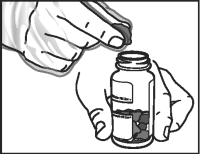
3. Drop each pinch-sized sample into the plastic container up to the Sample Fill Line (lower line) on the label. Allow fecal matter to sit loosely in the container - do not pack or compress.
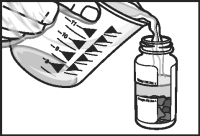
4. Add clean (potable) tap water to the fecal matter in the container. Fill to the Water Fill Line (top line). Do not use water from dirty containers or from sources that may be contaminated with equine blood. Water should be room temperature.
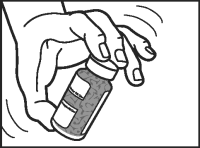
5. Replace cap on container, and shake vigorously to mix fecal matter and water. Set container on a flat surface, and remove lid.
6. Open foil pack and remove test cassette and sample pipette. (Discard empty foil pack and desiccant pouch.)
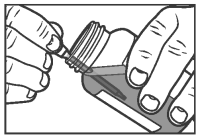
7. Use provided disposable pipette to collect solution from container. Be sure to collect liquid only, avoiding particles of fibrous material or silt. This can interfere with wicking of the sample into the test strips. For best results: (i) tip jar slightly, (ii) depress pipette bulb before placing in solution, (iii) insert tip of pipette below surface of solution and release bulb slowly to draw up solution.
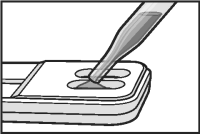
8. Apply 2 drops of solution from pipette to EACH of the two sample wells. Depress pipette bulb slowly to produce large drops.
Watch for liquid to wick up the membrane in the test windows. Wait until red lines appear at the CTL point in each window, called “control lines.” Control lines on each strip are your assurance that the strips are functioning properly. If wicking does not occur, check that well is not clogged with silt, and apply one more drop ONLY to non-wicking well. (Excess fluid can flood the test, negating the result.)
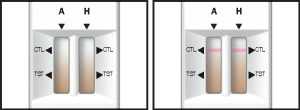
9. If a line appears at the TST point on either the Test A or Test H window, that is a positive test. Allow up to 15 minutes to assure a negative result. DO NOT read results after 15 minutes. Note that even a faint line reflects a positive test.
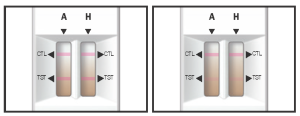
Reading The Tests
Observe results after applying the solution to each of the two sample wells on the cassette, per instructions.
1. If a Control line does not appear within 15 minutes (at the CTL point on the cassette) that test result is invalid. The test must then be repeated with a new SUCCEED Equine Fecal Blood Test.
2. If only a Control line appears on either strip, that test is NEGATIVE. NOTE: only a complete line is a meaningful result.
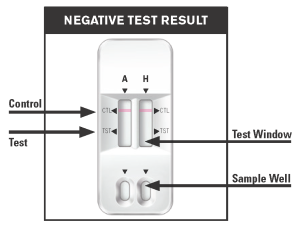
If a solid line appears only at the CTL point (Control line) on either Test A or Test H, this is a NEGATIVE result.
3. If both the Control and Test lines appear on either window (Test A or H), this indicates a POSITIVE test result. Even if the test line is faint, the test is POSITIVE.
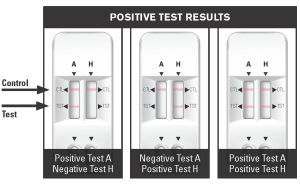
If a complete, solid line appears at the TST point (Test line) on either or both Test A and Test H, that is a POSITIVE test result. Test A detects equine albumin. Test H detects equine hemoglobin.
Note - even if the test line is faint, the test is POSITIVE.
4. Do not read test results after 15 minutes.
If you have questions about reading the SUCCEED Equine Fecal Blood Test, please call: 800-281-6727 from 8AM - 5PM ET Monday through Friday.
Interpreting The Results
The following chart summarizes the meaning of a positive and/or negative test results across SUCCEED FBT tests A and H.
|
|
Albumin Test (Test A) |
||
|
Negative |
Positive |
||
|
Hemoglobin Test (Test H) |
Negative |
No GI tract issue detected. Compromised basement membrane possible in foregut. |
GI tract issue detected in hindgut. Compromised basement membrane possible in foregut. |
|
Positive |
Active vascular bleeding in foregut. |
GI tract issue detected in hindgut. Active vascular bleeding possible in foregut, hindgut or both. |
|
NOTES: Test A uses antibodies for albumin, which typically breaks down in digestion, particularly when exposed to acids and digestive enzymes in the stomach and small intestine. Also, albumin may be present at the site of low-grade injury absent whole blood (i.e., albumin may be present without hemoglobin). Thus, a positive Test A with a negative Test H indicates low-grade lesions in the hindgut.
Test H uses antibodies for hemoglobin. Hemoglobin is more resistant to acids and enzymatic activity in the GI tract. Also, hemoglobin is only present with whole blood. Thus, a positive Test H, with negative Test A, will indicate bleeding from a foregut source. You will not obtain a positive result from either Test A or H when a horse has a foregut lesion equivalent to a grade 1 gastric ulcer, where whole blood loss does not occur.
For statistical data on the reliability of the FBT, refer to the Technical Information sheet in the outer 10-pack carton.
SUCCEED® FECAL BLOOD TEST™ TECHNICAL SHEET
INTENDED USE
The SUCCEED® Equine Fecal Blood Test™ (FBT) is a qualitative lateral-flow rapid test that detects horse hemoglobin and albumin in equine fecal specimens. The SUCCEED FBT is for veterinary use only, for use as a diagnostic aid in assessing GI tract conditions in their equine patients.
Test Mechanism
The SUCCEED FBT utilizes proprietary antibodies to equine albumin and hemoglobin, and has been calibrated to detect levels consistent with a disease condition. (See figures below for detection limits.)
Test A detects occult equine albumin in feces, which indicates injury caudal to the common bile duct (such as ulceration or inflammation in the hindgut). Test H detects occult equine hemoglobin in feces, which indicates injury that is producing whole blood anywhere along the GI tract of the horse. Taken together, the two parts of the test may provide a means of distinguishing foregut and hindgut conditions in horses.
PRECAUTIONS
● For veterinary use only.
● For in vitro diagnostic use.
● Note: the SUCCEED FBT is a medical device and must be handled with care.
● Do not use after expiration date, which is printed on the back of the test cassette and outside foil pack.
● Keep specimen clear of any potential contaminants. Use only the provided plastic container to collect and mix the fecal sample.
● Keep test cassette in sealed foil pack until use. Exposure to moisture will affect antibodies.
● Keep product refrigerated when not in use. Keep out of direct sunlight or heat sources.
Limitations Of The Test
The SUCCEED FBT is a fecal occult blood test. It is designed to detect blood components in feces that may be indicative of underlying pathologic conditions. This makes the SUCCEED FBT a qualitative test for the presence and location of gastrointestinal injury. It is not a quantitative test.
Albumin may be present at the site of injury absent whole blood: thus a positive test A reflects ANY injury in the hindgut (i.e. caudal to the Common Bile Duct). Hemoglobin is only present with whole blood: therefore, a positive test H reflects injury producing whole blood ANYWHERE in the GI tract.
Equine albumin and hemoglobin in feces may arise from a variety of conditions, including but not limited to:
● Bleeding ulcers (gastric or colonic)
● Excessive parasitic activity
● Protein-losing enteropathy (PLE)
● Lesions caused by hard particles of feed or other ingested material
● Petechiation, hyperemias or lypomas
Equine GI lesions - including petechiation and parasite pits - may bleed lightly or intermittently, so a test result may be negative even when disease is present. And because blood components may be non-uniformly distributed in a fecal dropping, negative readings may occasionally be obtained from a fecal sample of an unhealthy horse.
As with any fecal blood test, SUCCEED FBT is not a conclusive diagnostic for occult gastrointestinal bleeding or pathology; it should be employed only as an aid to diagnosis.
Additionally, a positive test result (especially Test H), can arise from extraneous sources, such as:
● Dentistry or exercise-induced pulmonary hemorrhage
● Mare ovulation
● Post-surgery bleeding
As with any diagnostic, a definitive diagnosis should not be based on the result of a single test. The test is designed to be complementary to blood tests and physical examination. NOTE: Practitioners experiencing a positive Test A without a positive Test H, should include a protein-losing enteropathy as one differential diagnosis, especially in the presence of hypoproteinemia/hypoalbuminemia on a CBC/chem profile. A negative test result in conjunction with hypoproteinemia/hypoalbuminemia may reflect a protein-losing nephropathy.
Applications
Because symptoms are an unreliable indicator of GI health, practitioners should test horses periodically. Given the ease and affordability of the FBT, testing all horses on a regular schedule is a practical option for early detection.
Consistent testing is especially important for performance horses, or wherever the care, feeding and general husbandry can affect digestive health, including intermittent feeding, high-grain diets, stall confinement, etc. Because it is possible that GI health may be a root cause of many performance or behavioral problems, horses with such issues may be prime candidates for testing.
The SUCCEED FBT may also be a valuable part of a pre-purchase exam.
Performance Characteristics
The accuracy of the SUCCEED FBT is validated by serial dilutions of horse blood, typically in powers of ten.
IN VITRO RESPONSE CURVES
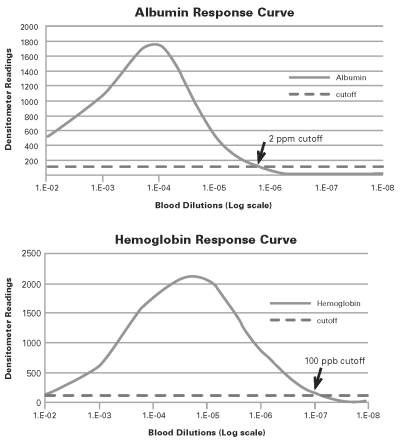
There are two wells in the kit, one to detect albumin and one for hemoglobin. In water, the sensitivity of the test is 2 parts per million (ppm) for albumin and 0.1 ppm for hemoglobin, based on whole blood equivalents. When either protein exceeds its cutoff value, a red line shows up in its window.
The following graphs show the serial dilution results for both test wells on the FBT (one for Albumin and one for Hemoglobin). Each graph goes from low to higher dilutions (lower concentrations) as you move to the right. The vertical axis lists densitometer readings; the dashed line represents the densitometer cutoff below which the test line is no longer visible to the naked eye. The cutoff for albumin is where the curve intersects the dashed line, at 2 ppm. For hemoglobin the cutoff is set to 100 ppb.
For more information about the research and technical data supporting the SUCCEED FBT, register to access the SUCCEED Veterinary Center:
www.succeed-vet.com
FREEDOM HEALTH, LLC, 65 Aurora Industrial Parkway, Aurora, OH 44202 USA
800-281-6727 - 24 hours/day
www.SucceedFBT.com
SUCCEED® is a registered trademark, and Equine Fecal Blood Test is a trademark of Freedom Health LLC. © 2017. All Rights Reserved. U.S. Patent Nos. 7,629,180 and 8,168,446. Canadian Patent No. 2,601,368.
|
CONTENTS: |
|
|
|
CONTAINS 2 TEST KITS. |
50102 |
P555 10/14 |
|
10 complete test kits. Each kit contains 1 dual test cassette, 1 sample pipette and 1 polyethylene glove, in plastic specimen jar with instruction sheet. (Desiccant pouch included to absorb moisture.) |
50110 |
P510 Rev F 06/14 L501A Rev G 06/14 US-FBT I506 11/17 |
CPN: 1333002.5
65 AURORA INDUSTRIAL PARKWAY, AURORA, OH, 44202-8088
| Toll-Free: | 877-734-6558 | |
| Website: | www.succeed-equine.com | |
| www.succeedFBT.com | ||
| www.succeed-vet.com | ||
| Email: | info@succeed-equine.com |
 |
THIS SERVICE AND DATA ARE PROVIDED "AS IS". DVMetrics assumes no liability, and each user assumes full risk, responsibility, and liability, related to its use of the DVMetrics service and data. See the Terms of Use for further details. |

Copyright © 2024 Animalytix LLC. Updated: 2024-08-26