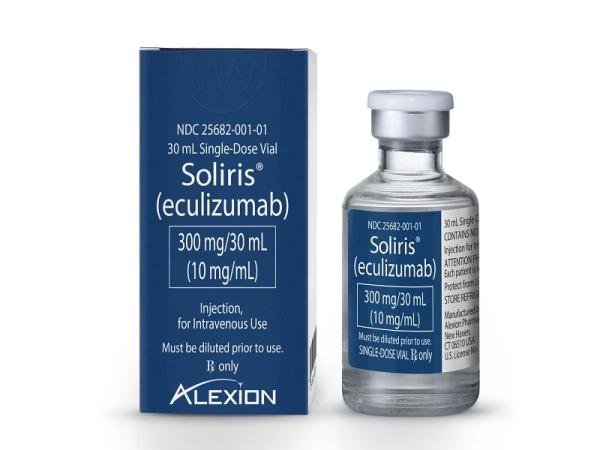
Soliris
Generic name: eculizumab [ E-kue-LIZ-oo-mab ]
Drug class: Selective immunosuppressants
What is Soliris?
Soliris is a monoclonal antibody. Eculizumab binds to proteins in the blood that can destroy red blood cells in people with genetic conditions that affect the natural defenses of red blood cells.
Soliris is used to prevent the breakdown of red blood cells in adults with paroxysmal nocturnal hemoglobinuria (PNH).
Soliris is also used to treat a rare chronic blood disease called atypical hemolytic uremic syndrome (aHUS) in adults and children who weigh at least 11 pounds (5 kilograms).
Soliris is also used to treat myasthenia gravis in adults.
Soliris is also used to treat neuromyelitis optica spectrum disorder (NMOSD) in adults.
Soliris is available only under a special program. You must be registered in the program and understand the risks and benefits of this medicine.
Warnings
Soliris affects your immune system. You may get infections more easily, even serious or fatal infections. Call your doctor right away if you have a headache and fever with nausea or vomiting, skin rash, body aches, flu symptoms, confusion, sensitivity to light, or stiffness in your neck or back.
You will receive a card listing the symptoms of meningococcal infection. Read this information and learn what symptoms to watch for. Keep the card with you at all times while using Soliris and for at least 3 months after your last dose.
You should not use Soliris if you have bacterial meningitis or if you have not been vaccinated against meningitis.
Seek emergency medical attention or call your doctor right away if you have symptoms of meningitis: headache and fever with nausea or vomiting, skin rash, body aches, flu symptoms, confusion, sensitivity to light, stiffness in your neck or back.
You must be vaccinated against meningococcal infection at least 2 weeks before treatment with Soliris.
Do not stop receiving Soliris without first talking to your doctor. Stopping or interrupting your treatment could cause sudden and serious effects on your red blood cells.
Related/similar drugs
Empaveli, Vyvgart, Zilbrysq, pyridostigmine, Mestinon, neostigmine, Ultomiris
Before taking this medicine
You should not use Soliris if:
-
you have a meningococcal infection; or
-
you have not been vaccinated against meningitis.
Tell your doctor if you have a fever or any type of infection.
Your doctor may recommend certain vaccines. You must be vaccinated against meningococcal infection at least 2 weeks before you start treatment with Soliris. If you were vaccinated in the past, you may need a booster dose.
Follow your doctor's instructions about using this medicine if you are pregnant. It is very important to control your blood disorder during pregnancy to avoid unwanted effects in you or the baby.
Ask a doctor if it is safe to breastfeed while using Soliris.
How is Soliris given?
Soliris is injected into a vein by a healthcare provider. The infusion can take at least 35 minutes to complete in adults, or up to 4 hours in children.
Your doctor will perform tests to make sure Soliris is the right treatment for you.
Soliris is not given every day. Follow your doctor's dosing instructions very carefully. The dosing schedule may be different for a child or teenager than for an adult.
Doses are based on weight in children and teenagers. Your child's dose may change if the child gains or loses weight.
You should be watched closely for at least 1 hour after each infusion, to make sure you do not have a reaction.
You may get infections more easily, even serious or fatal infections. You will need frequent medical tests.
You will receive a card listing the symptoms of meningococcal infection. Read this information and learn what symptoms to watch for. Keep the card with you at all times while using Soliris and for at least 3 months after your last dose.
Do not stop receiving Soliris without first talking to your doctor. Interrupting your treatment could cause sudden and serious effects on your red blood cells.
Eculizumab can effect your body for up to 3 months. You may need medical tests for 8 to 12 weeks if you stop using this medicine. Make sure any doctor who treats you knows that you've used Soliris.
Dosing information
Usual Adult Dose for Paroxysmal Nocturnal Hemoglobinuria:
600 mg IV every week for 4 weeks, followed by 900 mg IV at week 5, then 900 mg IV every 2 weeks
Use: For paroxysmal nocturnal hemoglobinuria (PNH) to reduce hemolysis
Usual Adult Dose for Hemolytic Uremic Syndrome:
900 mg IV every week for the first 4 weeks, followed by 1200 mg IV at week 5, then 1200 mg IV every 2 weeks
Use: For atypical hemolytic uremic syndrome (aHUS) to inhibit complement-mediated thrombotic microangiopathy
Usual Adult Dose for Myasthenia Gravis:
900 mg IV every week for the first 4 weeks, followed by 1200 mg IV at week 5, then 1200 mg IV every 2 weeks
Use: For patients with generalized myasthenia gravis (gMG) who are anti-acetylcholine receptor (AchR) antibody positive
Usual Adult Dose for Neuritis:
900 mg IV every week for the first 4 weeks, followed by 1200 mg IV at week 5, then 1200 mg IV every 2 weeks
Use: For the treatment of neuromyelitis optica spectrum disorder (NMOSD) in adult patients who are anti-aquaporin-4 (AQP4) antibody positive
Usual Pediatric Dose for Hemolytic Uremic Syndrome:
2 months and older:
-Weight 5 kg to less than 10 kg: 300 mg IV for the first dose, followed by 300 mg IV at week 2, then 300 mg IV every 3 weeks
-Weight 10 kg to less than 20 kg: 600 mg IV for the first dose, followed by 300 mg IV at week 2, then 300 mg IV every 2 weeks
-Weight 20 kg to less than 30 kg: 600 mg IV every week for the first 2 doses, followed by 600 mg IV at week 3, then 600 mg IV every 2 weeks
-Weight 30 kg to less than 40 kg: 600 mg IV every week for the first 2 doses, followed by 900 mg IV at week 3, then 900 mg IV every 2 weeks
-Weight 40 kg or greater: 900 mg IV every week for the first 4 doses, followed by 1200 mg IV at week 5, then 1200 mg IV every 2 weeks
Use: For atypical hemolytic uremic syndrome (aHUS) to inhibit complement-mediated thrombotic microangiopathy
What happens if I miss a dose?
Call your doctor for instructions.
What happens if I overdose?
Seek emergency medical attention or call the Poison Help line at 1-800-222-1222.
What should I avoid while using Soliris?
Follow your doctor's instructions about any restrictions on food, beverages, or activity.
Soliris side effects
Get emergency medical help if you have signs of an allergic reaction to Soliris: hives; chest pain, difficult breathing; feeling like you might pass out; swelling of your face, lips, tongue, or throat. These symptoms may occur during the injection.
Seek emergency medical attention if you have symptoms of meningitis:
-
fever and a headache or skin rash;
-
headache with nausea and vomiting;
-
body aches, flu symptoms;
-
confusion, increased sensitivity to light; or
-
stiffness in your neck or back.
During or after your treatment with Soliris call your doctor at once if you have:
-
fever;
-
pain or burning when you urinate;
-
dangerously high blood pressure - dizziness, weakness, numbness, confusion, blurred vision, vomiting, chest pain, cough, shortness of breath, seizure;
-
kidney problems - swelling, urinating less, feeling tired or short of breath;
-
signs of a blood cell disorder - pale skin, unusual tiredness, feeling light-headed, cold hands and feet, easy bruising, unusual bleeding, confusion, chest pain, trouble breathing, seizure (convulsions); or
-
signs of a blood clot - sudden numbness or weakness, problems with speech or balance, rapid breathing, coughing up blood, pain or swelling in your arms or legs.
Common Soliris side effects may include:
-
headache, dizziness;
-
flu symptoms (fever, tiredness, aches, cough, sore throat);
-
runny or stuffy nose, sinus pain;
-
painful urination;
-
nausea, vomiting, diarrhea, stomach pain;
-
swelling in your legs or feet;
-
bruising;
-
muscle or joint pain, back pain;
-
a blood cell disorder; or
-
high blood pressure.
This is not a complete list of side effects and others may occur. Call your doctor for medical advice about side effects. You may report side effects to FDA at 1-800-FDA-1088.
What other drugs will affect Soliris?
Other drugs may interact with eculizumab, including prescription and over-the-counter medicines, vitamins, and herbal products. Tell your doctor about all your current medicines and any medicine you start or stop using.
Popular FAQ
Yes, a visiting nurse may come to your house to administer Soliris or it may be given at a special infusion center. Soliris is given as an intravenous (IV) infusion into your vein. Your location and insurance type can affect where you will receive Soliris.
Ultomiris (ravulizumab) and Soliris (eculizumab) are both C5 complement inhibitors approved to treat patients with paroxysmal nocturnal hemoglobinuria (PNH), a blood disease caused by red blood cell destruction. Ultomiris has a longer half-life, meaning it stays in your blood longer and does not have to be dosed as often. Continue reading
Soliris works by binding to the complement protein C5. This helps stop the activation of C5a / C5b and prevents formation of terminal complement complex C5b-9. Clinically, Soliris helps to stop red blood cell destruction and symptoms like anemia, fatigue and blood clots in patients living with paroxysmal nocturnal hemoglobinuria (PNH). Continue reading
Empaveli is a brand name for pegcetacoplan which is a PEGylated 40kDa polyethylene glycol linear small molecule that acts as a C3 complement inhibitor and Soliris is a brand name for eculizumab which is a monoclonal antibody that specifically binds to the complement protein C5. Empaveli is given by subcutaneous infusion and people can be taught how to self-administer it at home. Soliris is given by infusion under the guidance of a healthcare professional every 2 weeks (after the initial dosing schedule) although most patients are encouraged to switch from Soliris to Ultomaris which only requires 7 infusions in adults a year. Continue reading
More about Soliris (eculizumab)
- Check interactions
- Compare alternatives
- Pricing & coupons
- Reviews (2)
- Drug images
- Side effects
- Dosage information
- During pregnancy
- FDA approval history
- Drug class: selective immunosuppressants
- Breastfeeding
- En español
Professional resources
Related treatment guides
Further information
Remember, keep this and all other medicines out of the reach of children, never share your medicines with others, and use Soliris only for the indication prescribed.
Always consult your healthcare provider to ensure the information displayed on this page applies to your personal circumstances.
Copyright 1996-2024 Cerner Multum, Inc. Version: 8.01.