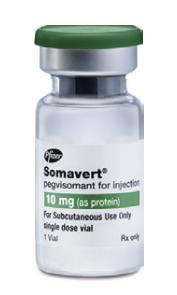
Drug Information
Side Effects > Somavert

Somavert Side Effects

Generic Name: pegvisomant

Please note - some side effects for Somavert may not be reported. Always consult your doctor or healthcare specialist for medical advice. You may also report side effects to the FDA at http://www.fda.gov/medwatch/ or 1-800-FDA-1088 (1-800-332-1088).


Side Effects of Somavert - for the Consumer

Somavert

All medicines may cause side effects, but many people have no, or minor, side effects. Check with your doctor if any of these most COMMON side effects persist or become bothersome when using Somavert:

Diarrhea; dizziness; nausea; pain; pain, redness, or itching at the injection site.

Seek medical attention right away if any of these SEVERE side effects occur when using Somavert:

Severe allergic reactions (rash; hives; itching; difficulty breathing; tightness in the chest; swelling of the mouth, face, lips, or tongue); chest pain; flu-like symptoms (eg, chills, fever, muscle aches, weakness); severe stomach pain; swelling of the legs and feet; thickening of the skin or lumps at the injection site; unusual weight gain; yellowing of the skin or eyes.

Top

Somavert Side Effects - for the Professional

Somavert

Laboratory Changes

Elevations of serum concentrations of ALT and AST greater than ten times the ULN were reported in two subjects (0.8%) exposed to Somavert in pre-approval clinical studies.

General

Nine acromegalic patients (9.6%) withdrew from pre-marketing clinical studies because of adverse events, including two patients with marked transaminase elevations, one patient with lipohypertrophy at the injection sites, and one patient with substantial weight gain. The majority of reported adverse events were of mild to moderate intensity and limited duration. Most adverse events did not appear to be dose dependent. Table 5 shows the incidence of treatment-emergent adverse events that were reported in at least two patients treated with Somavert and at frequencies greater than placebo during the 12-week, placebo-controlled study.

Table 5. Number of Patients (%) with Acromegaly Reporting Adverse Events in a 12-week Placebo-controlled Study with Somavert*
Event Somavert Placebo
n=32
10 mg/day
n=26
15 mg/day
n=26
20 mg/day
n=28
*
Table includes only those events that were reported in at least 2 patients and at a higher incidence in patients treated with Somavert than in patients treated with placebo.
The 6 events coded as "infection" in the group treated with Somavert 10 mg were reported as cold symptoms (3), upper respiratory infection (1), blister (1), and ear infection (1).The 2 events in the placebo group were reported as cold symptoms (1) and chest infection (1).
Body as a whole
  Infection 6 (23%) 0 0 2 (6%)
  Pain 2 (8%) 1 (4%) 4 (14%) 2 (6%)
  Injection site reaction 2 (8%) 1 (4%) 3 (11%) 0
  Accidental injury 2 (8%) 1 (4%) 0 1 (3%)
  Back pain 2 (8%) 0 1 (4%) 1 (3%)
  Flu syndrome 1 (4%) 3 (12%) 2 (7%) 0
  Chest pain 1 (4%) 2 (8%) 0 0
Digestive
  Abnormal liver function tests 3 (12%) 1 (4%) 1 (4%) 1 (3%)
  Diarrhea 1 (4%) 0 4 (14%) 1 (3%)
  Nausea 0 2 (8%) 4 (14%) 1 (3%)
Nervous
  Dizziness 2 (8%) 1 (4%) 1 (4%) 2 (6%)
  Paresthesia 0 0 2 (7%) 2 (6%)
Metabolic and nutritional
disorders
  Peripheral edema 2 (8%) 0 1 (4%) 0
Cardiovascular
  Hypertension 0 2 (8%) 0 0
Respiratory
  Sinusitis 2 (8%) 0 1 (4%) 1 (3%)

Immunogenicity

In pre-marketing clinical studies, approximately 17% of the patients developed low titer, non-neutralizing anti-GH antibodies. Although the presence of these antibodies did not appear to impact the efficacy of Somavert, the long-term clinical significance of these antibodies is not known. No assay for anti-pegvisomant antibodies is commercially available for patients receiving Somavert.

Post-Marketing Experience

Lipohypertrophy has been reported in <5% of patients following pegvisomant administration.

Asymptomatic, transient elevations in transaminases up to 15 times ULN have been observed in <2% of patients in the post-marketing experience. These reports were not associated with an increase in bilirubin, and there were no clinical consequences for these patients. Transaminase elevations normalized with time, most often after suspending treatment (Somavert should be used in accordance with the information presented in Table 4 with respect to liver test abnormalities).

Top

Side Effects by Body System

Hepatic

During premarketing clinical studies two patients (0.8%) had elevations of serum concentrations of alanine aminotransferase and aspartate aminotransferase greater than 10 times the upper limit of normal. In both patients, the transaminase elevations normalized after discontinuation of the drug. In other studies, up to 12% of patients experienced abnormal liver function tests.

Hepatic side effects have included abnormal liver function tests (elevations of serum concentrations of alanine aminotransferase and aspartate aminotransferase) in up to 12% of patients treated.

Immunologic

Immunologic side effects have included the development of low titer non-neutralizing antigrowth hormone antibodies.

General

General side effects have included infection (23 to 33%), pain (8 to 23%), flu syndrome (12 to 21%), and accidental injury (8 to 18%).

Musculoskeletal

Musculoskeletal side effects have included back pain (8%) and chest pain (4%).

Respiratory

Respiratory side effects have included sinusitis (8%).

Gastrointestinal

Gastrointestinal side effects have included diarrhea (4%) and nausea (8%).

Nervous system

Nervous system side effects have included headache (26%), dizziness (8%) and paresthesias (7%).

Cardiovascular

Cardiovascular side effects have included hypertension (8%) and peripheral edema (8%).

Local

Local side effects have included injection site reactions (11%).

Metabolic

Metabolic side effects have included hypercholesterolemia (14%). Lipohypertrophy has been reported in lass than 5% of patients following pegvisomant administration.

Top

More resources:

Drugs.com Somavert

MedFacts Somavert

Micromedex Somavert - Includes detailed dosage instructions.

FDA Somavert

Facts & Comparisons Pegvisomant

Disclaimer: Every effort has been made to ensure that the information provided is accurate, up-to-date, and complete, but no guarantee is made to that effect. In addition, the drug information contained herein may be time sensitive and should not be utilized as a reference resource beyond the date hereof. This information does not endorse drugs, diagnose patients, or recommend therapy. This drug information is a reference resource designed as supplement to, and not a substitute for, the expertise, skill , knowledge, and judgement of healthcare practitioners in patient care. The absence of a warning for a given drug or drug combination in no way should be construed to indicate that the drug of drug combination is safe, effective, or appropriate for any given patient. Drugs.com does not assume any responsibility for any aspect of healthcare administered with the aid of information provided. The information contained herein is not intended to cover all possible uses, directions, precautions, warnings, drug interactions, allergic reactions, or adverse effects. If you have questions about the drugs you are taking, check with your doctor, nurse, or pharmacist.


MedNotes
Advertisement

(web3)