Succimer (Monograph)
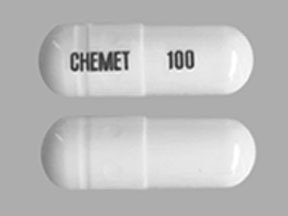
Brand name: Chemet
Drug class: Heavy Metal Antagonists
- Sulfhydryl Donors
Introduction
Heavy metal antagonist; chelates lead.
Uses for Succimer
Lead Poisoning
Alternative for treatment of lead poisoning in children with blood lead concentrations >45 mcg/dL (designated an orphan drug by FDA for this use).
The AAP recommends succimer in the treatment of lead poisoning in children with blood lead concentrations of 45–70 mcg/dL who do not have symptoms of lead encephalopathy. Alternatively, parenteral therapy with edetate calcium disodium (calcium EDTA) alone is recommended.
CDC and AAP do not recommend routine chelation therapy in pediatric patients with blood lead concentrations 25–45 mcg/dL. However, oral chelation therapy with succimer may be recommended in certain patients (e.g., blood lead concentrations of 35–44 mcg/dL, children <2 years of age, evidence of toxicity or symptoms).
The AAP currently states that patients with blood lead concentrations >70mcg/dL or with symptoms of lead encephalopathy require inpatient combined therapy with parenteral calcium EDTA and dimercaprol.
Children may need to be hospitalized during initiation of therapy to monitor for adverse effects, ensure patient compliance, and allow time for implementation of environmental lead abatement procedures.
Used in conjunction with a lead abatement program.
Notto be used prophylactically for the prevention of lead poisoning in a lead-containing environment.
Management of lead poisoning† [off-label] in adults with blood lead concentrations 70–100 mcg/dL or mild symptoms.
Other Heavy Metal Poisoning
Has been used in the treatment of mercury poisoning† [off-label] (designated an orphan drug by FDA for this use).
Has been used in the treatment of arsenic poisoning† [off-label].
Succimer Dosage and Administration
General
-
When source for lead poisoning has been identified, remove patient from that source.
-
Maintain adequate hydration to ensure renal excretion of chelating agents.
Administration
Oral Administration
Administer orally.
In patients who cannot swallow capsules, administer by opening capsule and sprinkling beads on a small amount of soft food or by putting beads in a spoon and following with fruit drink.
Dosage
Pediatric Patients
Lead Poisoning
Blood Lead Concentration 45–70 mcg/dL
OralChildren >12 months of age: 10 mg/kg or 350 mg/m2 every 8 hours for 5 days followed by 10 mg/kg or 350 mg/m2 every 12 hours for 14 days. Full course of treatment is 19 days.
Intervals ≥2 weeks are recommended between courses of succimer therapy unless blood lead concentrations require more prompt drug therapy.
≥4 week interval is recommended when succimer is given subsequent to calcium EDTA therapy, with or without dimercaprol.
Adults
Lead Poisoning
Mild Symptoms or Blood Lead Concentration 70–100 mcg/dL
Oral10 mg/kg or 350 mg/m2 every 8 hours for 5 days followed by 10 mg/kg or 350 mg/m2 every 12 hours for 14 days. Full course of treatment is 19 days.
Intervals ≥2 weeks are recommended between courses of succimer therapy unless blood lead concentrations require more prompt drug therapy.
≥4 week interval is recommended when succimer is given subsequent to calcium EDTA therapy, with or without dimercaprol.
Prescribing Limits
Pediatric Patients
Lead Poisoning
Oral
Children >12 months of age: Initially, maximum 10 mg/kg or 350 mg/m2 every 8 hours.
Safety of uninterrupted dosing >3 weeks not established and not recommended.
Adults
Lead Poisoning
Oral
Safety of uninterrupted dosing >3 weeks not established and not recommended.
Special Populations
No special population dosage recommendations at this time.
Cautions for Succimer
Contraindications
-
Known hypersensitivity to succimer or any ingredient in the formulation.
Warnings/Precautions
Warnings
Lead Exposure
Not a substitute for the abatement of lead exposure.
Neutropenia
Risk of mild to moderate neutropenia, possibly resulting in infection.
Perform CBCs, including differential and platelet counts, prior to and weekly during therapy. Withhold therapy if ANC <1200/mm3; continue monitoring until ANC >1500/mm3 or recovery to patient’s baseline neutrophil count. Rechallenge only if the benefit of therapy outweighs the risk of neutropenia and only with careful monitoring.
Assess blood counts if infection is suspected.
Sensitivity Reactions
Hypersensitivity
Possible allergic or mucocutaneous reactions; may occur with readministration as well as during initial course.
Recurrent mucocutaneous vesicular eruptions affecting oral mucosa, external urethral meatus, and perianal area reported in one patient; reactions increased in severity with administration of each subsequent course and resolved between courses and upon discontinuance of therapy.
General Precautions
Monitoring
Clinical experience is limited; careful observation recommended during therapy.
Rebound Lead Toxicity
Risk of elevated blood lead concentrations and associated symptoms after discontinuance of drug due to redistribution of lead from bone stores to soft tissues and blood.
After completion of therapy, monitor blood lead concentrations at least once weekly until stable. Use the severity of lead intoxication (as measured by the initial blood lead concentration and the rate and degree of rebound of blood lead) as a guide for more frequent monitoring.
Elevated Serum Transaminases
Transient mild elevations of serum transaminases observed in 6–10% of patients. Obtain baseline and weekly serum transaminase levels during therapy.
Specific Populations
Pregnancy
Category C.
Lactation
Not known whether succimer is distributed into milk; however, breastfeeding is contraindicated in women receiving succimer due to maternal lead poisoning and risk of exposing nursing infant to the toxic heavy metal.
Pediatric Use
Safety and efficacy not established in children <12 months of age.
Hepatic Impairment
Use with caution; assess hepatic function prior to and periodically during therapy.
Closely monitor patients with a history of liver disease.
Renal Impairment
Use with caution; assess renal function prior to and periodically during prolonged therapy. Adequately hydrate patients during therapy. Limited data suggests that succimer is dialyzable, but the lead chelates are not.
Common Adverse Effects
GI symptoms (nausea, vomiting, diarrhea, appetite loss, loose stools, metallic taste), elevated serum transaminases, rash, neutropenia.
Drug Interactions
Chelating Agents
Concomitant administration with other chelating agents (i.e., edetate sodium dicalcium) is not recommended.
Laboratory Tests
May interfere with serum and urinary laboratory tests. May cause false positive results for ketones in urine using nitroprusside reagents (e.g., Ketostix) and falsely decreased measurements of serum uric acid and CPK.
Succimer Pharmacokinetics
Absorption
Bioavailability
Absorption is rapid and variable, with peak plasma concentrations obtained at 1–2 hours.
Elimination
Metabolism
Approximately 90% of absorbed dose is metabolized to mixed succimer-cysteine disulfides.
Elimination Route
Unabsorbed drug excreted principally in feces; absorbed drug excreted principally in the urine as metabolites.
Half-life
Approximately 2 days.
Stability
Storage
Oral
Capsules
15–25°C. Avoid excessive heat.
Actions
-
Chelates heavy metals with a high specificity for lead.
-
Forms water soluble chelates with lead and increases urinary excretion of lead.
-
At recommended oral doses, decreases average blood lead concentrations by 72.5%. An average of 19 mg of lead was excreted in urine following administration of 30 mg/kg of succimer daily for 5 days.
-
Improves clinical symptoms (e.g., headache, colic) and biochemical indices of lead poisoning.
-
Does not affect urinary elimination of iron, calcium, or magnesium; however, may double zinc excretion.
Advice to Patients
-
Importance of identifying source of lead poisoning and then removing patient from that source. Importance of patient residing in an environment free of lead both during and after therapy.
-
For patients unable to swallow capsules, contents of capsules may be sprinkled on soft food just before administration or placed on a spoon for administration and taken with fruit juice.
-
Importance of maintaining adequate fluid intake.
-
Importance of informing clinicians if rash or infection occurs.
-
Importance of completing full course of therapy.
-
Importance of women informing clinicians if they are or plan to become pregnant or plan to breast-feed.
-
Importance of keeping succimer out of reach of children.
-
Importance of informing patients of other important precautionary information. (See Cautions.)
Additional Information
The American Society of Health-System Pharmacists, Inc. represents that the information provided in the accompanying monograph was formulated with a reasonable standard of care, and in conformity with professional standards in the field. Readers are advised that decisions regarding use of drugs are complex medical decisions requiring the independent, informed decision of an appropriate health care professional, and that the information contained in the monograph is provided for informational purposes only. The manufacturer’s labeling should be consulted for more detailed information. The American Society of Health-System Pharmacists, Inc. does not endorse or recommend the use of any drug. The information contained in the monograph is not a substitute for medical care.
Preparations
Excipients in commercially available drug preparations may have clinically important effects in some individuals; consult specific product labeling for details.
Please refer to the ASHP Drug Shortages Resource Center for information on shortages of one or more of these preparations.
|
Routes |
Dosage Forms |
Strengths |
Brand Names |
Manufacturer |
|---|---|---|---|---|
|
Oral |
Capsules |
100 mg |
Chemet |
Schwarz Pharma |
AHFS DI Essentials™. © Copyright 2025, Selected Revisions August 1, 2009. American Society of Health-System Pharmacists, Inc., 4500 East-West Highway, Suite 900, Bethesda, Maryland 20814.
† Off-label: Use is not currently included in the labeling approved by the US Food and Drug Administration.
Reload page with references included
Related/similar drugs
More about succimer
- Check interactions
- Compare alternatives
- Side effects
- Dosage information
- During pregnancy
- Drug class: chelating agents
- En español