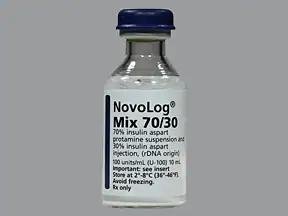
Insulin aspart and insulin aspart protamine
Generic name: insulin aspart and insulin aspart protamine [ IN-su-lin-AS-part, IN-su-lin-AS-part-PRO-ta-meen ]
Brand names: NovoLOG Mix 70/30, NovoLOG Mix 70/30 FlexPen, NovoLOG Mix 70/30 PenFill, Insulin Aspart-Insulin Aspart Protamine FlexPen, Relion NovoLOG Mix 70/30, Relion NovoLOG Mix 70/30 FlexPen
Dosage form: subcutaneous suspension (30 units-70 units/mL)
Drug class: Insulin
What is insulin aspart and insulin aspart protamine?
Insulin is a hormone that works by lowering levels of glucose (sugar) in the blood. Insulin aspart is a fast-acting insulin. Insulin aspart protamine is an intermediate-acting insulin. This combination insulin starts to work within 10 to 20 minutes after injection, peaks in 2 hours, and keeps working for up to 24 hours.
Insulin aspart and insulin aspart protamine is a combination medicine used to improve blood sugar control in adults with diabetes mellitus (type 1 or type 2).
Insulin aspart and insulin aspart protamine may also be used for purposes not listed in this medication guide.
Insulin aspart and insulin aspart protamine side effects
Get emergency medical help if you have signs of insulin allergy: redness or swelling where an injection was given, itchy skin rash over the entire body, trouble breathing, wheezing, rapid pulse, sweating, feeling like you might pass out, or swelling in your tongue or throat.
Insulin aspart and insulin aspart protamine may cause serious side effects. Call your doctor at once if you have:
-
fluid retention--weight gain, swelling in your hands or feet, feeling short of breath; or
-
low potassium--leg cramps, constipation, irregular heartbeats, fluttering in your chest, increased thirst or urination, numbness or tingling, muscle weakness or limp feeling.
Common side effects of insulin aspart and insulin aspart protamine may include:
-
low potassium;
-
itching, mild skin rash; or
-
thickening or hollowing of the skin where you injected the medicine.
This is not a complete list of side effects and others may occur. Call your doctor for medical advice about side effects. You may report side effects to FDA at 1-800-FDA-1088.
Warnings
Never share an injection pen or syringe with another person, even if the needle has been changed.
Before taking this medicine
You should not use this medicine if you are allergic to insulin aspart, or if you are having an episode of hypoglycemia (low blood sugar).
This medicine is not approved for use by anyone younger than 18 years old.
Tell your doctor if you have ever had:
-
liver or kidney disease; or
-
low levels of potassium in your blood (hypokalemia).
Tell your doctor if you also take pioglitazone or rosiglitazone (sometimes contained in combinations with glimepiride or metformin). Taking certain oral diabetes medicines while you are using insulin may increase your risk of serious heart problems.
Tell your doctor if you are pregnant or breastfeeding.
Follow your doctor's instructions about using insulin if you are pregnant or you become pregnant. Controlling diabetes is very important during pregnancy, and having high blood sugar may cause complications in both the mother and the baby.
How should I use insulin aspart and insulin aspart protamine?
Follow all directions on your prescription label and read all medication guides or instruction sheets. Use the medicine exactly as directed.
This medicine is injected under the skin. A healthcare provider may teach you how to properly use the medication by yourself. Do not inject this medicine into a vein or a muscle. This type of insulin must not be given with an insulin pump, or mixed with other insulins.
Read and carefully follow any Instructions for Use provided with your medicine. Ask your doctor or pharmacist if you don't understand all instructions.
Prepare an injection only when you are ready to give it. This medicine should look white and cloudy. Do not use the medicine if it looks clear or has particles in it. Call your pharmacist for new medicine.
It is important to time your insulin use with meals.
-
If you have type 1 diabetes: Use this medicine within 15 minutes before the start of a meal.
-
If you have type 2 diabetes: Use this medicine within 15 minutes before or after the start of a meal.
If you use an injection pen, use only the injection pen that comes with this medicine. Attach a new needle before each use.
Never share an injection pen or syringe with another person, even if the needle has been changed. Sharing these devices can allow infections or disease to pass from one person to another.
Do not inject this medicine into skin that is damaged, tender, bruised, pitted, thickened, scaly, or has a scar or hard lump.
You may have low blood sugar (hypoglycemia) and feel very hungry, dizzy, irritable, confused, anxious, or shaky. To quickly treat hypoglycemia, eat or drink a fast-acting source of sugar (fruit juice, hard candy, crackers, raisins, or non-diet soda).
Your doctor may prescribe a glucagon injection kit in case you have severe hypoglycemia. Be sure your family or close friends know how to give you this injection in an emergency.
Also watch for signs of high blood sugar (hyperglycemia) such as increased thirst or urination.
Blood sugar levels can be affected by stress, illness, surgery, exercise, alcohol use, or skipping meals. Ask your doctor before changing your dose or medication schedule.
Keep this medicine in its original container protected from heat and light. Do not freeze insulin or store it near the cooling element in a refrigerator. Throw away any insulin that has been frozen.
Storing this medicine unopened (not in use):
-
Refrigerate and use until expiration date; or
-
Store at room temperature, and use the vial within 28 days or use the injection pen within 14 days.
Storing this medicine opened (in use):
-
Store vial in a refrigerator or at room temperature and use within 28 days.
-
Store the injection pen at room temperature (do not refrigerate) and use within 14 days. Do not store the injection pen with a needle attached.
Use a needle and syringe only once and then place them in a puncture-proof "sharps" container. Follow state or local laws about how to dispose of this container. Keep it out of the reach of children and pets.
Insulin aspart and insulin aspart protamine dosing information
Usual Adult Dose for Diabetes Type 1:
Individualize dose based on glucose treatment goals, metabolic needs, eating habits, and other lifestyle variables.
--Important Limitation of Premix Insulin Use: These insulins have a fixed proportion of rapid acting and long acting insulins which does not allow for basal versus prandial dose adjustments; this premix consists of 70% insulin aspart protamine (intermediate-acting insulin) and 30% insulin aspart (rapid-acting insulin).
Usual dose: Administer prescribed units subcutaneously within 15 minutes before meal initiation
-Typically dosed twice a day with each dose designed to cover 2 meals or 1 meal and 1 snack
Comments:
-Total daily insulin requirements are estimated to be between 0.5 and 1 unit/kg/day.
-Duration of action may vary according to the dose, injection site, blood flow, temperature, and level of physical activity.
Use: To improve glycemic control in patients with diabetes mellitus.
Usual Adult Dose for Diabetes Type 2:
Individualize dose based on glucose treatment goals, metabolic needs, eating habits, and other lifestyle variables.
--Important Limitation of Premix Insulin Use: These insulins have a fixed proportion of rapid acting and long acting insulins which does not allow for basal versus prandial dose adjustments; this premix consists of 70% insulin aspart protamine (intermediate-acting insulin) and 30% insulin aspart (rapid-acting insulin).
Usual dose: Administer prescribed units subcutaneously within 15 minutes before or after meal initiation
-Typically dosed twice a day with each dose designed to cover 2 meals or 1 meal and 1 snack
Comments:
-Duration of action may vary according to the dose, injection site, blood flow, temperature, and level of physical activity.
Use: To improve glycemic control in patients with diabetes mellitus.
What happens if I miss a dose?
Since insulin aspart and insulin aspart protamine is used with meals, you may not be on a timed dosing schedule. Whenever you use this insulin, be sure to eat a meal within 15 minutes. Do not use extra medicine to make up a missed dose.
What happens if I overdose?
Seek emergency medical attention or call the Poison Help line at 1-800-222-1222. Insulin overdose can cause life-threatening hypoglycemia. Symptoms include drowsiness, confusion, blurred vision, trouble speaking, muscle weakness, clumsy or jerky movements, seizure (convulsions), or loss of consciousness.
What should I avoid while using insulin aspart and insulin aspart protamine?
Avoid driving or operating machinery until you know how this medicine will affect you.
Avoid medication errors by always checking the medicine label before injecting your insulin.
Avoid drinking alcohol. It can cause low blood sugar and may interfere with your diabetes treatment.
What other drugs will affect insulin aspart and insulin aspart protamine?
Many other medicines can affect your blood sugar, and some medicines can increase or decrease the effects of insulin. Some drugs can also cause you to have fewer symptoms of hypoglycemia, making it harder to tell when your blood sugar is low. Tell each of your health care providers about all medicines you use now and any medicine you start or stop using. This includes prescription and over-the-counter medicines, vitamins, and herbal products.
More about insulin aspart/insulin aspart protamine
- Check interactions
- Compare alternatives
- Pricing & coupons
- Reviews (3)
- Side effects
- Dosage information
- During pregnancy
- Drug class: insulin
- En español
Patient resources
Other brands
NovoLog Mix 70/30, NovoLog Mix 70/30 FlexPen
Related treatment guides
Further information
Remember, keep this and all other medicines out of the reach of children, never share your medicines with others, and use this medication only for the indication prescribed.
Always consult your healthcare provider to ensure the information displayed on this page applies to your personal circumstances.
Copyright 1996-2024 Cerner Multum, Inc. Version: 11.03.