C1-Esterase Inhibitor (Human) (Monograph)
Brand names: Berinert, Cinryze, Haegarda
Drug class: Complement Inhibitors
Introduction
Preparation of complement 1 (C1)-esterase inhibitor derived from pooled human plasma.
C1-esterase inhibitor is a naturally occurring inhibitor of certain serine proteases (e.g., C1 complement, kallikrein, coagulation factor XIIa, plasmin) involved in the complement, coagulation (contact), and fibrinolytic systems.
Uses for C1-Esterase Inhibitor (Human)
Hereditary Angioedema
Used for prevention and treatment of angioedema attacks in patients with hereditary angioedema (HAE).
There are 3 preparations of C1-esterase inhibitor (human) available in the US: Cinryze (IV injection) and Haegarda (sub-Q injection) are FDA-approved for routine prophylaxis against angioedema attacks in adult, adolescent, and pediatric patients ≥6 years of age with HAE, while Berinert (IV injection) is FDA-approved for treatment of acute abdominal, facial, or laryngeal HAE attacks in adult and pediatric patients.
Cinryze and Haegarda have been designated orphan drugs by FDA for HAE prophylaxis in patients 6 to 11 years of age, and in adolescent and adult patients, respectively.
Guidelines generally support consideration of C1-esterase inhibitor (human) among other options for prevention and treatment of HAE attacks.
C1-Esterase Inhibitor (Human) Dosage and Administration
General
Patient Monitoring
-
Monitor for signs and symptoms of acute hypersensitivity reaction (e.g., hives, urticaria, chest tightness, wheezing, hypotension and/or anaphylaxis) during or after administration of C1-esterase inhibitor (human). Epinephrine should be immediately available to treat any acute severe hypersensitivity reactions that occur.
-
Monitor patients with known risk factors for signs and symptoms of thrombosis during treatment with C1-esterase inhibitor (human).
Other General Considerations
-
C1-esterase inhibitor (human) may be administered in the home or other appropriate setting if it is determined that the drug can be safely and effectively administered by the patient or caregiver; this determination should include an assessment of whether the patient/caregiver has the dexterity and comprehension to administer the drug. Appropriate training should be provided to patients/caregivers who are deemed appropriate candidates, and such individuals should be able to demonstrate their ability to perform IV infusions or sub-Q injections. Patients/caregivers who are administering C1-esterase inhibitor (human) for treatment of acute attacks should be able to reliably recognize signs and symptoms of an acute HAE attack and should understand the importance of not starting administration if the attack has progressed to a point that the patient or caregiver would not be able to successfully administer the drug.
-
Because of the potential for serious complications with acute HAE attacks and to exclude the possibility of another potentially serious medical condition being responsible for their symptoms, patients who experience an acute laryngeal or abdominal attack should be advised to seek immediate medical attention after the drug is self-administered.
Administration
IV Administration
Cinryze and Berinert: Administer by slow IV injection after reconstituion.
Do not mix with any other drug or solution. Administer via dedicated IV line.
Vials are for single use only; discard any unused portions.
Reconstitution of Cinryze
Allow vials of drug and diluent (sterile water for injection) to reach room temperature prior to reconstitution.
Reconstitute vial of Cinryzecontaining 500 international units (IU) of C1-esterase inhibitor (human) with 5 mL of sterile water for injection using transfer set provided by manufacturer or another commercially available double-ended needle; vacuum will draw in the diluent. Do not use vials that lack a vacuum. Gently swirl until powder is completely dissolved. Resultant solution contains 100 IU/mL and should be colorless to slightly blue, and free from visible particles. Reconstitute 2 vials to obtain a 1000 IU dose.
Manufacturer recommends that silicone-free syringes be used for reconstitution and administration of Cinryze.
Administer within 3 hours of reconstitution.
Reconstitution of Berinert
Allow vials of drug and diluent (sterile water for injection) to reach room temperature prior to reconstitution.
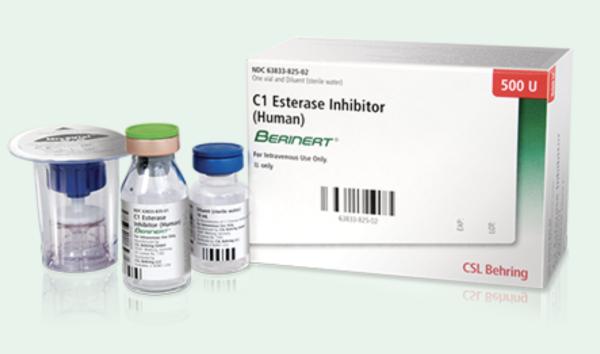
Reconstitute vial of Berinert containing 500 IU of C1-esterase inhibitor (human) with 10 mL of sterile water for injection using transfer set provided by manufacturer or another commercially available double-ended needle and vented filter spike. Gently swirl vial to ensure complete dissolution. Resultant solution should be colorless, clear, and free from visible particles.
Manufacturer recommends that the provided silicone-free syringe be used for reconstitution and administration of Berinert.
Administer within 8 hours of reconstitution.
Rate of Administration
Cinryze: Administer IV at a rate of approximately 1 mL/minute.
Berinert: Administer IV at a rate of approximately 4 mL/minute.
Sub-Q Administration
Haegarda: Administer as a sub-Q injection.
Vials are for single use only; discard any unused portions.
Reconstitution of Haegarda
Reconstitute Haegarda by adding 4 mL of sterile water for injection to a vial labeled as containing 2000 IU of the lyophilized drug, or by adding 5.6 mL of sterile water for injection to a vial labeled as containing 3000 IU of the lyophilized drug, using either the transfer set provided with the product or a commercially available double-ended needle and vented filter spike. Gently swirl vial to ensure complete dissolution. Resultant solution contains 500 IU of C1-esterase inhibitor (human) per mL and should be colorless, clear, and free from visible particles. If the dose requires more than 1 vial, use a separate, unused transfer set and diluent vial for each product vial. Use a silicone-free syringe for reconstitution and administration.
Use within 8 hours of reconstitution.
Rate of Administration
Haegarda: Adapt the rate of administration to the comfort level of the patient.
Dosage
Dosage of C1-esterase inhibitor (human) is expressed in international units (IU).
Pediatric Patients
Hereditary Angioedema
Routine Prophylaxis of Hereditary Angioedema Attacks
IVCinryze in pediatric patients 6–11 years of age: 500 IU every 3 or 4 days; may be adjusted up to 1000 IU every 3 or 4 days based on response.
IVCinryze in adolescents 12–17 years of age: 1000 IU every 3 or 4 days; may be adjusted up to 2000 IU (not to exceed 80 IU/kg) every 3 or 4 days based on response.
Sub-QHaegardain pediatric patients ≥6 years of age: 60 IU/kg twice weekly (every 3 or 4 days).
Treatment of Hereditary Angioedema Attacks
IVBerinert: 20 IU/kg. Do not administer doses <20 IU/kg.
Adults
Hereditary Angioedema
Routine Prophylaxis of Hereditary Angioedema Attacks
IVCinryze: 1000 IU every 3 or 4 days; may be adjusted up to 2000 IU (not to exceed 80 IU/kg) every 3 or 4 days based on response.
Sub-QHaegarda: 60 IU/kg twice weekly (every 3 or 4 days).
Treatment of Hereditary Angioedema Attacks
IVBerinert: 20 IU/kg. Do not administer doses <20 IU/kg.
Special Populations
Geriatric Patients
No specific dosage recommendations at this time. However, manufacturers of Cinryze and Haegarda suggest using caution and initiating dosages at the lower end of the dosage range due to increased prevalence of reduced organ function and other coexisting conditions in geriatric patients.
Hepatic Impairment
No specific dosage recommendations at this time.
Renal Impairment
No specific dosage recommendations at this time.
Cautions for C1-Esterase Inhibitor (Human)
Contraindications
-
Known life-threatening hypersensitivity (e.g., anaphylaxis) to C1-esterase inhibitor (human) or any ingredient in the formulation.
Warnings/Precautions
Hypersensitivity
Risk of severe hypersensitivity reactions (e.g., hives, urticaria, chest tightness, wheezing, hypotension, anaphylaxis). If hypersensitivity occurs, discontinue drug immediately and initiate appropriate treatment. Because symptoms of hypersensitivity can resemble acute attacks of hereditary angioedema, carefully consider treatment method. Epinephrine should be available for immediate use.
Thrombotic Events
Risk of thromboembolic events (e.g., MI, cerebrovascular accident, DVT, PE); reported in association with recommended as well as with higher than recommended (e.g., ≥100 units/kg) doses.
Risk factors for thrombosis include presence of indwelling catheters/access devices, prior history of clots, presence of atherosclerosis, use of oral contraceptives or certain androgens, immobility, and morbid obesity. Weigh benefits of C1-esterase inhibitor (human) against risks of thromboembolic events if risk factors are present.
Closely monitor patients with known risk factors for thrombosis.
Risk of Transmissible Agents in Plasma-derived Preparations
Potential vehicle for transmission of human viruses (e.g., HIV, hepatitis A virus [HAV], HBV, HCV, parvovirus B19) or other infectious agents (e.g., causative agent for Creutzfeldt-Jakob disease [CJD]). Risk substantially reduced with current donor screening practices and viral inactivating procedures; however, possibility of disease transmission still exists.
Report any suspected infections thought to be associated with C1-esterase inhibitor (human) to the manufacturer.
Laryngeal Attacks
Because of potential for airway obstruction, patients who self-administer C1-esterase inhibitor (human) for treatment of a laryngeal attack should seek immediate medical attention in an appropriate healthcare facility after the drug is administered.
Immunogenicity
Potential for immunogenicity with use of all therapeutic proteins, including C1-esterase inhibitor (human). Development of antibodies to C1-esterase inhibitor (human) reported in a post-marketing study; however, clinically important effects not observed.
Specific Populations
Pregnancy
Data insufficient to establish a drug-associated risk with C1-esterase inhibitor (human) use.
Lactation
Not known whether C1-esterase inhibitor (human) is distributed into milk. Use with caution and only if clearly needed.
Pediatric Use
Safety and efficacy of Cinryze not established in children <6 years of age.
Safety and efficacy of Berinert evaluated in pediatric patients 10-16 years of age, although used successfully for the treatment of acute HAE attacks in a limited number of children as young as 5 years of age. Safety profile similar to that in adults.
Safety and efficacy of Haegarda evaluated in 9 patients age 8 to <17 years in 2 clinical studies; results of subgroup analysis by age consistent with overall results.
Geriatric Use
Insufficient experience in patients ≥65 years of age to determine whether geriatric patients respond differently to Cinryze and Haegarda than younger patients. Berinert was evaluated in 27 geriatric subjects in a registry study, which found that safety profile was similar to that in younger populations.
Hepatic Impairment
Pharmacokinetics not evaluated in patients with hepatic impairment.
Renal Impairment
Pharmacokinetics not evaluated in patients with renal impairment.
Common Adverse Effects
Adverse reactions (≥5%) with Cinryze: headache, nausea, rash, vomiting, fever.
Adverse reactions (>4%) with Berinert: dysgeusia.
Adverse reactions (>4%) Haegarda: injection site reactions, hypersensitivity, nasopharyngitis, dizziness.
Drug Interactions
No formal drug interaction studies to date.
C1-Esterase Inhibitor (Human) Pharmacokinetics
Absorption
Onset
Plasma concentrations of C1-esterase inhibitor increase immediately (i.e., within 1 hour) following IV administration; C4 levels subsequently rise 2–24 hours later, indicating consumption of C1-esterase inhibitor and stabilization of the complement activation system.
Plasma Concentrations
Peak plasma concentrations attained in approximately 4 hours following a single 1000-unit dose of Cinryzeand in approximately 59 hours following twice-weekly dosing of Haegarda 60 IU/kg.
Distribution
Extent
Not known whether C1-esterase inhibitor is distributed into milk.
Elimination
Half-life
Cinryze: Mean half-life about 56 hours following a single 1000-unit dose in asymptomatic adult patients.
Cinryze: Mean half-life at steady state about 34 hours, regardless of 500-unit or 1000-unit dosing, in pediatric subjects 7–11 years of age.
Berinert: Following administration of single doses (500–1500 units) in patients with mild to severe HAE, half-life approximately 18 hours in adults and 17 hours in pediatric patients 6–13 years of age.
Haegarda: Following twice-weekly dosing at 60 IU/kg, median half-life was approximately 69 hours.
Special Populations
Limited data on Berinert suggest that half-life of C1-esterase inhibitor (human) may be decreased and clearance increased in pediatric patients <12 years of age compared with adults; clinical importance of such findings not known.
Stability
Storage
Parenteral
Powder for Injection
Cinryze: 2–25°C.
Berinert: 2–30°C.
Haegarda:: up to 30°C.
Do not freeze. Store in original container and protect from light.
May store reconstituted solutions at room temperature for up to 3 hours (Cinryze) or up to 8 hours (Berinertand Haegarda); do not refrigerate or freeze.
Actions
-
Naturally occurring serine protease inhibitor that principally regulates the activation of the complement and intrinsic coagulation (e.g., contact system) pathways. Also plays a role in the fibrinolytic system.
-
Regulates contact system activation by inhibiting plasma kallikrein and coagulation factor XIIa; such actions prevent formation of bradykinin, the presumed mediator of increased vascular permeability in HAE.
-
Blocks both the spontaneous activation of C1 complement and formation of activated C1 complement, suppressing the classical complement pathway.
-
Also exhibits inhibitory effects on plasmin.
-
Binds to and forms irreversible complexes with target protease; the complexes are then inactivated and removed from circulation.
-
Preparation of highly purified C1-esterase inhibitor derived from pooled human plasma. Undergoes a series of viral reduction steps (e.g., pasteurization, precipitation, nanofiltration, chromatography) to reduce risk of viral transmission.
Advice to Patients
-
Importance of discussing potential risks and benefits of therapy with the patient prior to prescribing or administering the drug.
-
Importance of clinicians providing clear instructions and training on proper IV or sub-Q administration technique to patients self-administering C1-esterase inhibitor (human). Because of the potential for airway obstruction, patients who experience an acute laryngeal attack of hereditary angioedema (HAE) should be advised to seek immediate medical attention in an appropriate healthcare facility after the drug is self-administered. Following treatment of a suspected abdominal HAE attack, patients should be advised to contact their clinician to rule out the possibility of other potentially serious causes. Importance of patients not starting self-administration if the HAE attack has progressed to a point where the patient or caregiver is unable to successfully prepare or administer the drug. Advise patients to record the lot number of the C1-esterase inhibitor (human) vial used each time they self-administer the drug.
-
Importance of informing patients treated with products approved only for prophylaxis of HAE attacks that these products should not be used for the treatment of acute HAE attacks. Counsel patients regarding appropriate actions if breakthrough HAE attacks occur.
-
Risk of transmission of human viruses (i.e., HAV, HBV, HCV, HIV, parvovirus B19) and other infectious agents (i.e., causative agent for Creutzfeldt-Jakob disease). Advise patients that current donor screening and viral inactivating procedures have reduced, but not completely eliminated, the risk of disease transmission.
-
Importance of discontinuing therapy and immediately informing clinician if any signs or symptoms of hypersensitivity (e.g., rash, hives, chest tightness, wheezing, hypotension, anaphylaxis) occur.
-
Risk of thrombotic events; advise patients to immediately report any signs and symptoms of thrombosis (e.g., new-onset swelling and pain or discoloration in the limbs with warmth in the affected area; worsening chest pain or discomfort with deep breathing; shortness of breath; unexplainable rapid pulse; loss of sensation or motor ability; weakness on one side of the body). Advise patients with risk factors that they are at an increased risk for thrombosis.
-
Advise patients to bring an adequate supply of C1-esterase inhibitor (human) while traveling and to consult a clinician prior to travel. In addition, advise patients to bring their drug with them when visiting a healthcare provider or facility for an acute HAE attack.
-
Importance of women informing clinicians if they are or plan to become pregnant or plan to breast-feed.
-
Importance of informing clinicians of existing or contemplated concomitant therapy, including prescription and OTC drugs, as well as any concomitant illnesses.
-
Importance of informing patients of other important precautionary information.
Additional Information
The American Society of Health-System Pharmacists, Inc. represents that the information provided in the accompanying monograph was formulated with a reasonable standard of care, and in conformity with professional standards in the field. Readers are advised that decisions regarding use of drugs are complex medical decisions requiring the independent, informed decision of an appropriate health care professional, and that the information contained in the monograph is provided for informational purposes only. The manufacturer’s labeling should be consulted for more detailed information. The American Society of Health-System Pharmacists, Inc. does not endorse or recommend the use of any drug. The information contained in the monograph is not a substitute for medical care.
Preparations
Excipients in commercially available drug preparations may have clinically important effects in some individuals; consult specific product labeling for details.
Please refer to the ASHP Drug Shortages Resource Center for information on shortages of one or more of these preparations.
|
Routes |
Dosage Forms |
Strengths |
Brand Names |
Manufacturer |
|---|---|---|---|---|
|
Parenteral |
For injection, for IV use |
500 international units (IU) |
Berinert |
CSL Behring |
|
Cinryze |
Viro Pharma |
|||
|
For injection, for sub-Q use |
2000 international units (IU) |
Haegarda |
||
|
3000 international units (IU) |
Haegarda |
AHFS DI Essentials™. © Copyright 2024, Selected Revisions August 25, 2023. American Society of Health-System Pharmacists, Inc., 4500 East-West Highway, Suite 900, Bethesda, Maryland 20814.
Reload page with references included
Frequently asked questions
- What is Haegarda used for and how does it work?
- How is Berinert administered?
- What is Ruconest used for and how does it work?
- How does Berinert work for Hereditary Angioedema (HAE)?
- What is Cinryze used for and how does it work?
More about C1 esterase inhibitor (human)
- Check interactions
- Compare alternatives
- Reviews (7)
- Side effects
- Dosage information
- During pregnancy
- Drug class: hereditary angioedema agents
- Breastfeeding
- En español