
Bunion
Medically reviewed by Drugs.com. Last updated on Oct 25, 2023.
What is a bunion?

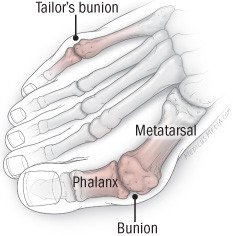
A bunion is a firm bump that forms over a bony bulge at the base of the big toe. In most cases, the big toe joint also is enlarged and has degenerative arthritis. The toe also may be pushed toward the second toe (hallux valgus). Bunions are often painful, especially when wearing stiff shoes that press on the bump.
Bunions tend to be inherited, but they also are common in the following groups:
- women who wear high heels
- people who wear shoes that are too narrow or too pointed
- people with flat feet.
All of these situations force the big toe to drift toward the little toes, and this can cause bunions to form.
|
|
Symptoms of a bunion
The dominant symptom of a bunion is a big bulging bump on the inside of the base of the big toe. Other symptoms include swelling, soreness and redness around the big toe joint, a tough callus at the bottom of the big toe and persistent or intermittent pain.
Diagnosing a bunion
Before examining your foot, the doctor will ask you about the types of shoes you wear and how often you wear them. He or she also will ask if anyone else in your family has had bunions or if you have had any previous injury to the foot.
In most cases, your doctor can diagnose a bunion just by examining your foot. During this exam, you will be asked to move your big toe up and down to see if you can move it as much as you should be able to. The doctor also will look for signs of redness and swelling and ask if the area is painful. Your doctor may want to order X-rays of the foot to check for other causes of pain, to determine whether there is significant arthritis and to see if the bones are aligned properly.
Expected duration of a bunion
A bunion can develop at any time during childhood or adulthood. It will remain until it is treated.
Preventing a bunion
To help prevent bunions, select your style and size of shoes wisely. Choose shoes with a wide toe area and a half-inch of space between the tip of your longest toe and the end of the shoe. Shoes also should conform to the shape of your feet without causing too much pressure.
Treating a bunion
Treatment options are based on the severity of the deformity and symptoms. Nonsurgical treatments usually are enough to relieve the pain and pressure on the big toe. Your doctor may tell you to start wearing roomy, comfortable shoes and use toe padding or a special corrective device that slips into your shoes to push the big toe back into its proper position. To help relieve pain, you can take over-the-counter medications such as acetaminophen (Tylenol) or ibuprofen (Advil, Motrin and others).
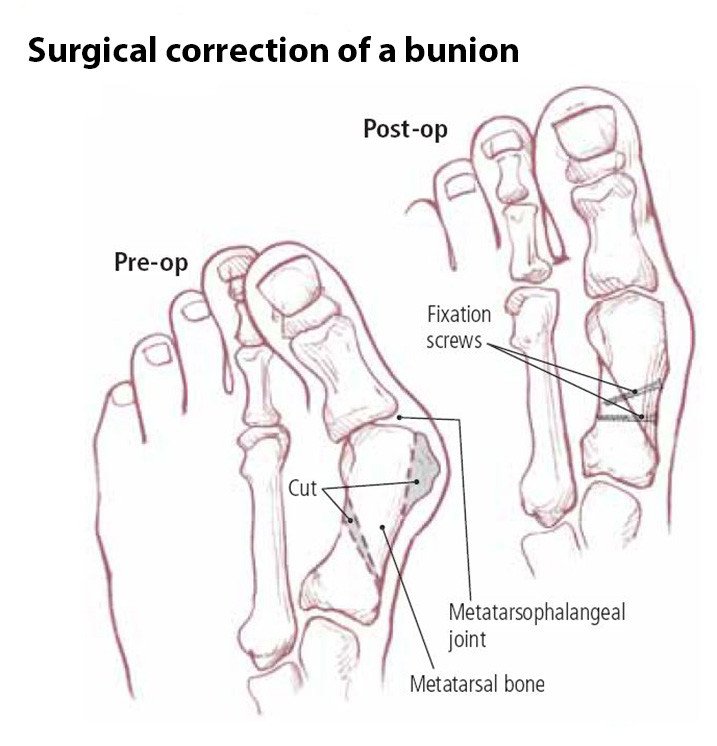
To end persistent pain, your doctor may recommend a type of foot surgery called a bunionectomy to remove the bunion and perhaps to reshape the first toe joint. During the operation, the swollen tissue will be removed, the big toe will be straightened if necessary, and the bones of the affected joint may be reshaped or permanently joined. The goal of the surgery is to correct the cause of the bunion and to prevent the bunion from growing back. After surgery, pain medication will be prescribed, and you will be told when you can start moving your toes and ankle.
|
|
When to call a professional
Contact a health care professional if you have persistent pain and a visible bump along the first toe, difficulty moving your toe or foot or difficulty finding shoes that fit properly because of pain or because the first toe has changed shape.
Prognosis
For people with mild symptoms and a small bunion, the outlook is excellent. For people who have a bunion removed surgically, the prognosis is also excellent for long-term relief from discomfort and deformity, although after surgery, full recovery can take two months or more.
Additional info
American Orthopaedic Foot and Ankle Society
https://www.aofas.org/
Further information
Always consult your healthcare provider to ensure the information displayed on this page applies to your personal circumstances.