Urinary Retention In Men
GENERAL INFORMATION:
What is urinary retention?
- Urinary (UR-in-er-ee) retention (re-TEN-shun) is a condition when urine is not completely emptied from the bladder. Normally, nerves in the bladder send signals to the spinal cord and brain that the bladder is full. The brain then returns a signal to the bladder muscles that it is time to urinate. This process allows the bladder to completely void (pass urine). With urinary retention, the urine is abnormally kept in the bladder. Urinary retention may be acute (sudden) or chronic (long-standing). Acute urinary retention occurs when there is a sudden inability to pass urine. In chronic urinary retention, there is always some urine left in the bladder as it never completely empties.
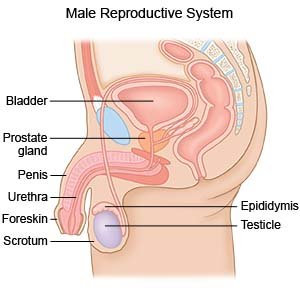
- The urinary system is made up of the kidneys, ureters, bladder, and urethra. The kidneys are two bean-shaped organs in the back of the abdomen (stomach) on both sides of the spine. They filter the blood to remove waste products and make urine. The urine flows from the kidneys down through tubes called ureters. From the ureters, the urine goes down and is stored for a short time in the bladder. Urine passes out of the body through another tube, called the urethra. In men, the bladder lies just above a walnut-sized gland called the prostate. The prostate gland wraps around the neck of the bladder and the urethra.
![]() |
What causes urinary retention? Urinary retention usually occurs as men get older. The following are diseases and conditions that may cause or increase your risk of having urinary retention:
- Obstruction problems: The following conditions and diseases may cause blockages in the urinary system:
- Benign prostatic hyperplasia: Benign prostatic hyperplasia, also called BPH, is a condition where the prostate becomes enlarged. An enlarged prostate can squeeze the urethra and block urine flow making it harder to urinate. BPH is not a type of cancer.
- Bladder stones: Bladder stones may grow so big that they block urine flow. This can be at any point in the urinary system, such as in the urethra.
- Cancer: Tumors of the bladder or the prostate may cause an obstruction at any place in the urinary system as they increase in size. Common cancers that may cause urinary retention include cancer of the bladder and of the prostate.
- Foreign bodies: Foreign bodies are objects that are not normally found in the urinary system. A foreign body is an object, such as a bead, that has been put into the urethra and has become stuck.
- Strictures: Strictures are where a muscular tube, such as the urethra, becomes narrowed and may not allow urine to fully pass out of the body.
- Benign prostatic hyperplasia: Benign prostatic hyperplasia, also called BPH, is a condition where the prostate becomes enlarged. An enlarged prostate can squeeze the urethra and block urine flow making it harder to urinate. BPH is not a type of cancer.
- Bladder Diverticula: Bladder diverticula are where diverticula (pockets) form in the bladder. When the bladder gets full and empties, urine goes out the urethra, but also fills the pockets in the bladder. After the bladder is emptied, urine from the pockets then fills the bladder. This causes the bladder to never be completely emptied.
- Drinking too much: Drinking too much liquid and alcohol may increase your chance of overfilling your bladder. Alcohol is found in beer, wine, liquor (vodka and whiskey), and other adult drinks.
- Infections: Germs, such as bacteria and viruses, can damage the urinary tract and cause inflammation (swelling).
- Medicines: Certain medicines may cause the bladder muscles to relax or the muscles of the urethra to tighten. These include medicines used in treating depression, colds, or allergies, or the use of general anesthesia (numbing medicine) during surgery.
- Nerve damage: Nerves that send signals to and from the bladder may get damaged due to diseases. These diseases may include diabetes, stroke, spinal cord injuries or infections, and heavy metal poisoning.
What are the signs and symptoms of urinary retention? You may have any of the following:
- Slow urinary flow.
- Difficult, painful, or frequent urination, especially at night, or not being able to urinate at all.
- Feeling like you have not completely emptied your bladder, even after urinating.
- Pain or pressure in your abdomen or penis, especially when passing urine or having sex.
- Pain or stiffness in your abdomen, lower back, hips, or upper thighs.
- Pink or red-colored urine.
- Problems having an erection.
How is urinary retention diagnosed? Your caregiver will take a complete health history from you. You may need one or more of the following tests:
- Digital rectal examination: This is also called DRE. Caregivers carefully feel the size of your prostate gland to learn if it is larger than normal.
- Blood or urine tests: A sample of your blood or urine is collected and sent to a lab for tests. Your caregiver may suggest a special blood test to check for the prostate-specific antigen (PSA). PSA blood levels may be increased in prostate cancer.
- Imaging tests:
- Cystoscopy: A cystoscopy allows caregivers to look for problems inside your bladder. A cystoscope is put into your bladder through your urethra. The urethra is the tube that urine flows through when you urinate. The cystoscope is a long tube with a lens and a light on the end. The scope may be hooked to a camera or monitor, and pictures may be taken. A tissue sample may also be taken during your cystoscopy. During this test, small tumors may be removed or bleeding may be stopped.
- Computerized tomography scan: This test is also called a CT scan. A special x-ray machine uses a computer to take pictures of your prostate, kidneys, ureters, and bladder. Before taking the pictures, you may be given dye through an IV in your vein. The dye helps cancer show up better in the pictures. Tell your caregiver if you are allergic to shellfish (lobster, crab, or shrimp) as may also be allergic to this dye.
- Cystourethrogram: A dye is injected and x-rays are taken while you pass urine. The dye makes an outline of your bladder and urethra. This shows the changes that occur in your urinary tract while urinating.
- IVP: This is also called an intravenous pyelogram. An IVP is an x-ray of the kidneys, bladder, and ureters (tubes that carry urine). Dye is put into your IV, which makes these organs show up better in x-ray pictures. You may need to have more than one x-ray over short periods of time during your IVP. People who are allergic to shellfish (lobster, crab, or shrimp) may be allergic to this dye. Tell your caregiver if you are allergic to shellfish, dyes, or other medicines.
- KUB x-ray: An x-ray machine takes pictures of your kidneys (K), ureters (U), and bladder (B). The ureters are tiny tubes that carry urine from your kidneys to your bladder. The bladder is where the urine is stored before leaving your body. Caregivers use these pictures to check for problems with your intestines , kidneys, or abdomen.
- Ultrasound: Sound waves are used to show pictures of the inside of your abdomen. A small closed tube with lotion on it is gently moved around on your abdomen. The handle may also be placed in your rectum. Pictures of your bladder, prostate, rectum, or other organs are seen on a TV-like screen.
- Cystoscopy: A cystoscopy allows caregivers to look for problems inside your bladder. A cystoscope is put into your bladder through your urethra. The urethra is the tube that urine flows through when you urinate. The cystoscope is a long tube with a lens and a light on the end. The scope may be hooked to a camera or monitor, and pictures may be taken. A tissue sample may also be taken during your cystoscopy. During this test, small tumors may be removed or bleeding may be stopped.
- Prostate biopsy: A sample of your prostate or its fluid may be taken and sent to the lab for tests.
- Urine flow test: This test checks if the muscles of your bladder are working properly. It also measures how much urine your bladder can hold. This test can also tell whether your bladder fills and empties in a normal way.
How is urinary retention treated? Treatment for urinary retention aims to restore normal urine flow, relieve symptoms, and prevent serious problems. This is done by treating the cause and controlling the problem. You may have any of the following:
- Catheter: A catheter may be placed into your bladder to help drain your urine.
- Medicines: Depending on the cause of your urinary retention, your caregiver may give you different medicines to treat your symptoms. These medicines may also help prevent further problems. You may have any of the following:
- 5-alpha-reductase inhibitors: These medicines decrease the size of a large prostate gland by stopping the action of 5-alpha reductase. 5-alpha reductase is a protein that makes the prostate gland grow bigger.
- Alpha blockers: These medicines relax the muscles in your prostate and bladder and may help you urinate more easily.
- Antibiotics: Antibiotics may be given to help treat or prevent an infection caused by germs called bacteria.
- Hormone therapy: Hormones (such as testosterone) may cause some cancer cells to grow. Medicine or surgery may be needed to block the testosterone and slow a growing tumor. Sometimes both medicine and surgery are needed. If you need surgery, your testicles may be removed to stop the testosterone.
- 5-alpha-reductase inhibitors: These medicines decrease the size of a large prostate gland by stopping the action of 5-alpha reductase. 5-alpha reductase is a protein that makes the prostate gland grow bigger.
- Surgery: Sometimes, caregivers may do surgery to remove a blockage so urine can drain from the bladder. A hollow tube, such as a shunt or stent, may also be placed to help widen a narrowed part of your urinary tract. If you have an enlarged prostate, your caregiver may also need to remove your prostate.
- Other procedures: The prostate may be made smaller by using a special ultrasound, transurethral needle ablation (TUNA), or microwave heat treatment. You may also have a laser procedure, called interstitial laser coagulation (ILC), to remove the prostate. Ask your caregiver about these different treatment options for urinary retention.
Where can I find more information? Having urinary retention may be hard for you and your family. Call or write the following organizations for more information:
- American Foundation for Urologic Disease
1128 North Charles Street
Baltimore, MD 21201
Phone: 1-410-468-1800
Phone: 1-800-242-2383
Web Address: http://www.afud.org
- National Kidney and Urologic Diseases Information Clearinghouse
3 Information Way
Bethesda, MD 20892-3580
Phone: 1-800-891-5390
Web Address: http://kidney.niddk.nih.gov/
CARE AGREEMENT:
You have the right to help plan your care. To help with this plan, you must learn about your health condition and how it may be treated. You can then discuss treatment options with your caregivers. Work with them to decide what care may be used to treat you. You always have the right to refuse treatment.
Copyright © 2008 Thomson Healthcare Inc. All rights reserved. Information is for End User's use only and may not be sold, redistributed or otherwise used for commercial purposes.
The above information is an educational aid only. It is not intended as medical advice for individual conditions or treatments. Talk to your doctor, nurse or pharmacist before following any medical regimen to see if it is safe and effective for you.
| Link to Page | Print Page | Email Page |