
Chronic Urinary Retention in Women
Medically reviewed by Drugs.com. Last updated on Sep 1, 2024.
What is chronic urinary retention (CUR)?
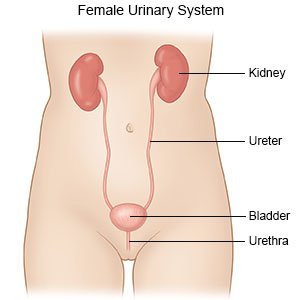
CUR is a long-term condition that develops when your bladder does not empty completely when you urinate.
 |
What causes CUR?
- Weak bladder muscle
- Blockages, such as a stone or growth
- Nerve damage from diabetes, stroke, or spinal cord injuries
- Certain medicines, such as narcotics, antihistamines, or antidepressants
What are the signs and symptoms of CUR?
- Frequent urination, or the urge to urinate after you just finished
- An urge to urinate, but your urine does not come out or dribbles out slowly and weakly
- Frequent urine leaks that happen during the day or while you sleep
- Discomfort or pain in your lower abdomen
How is CUR diagnosed?
Your healthcare provider will ask about your health history and the medicines you take. He or she will press or tap on your lower abdomen. You may need any of the following tests:
- A pelvic exam will be done to check for blockages. A pelvic exam will also show if your bladder, uterus, or other organs have moved out of place.
- A post void residual test will show how much urine is left in your bladder after you urinate. You will be asked to urinate and then healthcare providers will use a small ultrasound machine to check the remaining urine in your bladder.
- A neuro exam may be done to test your strength, balance, and movement. A neuro exam is used to find changes in your brain and nervous system.
- Blood tests may be needed to check for infection and kidney function.
- An ultrasound uses sound waves to show pictures on a monitor. An ultrasound may be done to show bladder stones, infection, or other problems.
- A CT scan , or CAT scan, is a type of x-ray that is taken of your abdomen. The pictures may show what is causing your CUR. You may be given contrast liquid before the pictures are taken to help healthcare providers see the pictures better. Tell the healthcare provider if you have ever had an allergic reaction to contrast liquid.
How is CUR treated?
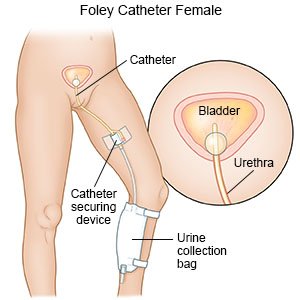
- Urinary catheters: Ask your healthcare provider for more information about the type of catheter you need:
- A Foley catheter is a tube put into your bladder to drain urine into a bag. Keep the bag below your waist. This will prevent urine from flowing back into your bladder and causing an infection or other problems. Also, keep the tube free of kinks so the urine will drain properly. Do not pull on the catheter. This can cause pain and bleeding, and may cause the catheter to come out.
- A suprapubic catheter is inserted into your bladder through an incision in your abdomen. It may be used when you have a long-term need for bladder drainage.
- A straight catheter may be inserted several times a day if you cannot urinate on your own. You put the catheter in your urethra and remove it once your bladder is empty.
- A Foley catheter is a tube put into your bladder to drain urine into a bag. Keep the bag below your waist. This will prevent urine from flowing back into your bladder and causing an infection or other problems. Also, keep the tube free of kinks so the urine will drain properly. Do not pull on the catheter. This can cause pain and bleeding, and may cause the catheter to come out.
- Surgery may be needed to treat the condition that is causing your CUR.
- Sacral neuromodulation is a long-term treatment that may be needed if other treatments do not work. A device that works with your bladder's nerves is used to help you urinate.
Treatment options
The following list of medications are related to or used in the treatment of this condition.
When should I seek immediate care?
- You have severe abdominal pain.
- You are breathing faster than usual.
- Your heartbeat is faster than usual.
- Your face, hands, feet, or ankles are swollen.
When should I contact my healthcare provider?
- You have a fever.
- You have pain when you urinate.
- You see blood in your urine.
- You have problems with your catheter.
- You have questions or concerns about your condition or care.
Care Agreement
You have the right to help plan your care. Learn about your health condition and how it may be treated. Discuss treatment options with your healthcare providers to decide what care you want to receive. You always have the right to refuse treatment. The above information is an educational aid only. It is not intended as medical advice for individual conditions or treatments. Talk to your doctor, nurse or pharmacist before following any medical regimen to see if it is safe and effective for you.© Copyright Merative 2024 Information is for End User's use only and may not be sold, redistributed or otherwise used for commercial purposes.
Learn more about Chronic Urinary Retention
Treatment options
Care guides
Further information
Always consult your healthcare provider to ensure the information displayed on this page applies to your personal circumstances.