
Traumatic Pneumothorax
Medically reviewed by Drugs.com. Last updated on May 6, 2024.
What is a traumatic pneumothorax?
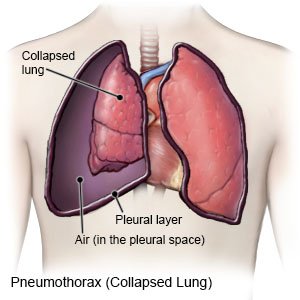
A traumatic pneumothorax is a collapsed lung. All or part of your lung may collapse. A traumatic pneumothorax is caused by an injury that tears your lung and allows air to enter the pleural space. The pleural space is the area between your lungs and your chest wall. The air trapped in your pleural space prevents your lung from filling, and it collapses. A pneumothorax can happen in one or both lungs.
 |
What are the signs and symptoms of a traumatic pneumothorax?
- Shortness of breath
- Soft bulges under your skin caused by air bubbles
- Chest pain
- Chest movement that is not even when you breathe
- Fast heartbeat
- A cough
How is a traumatic pneumothorax diagnosed?
Your healthcare provider will ask about your signs and symptoms and examine you. He or she will listen to your lungs. You may also need any of the following:
- Blood tests may be used to measure the amount of oxygen and carbon dioxide. The results can tell healthcare providers how well your lungs are working.
- A heart monitor is used to record your heart's electrical activity.
- X-rays may be used to check the bones, lungs, and other tissues in your chest. The pictures may show broken ribs. X-rays may show the size of your pneumothorax and if you have fluid around your heart and lungs.
- CT scan or ultrasound pictures may be used to check for a pneumothorax that did not show up on a chest x-ray. You may be given contrast liquid to help your lungs show up better in the pictures. Tell the healthcare provider if you have ever had an allergic reaction to contrast liquid.
How is a traumatic pneumothorax treated?
Treatment will depend on the size of your pneumothorax. If your pneumothorax is small, it may get better on its own. The goal of treatment is to remove the air from your pleural space. When your lung is able to fill with air, you will be able to breathe easier. You may need any of the following:
- Extra oxygen may be given if your oxygen level is too low. Oxygen may help the pneumothorax get better faster.
- Medicines may be given to prevent or treat pain or a bacterial infection. A sedative may be given to help you stay calm and relaxed.
- Needle aspiration is used to pull the air out of your pleural space through a needle.
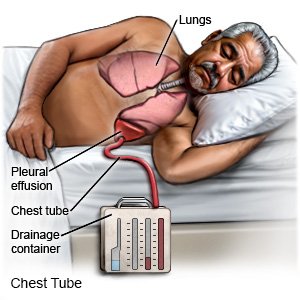
- A chest tube may be placed to remove air, blood, or fluid from around your collapsed lung. This allows your lung to fill with air when you breathe, and helps your heart beat normally. The chest tube is attached to a container to remove air and collect any blood or fluid.
- Pleurodesis is a procedure used to irritate the walls of your pleural space. This causes the walls to close so air can no longer be trapped.
- Surgery may be used to repair your lung.
Call your local emergency number (911 in the US), or have someone call if:
- You have new or increased shortness of breath or chest pain.
- Your throat or the front of your neck is pushed to one side.
- You are sweating and feel like you are going to pass out.
- Your fingernails, toenails, or lips begin to turn blue.
- You have trouble thinking clearly.
When should I call my doctor?
- You have a fever.
- You hear a crackling noise or feel popping when you touch your skin.
- You have questions or concerns about your condition or care.
Care Agreement
You have the right to help plan your care. Learn about your health condition and how it may be treated. Discuss treatment options with your healthcare providers to decide what care you want to receive. You always have the right to refuse treatment. The above information is an educational aid only. It is not intended as medical advice for individual conditions or treatments. Talk to your doctor, nurse or pharmacist before following any medical regimen to see if it is safe and effective for you.© Copyright Merative 2024 Information is for End User's use only and may not be sold, redistributed or otherwise used for commercial purposes.
Further information
Always consult your healthcare provider to ensure the information displayed on this page applies to your personal circumstances.
